
ASIC Afsl Australian Superannuation
Australian Non-Bank RMBS Issuance, Warehouse Facility Mechanics & APRA APS 120 Securitisation
Issuing over AUD 60 billion annually in AAA/mezzanine tranches—representing >75% of all APAC ex-Japan structured finance—Australian non-bank RMBS thrives under APRA APS 120.
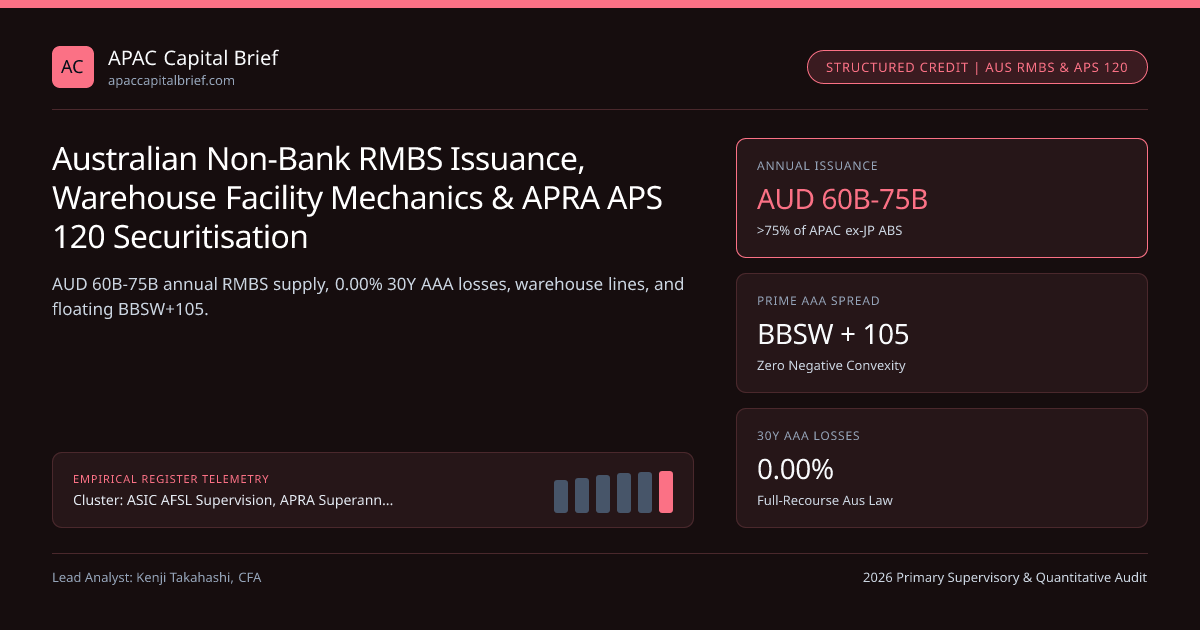
Australia punches wildly above its economic weight in global structured credit: across 2025–2026, public Australian Residential Mortgage-Backed Securities (RMBS) and auto/equipment ABS issuance exceeded AUD 60 billion to AUD 75 billion per year—accounting for over 75% of total public securitization volume across the entire Asia-Pacific ex-Japan region! Even more impressive is its zero-loss AAA historical track record: not a single rated senior AAA prime or non-conforming Australian RMBS tranche has ever suffered a principal write-off since inception in the 1990s! Understanding how non-bank mortgage originators (Firstmac, Pepper Money, Resimac, Liberty Financial, La Trobe Financial) cycle loans from ADI Warehouse Facilities into multi-currency public RMBS—governed by *APRA Prudential Standard APS 120 (Securitisation)* and AOFM / RBA repo eligibility—unlocks one of Asia's highest-Sharpe floating-rate credit sleeves.
Why Non-Bank Lenders Dominate Public RMBS (70%+ of Volume!)#
Australia's Big-4 banks (CBA, Westpac, NAB, ANZ) originate ~74% of domestic home loans, yet non-bank financial institutions (NBFIs) issue ~68%–75% of all public Australian RMBS! Why?
- ADIs Hold Loans on Balance Sheet: Under APRA IRB capital weights, Big-4 banks fund prime mortgages cheaply via retail deposits and covered bonds, using securitization primarily for "Funding-Only" or internal self-securitized RBA repo HQLA collateral!
- Non-Banks Have Zero Deposits: Regulated for consumer credit conduct by ASIC (under National Credit Code ACLs, without APRA deposit licenses—comparable in non-bank specialization to Trans-Tasman peers like The New Zealand Home Loan Company), non-banks fund 100% of new mortgages via revolving 12-to-24-month Bank Warehouse Trusts provided by domestic Big-4 and global investment banks, then "term out" AUD 750M–2.0B loan pools into the public RMBS market every quarter to free warehouse capacity!
Inside APRA APS 120: "Funding-Only" vs "Capital-Relief" & Skin-in-the-Game#
For Australian and foreign banks financing non-bank warehouses or issuing their own RMBS, *APRA APS 120 (Securitisation)* enforces strict structural separation:
- Clean Separation ("No Implicit Support"): An originating ADI executing a Capital-Relief ("Significant Risk Transfer" — SRT) RMBS must transfer junior/mezzanine first-loss tranches irrevocably to third-party credit funds—if the bank ever props up a struggling trust beyond contractual terms, APRA revokes 100% of RWA relief across ALL securitizations!
- Senior Warehouse Risk Weights (15%–20% Floor): When CBA or NAB provides a senior warehouse line to Firstmac or Pepper, APS 120 External Ratings-Based / Standardized Securitisation Approach assigns a 15% to 20% RWA floor only if the warehouse features sufficient junior subordinated notes + originator equity ("skin-in-the-game", >=5% risk retention for EU/UK/JP investor compliance!) and automatic Excess Spread Trapping + Arrears Stop-Purchase Triggers!
| RMBS Tranche / Cohort | Typical Credit Enhancement (% Subordination) | 2026 Clearing Spread Over 3M BBSW | Primary Institutional Buyer Cohort |
|---|---|---|---|
| Class A1 (Prime AAA — ~2.8Yr WAL) | 8.0% – 10.0% Subordination + Lenders Mortgage Insurance (LMI) + Excess Spread | 1M/3M BBSW + 95 to 112 bps (~5.35%–5.50% AUD floating!) | Domestic ADI treasuries (RBA OMO repo eligible!), Japanese megabanks/lifers, UK ABS funds |
| Class A1-U / A1-G (USD / JPY AAA) | Identical AAA senior priority hedged via trust balance-sheet XCCY swap | USD SOFR + 105–120 bps / JPY TONA + 75 bps | US money-market/ABS funds & Japanese regional/agricultural banks |
| Non-Conforming / Near-Prime AAA | 15.0% – 22.0% Subordination (Self-employed, alt-doc, SMSF borrowers) | 1M/3M BBSW + 125 to 145 bps | Global structured credit funds & Australian superannuation credit mandates |
| Mezzanine Class B / C / D / E (AA to BB) | 1.5% – 8.0% Subordination | 3M BBSW + 185 bps (AA) -> +475–620 bps (BB) | Private credit funds, hedge funds & family offices |
Non-Bank RMBS Net Excess Spread Waterfall & Prepayment (CPR) Weighted-Average Life Sensitivity#
- AnnualNetExcessSpread = RBorrowerMortgage - ( r1MBBSW + sWeightedBondMargin + cTrustServicing25bps + DefaultNet_Losses )
- CleanUpCallOption = Originator may redeem residual trust at par once PoolBalance <= 10.0% of InitialCutOffBalance
- Worked AUD 1.00 Billion Prime Non-Bank RMBS Waterfall (2026 Vintage, CPR = 22% Constant Prepayment Rate):
- Weighted-Average Borrower Variable Mortgage Rate = 6.38%
- Weighted-Average RMBS Note Cost (90% AAA @ BBSW+102, 8% Mezz @ BBSW+245, 2% Jr; 1M BBSW = 4.30%) = 4.30% + 1.18% = 5.48%
- Less Servicing/Trustee Fees (0.25%) & Realized Net Mortgage Loss After Property Sale/LMI (0.04% — Full-Recourse Aus Law!):
- Net Residual Excess Spread to Originator Equity = 6.38% - 5.48% - 0.25% - 0.04% = +0.61% (+61 bps = AUD 6.1M/yr Year-1 profit!)
Why Australian AAA RMBS Has Never Suffered a Principal Loss#
Why Japanese & UK Banks Love Australian AAA RMBS Over US MBS#
Highlight the third bar in our chart for global fixed-income allocators: US 30-year Agency MBS carries toxic negative convexity (when rates rise, homeowners stop refinancing and duration stretches from 4 years to 9 years!). Australian mortgages are ~85%+ floating-rate, and Australian RMBS pays monthly/quarterly floating 1M/3M BBSW + ~105 bps with ~2.8-year WAL and ZERO duration extension risk—plus full personal recourse law! Pair this structured-credit guide with ASX 3M BBSW waterfall mechanics, AUD/USD XCCY basis, and our Australia ASIC, APRA & AUD rates hub, or explore all APAC credit dispatches.
Frequently asked questions
Why have zero AAA Australian RMBS tranches ever defaulted even during the 2008 GFC and 425 bps of RBA rate hikes?
All Australian residential mortgages are full personal recourse against the borrower future income and assets (stopping strategic walk-aways), reinforced by 8%–22% credit subordination, Lenders Mortgage Insurance (LMI), positive excess spread, and massive household offset cash buffers.
Why do non-bank lenders issue 72% of public Australian RMBS when Big-4 banks write 74% of mortgages?
Non-banks cannot legally take retail deposits, so securitizing bank warehouse pools into public RMBS is their sole scalable term funding engine; Big-4 banks fund cheaper via deposits and primarily self-securitize internal RMBS for RBA repo liquidity.
How do Australian RMBS issuers attract European and Japanese bank investors?
Issuers structure EU/UK Securitisation Regulation and Japanese JFSA-compliant >=5% originator risk-retention pools ("skin-in-the-game") and frequently carve out dedicated USD SOFR (Class A1-U) or JPY TONA currency-hedged AAA tranches.
What is "internal self-securitization" at Australian Big-4 banks under RBA rules?
CBA, Westpac, NAB, and ANZ package AUD hundreds of billions of their own balance-sheet mortgages into retained internal AAA RMBS notes kept purely on-balance-sheet so they can be pledged immediately as eligible collateral in RBA Open Market Operations or emergency liquidity.
Publication record
- Published
- 13 November 2026
- Updated
- 15 November 2026
- Author
- Kenji Takahashi, CFA
- Review
- Review not recorded
- Automated fact check
- Passed in the stored pipeline record
- Source URLs
- 3 recorded
AI assistance recorded: anthropic/claude-opus-4.6. This field does not establish human review or source verification.
Academic & Institutional Attribution
Cite This Research & Embed Live Data Card
Standard academic & institutional research paper citation format.
Kenji Takahashi, CFA. (2026, November 15). Australian Non-Bank RMBS Issuance, Warehouse Facility Mechanics & APRA APS 120 Securitisation. APAC Capital Brief. https://apaccapitalbrief.com/dispatches/australian-non-bank-rmbs-warehouse-apra-aps-120-capitalRegulatory Directory Cross-Reference
Referenced Institutions & Regulatory Registries
Mentioned Regulated Institutions
Referenced Supervisory Authorities
Related ASIC Afsl Australian Superannuation & Institutional Briefings
Explore ASIC Afsl Australian Superannuation Hub (20) →ASIC Afsl Australian Superannuation
ASIC AFSL Supervision, APRA Superannuation Flows & RBA AUD Rates Markets: 2026 APAC GuideASIC Afsl Australian Superannuation
RBNZ OCR vs RBA Cash Rate Divergence: AUD/NZD Cross, BKBM–BBSW & Trans-Tasman Mortgage TransmissionASIC Afsl Australian Superannuation
Australia Mandatory AASB S2 Climate Reporting (Group 1 & 2), Scope 3 Safe Harbor & ASIC Greenwashing SuitsASIC Afsl Australian Superannuation
Australian Superannuation Decumulation Wave: Retirement Income Covenant & AUD Bond/Annuity RotationASIC Afsl Australian Superannuation
APRA Your Future, Your Super (YFYS) -50 bps Performance Test & Benchmark-Hugging MechanicsASIC Afsl Australian Superannuation
Australian Super AUD 1.3T Offshore Equity Outflows, FX Hedge Ratios & AUD/USD Risk-On BetaASIC Afsl Australian Superannuation
RBA Ample-Reserves Corridor, Exchange Settlement (ES) Balances & Full-Allotment OMO RepoASIC Afsl Australian Superannuation
ASX 3M BBSW Prime Bank VWAP Waterfall, 90-Day Bank Bill Futures & AONIA BasisAsean India Sovereign Bond Inclusion
India Overnight Money Markets: CCIL TREPS Tri-Party Repo, FBIL MIBOR OIS & RBI VRR AuctionsAsean India Sovereign Bond Inclusion
Indonesia UU P2SK Financial Omnibus Law: January 2025 Crypto & Derivatives Shift From Bappebti to OJK & BIAsean India Sovereign Bond Inclusion
Singapore EDB Finance & Treasury Centre (FTC) 8% Tax Incentive, Pillar Two & ASEAN Trapped-Cash SweepsMergers and Acquisitions
Nikkei Says Subway, TGI Fridays Japan Partner Watami Aims To Go Private Under Founder - TradingView
APAC Capital Brief Data, Benchmarks & Contributor Records
CC BY 4.0 Open Data
Open Institutional Datasets (CSV / JSON) →
Download desk-compiled quantitative series & schemas.
2026 Reference Matrix
2026 Institutional Benchmarks & Thresholds →
Statutory capital, clearing, margin & rate conventions.
Editorial Records
Authors & Review Records →
View named contributors where those records are available.
Complete Index
Master Research & Dossier Archive →
Browse all published briefings by topic pillar & date.