
Asean India Sovereign Bond Inclusion
India Overnight Money Markets: CCIL TREPS Tri-Party Repo, FBIL MIBOR OIS & RBI VRR Auctions
Clearing over INR 5.5 trillion daily, India overnight money market splits across CCIL TREPS tri-party repo (~72% share), CROMS bilateral repo (~26%), and FBIL MIBOR Call (~2%).
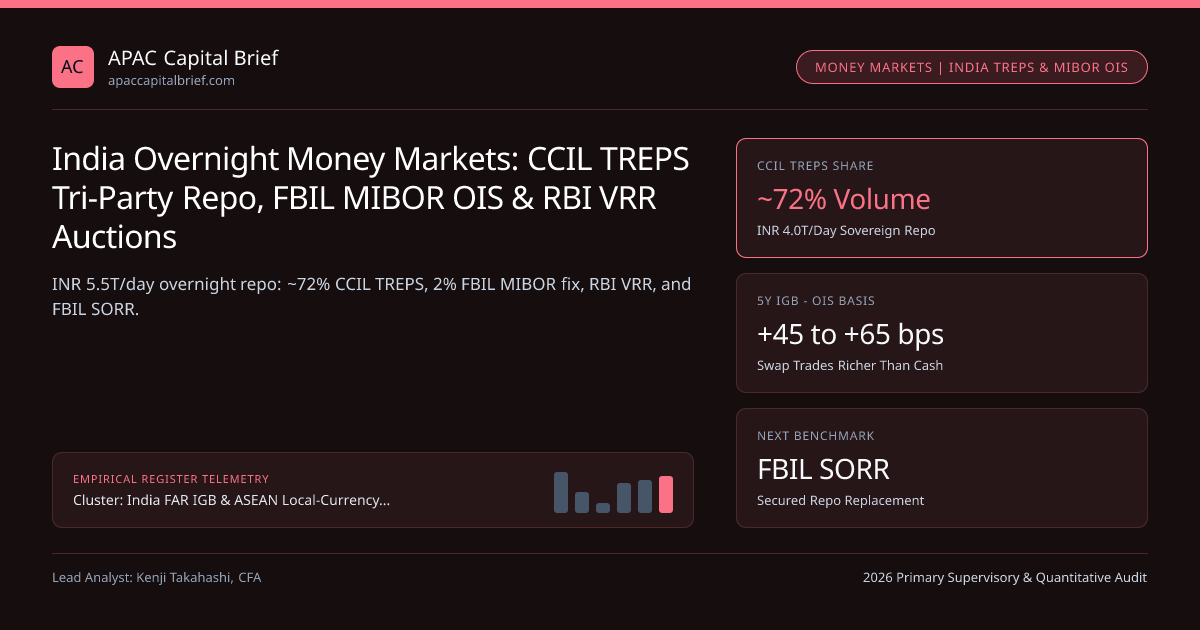
Every basis point along India's Fully Accessible Route (FAR) Sovereign Bond Curve and Mumbai's liquid INR Overnight Index Swap (MIBOR OIS) curve is anchored inside a unique INR 5.5+ trillion/day (~US$65 billion/day) three-tier overnight money market supervised by the Reserve Bank of India (RBI) and novated by the Clearing Corporation of India Ltd (CCIL)! Yet Western fixed-income PMs accustomed to US SOFR (100% Treasury repo) or UK SONIA (unsecured wholesale deposits) are routinely blindsided by Mumbai's structural quirk: *~98% of India's overnight cash trades in secured sovereign repo* (TREPS + CROMS), yet India's flagship interest-rate swap curve (MIBOR OIS) still fixes off the tiny ~2% uncollateralized Interbank Call market (FBIL Overnight MIBOR)**!
Inside Mumbai's Three Overnight Pools: Why TREPS Commands ~72% of Daily Volume!#
Why did CCIL's Triparty Repo Dealing System (TREPS, which replaced CBLO in November 2018`) grow to INR 3.8 trillion – INR 4.3 trillion per day (~72% of all Indian overnight volume)? Because RBI regulations completely phased non-bank institutions (Indian mutual funds, insurance companies, and corporates) OUT of the uncollateralized Interbank Call market to eliminate systemic unsecured contagion!
- TREPS (
~72% Share — Anonymous CCIL Tri-Party Sovereign Repo): Cash-rich SEBI-regulated Liquid & Overnight Mutual Funds (holding INR 6+ lakh crore!), LIC/insurers, and corporate treasuries lend overnight cash on TREPS against a pooled basket of haircutted Central Government IGBs, T-Bills, and State Development Loans (SDLs) posted by borrowing commercial banks and Primary Dealers (with CCIL acting as both Triparty Collateral Agent and CCP guarantor!). - Market Repo on CROMS (
~26% Share — Clearcorp Repo Order Matching System): Bilateral/anonymous specific-ISIN ("special") and general-collateral repo where Primary Dealers and hedge-capable banks borrow specific benchmark 10Y FAR IGBs (e.g., to cover short bond deliveries ahead of Friday G-Sec auctions!). - Uncollateralized Interbank Call (
~1.8%–2.5% Share — Banks & Primary Dealers Only!): Small INR 90B–130B/day unsecured interbank pool during the 09:00–10:00 AM IST window, from which Financial Benchmarks India Pvt Ltd (FBIL) computes Overnight MIBOR (volume-weighted average of first-hour NDS-Call trades)!
RBI's Symmetric 50 bps LAF Corridor (SDF – Repo – MSF) & VRR / VRRR Fine-Tuning#
How does RBI steer Mumbai's Weighted Average Call Rate (WACR — RBI's official operating target!) when Goods and Services Tax (GST — ~20th of every month) and Quarterly Corporate Advance Tax (15th of Jun/Sep/Dec/Mar) abruptly drain INR 1.5 lakh crore to INR 2.8 lakh crore out of Indian banks into the Government's Treasury Single Account (Just-in-Time SNA/CNA cash balances at RBI)?
| Overnight Benchmark / Facility | Rate Level vs RBI Policy Repo | Eligible Counterparties | Trading & Swap Curve Behavior |
|---|---|---|---|
Standing Deposit Facility (SDF) | Repo Rate - 25 bps (Hard Floor for Banks, Soft Floor for TREPS!) | Scheduled Commercial Banks (uncollateralized deposit at RBI) | *Why TREPS prints below* SDF in glut weeks: Mutual funds have NO access to RBI's SDF window, so when MF cash floods in, TREPS clears 5–15 bps below SDF**! |
| RBI Policy Repo + VRR / VRRR | Policy Anchor (e.g., 6.00%–6.50% cycle) | Banks via 14-day main & 1–7 day fine-tuning VRR (inject) / VRRR (drain) auctions | RBI conducts nimble intraday Variable Rate Repo (VRR) injections whenever GST/Advance Tax drains push WACR toward MSF! |
Marginal Standing Facility (MSF) | Repo Rate + 25 bps (Corridor Ceiling) | Banks dipping up to 2% into statutory SLR (18% G-Sec) portfolio overnight | Caps extreme overnight bank funding spikes at Repo + 25 bps |
FBIL Overnight MIBOR (OIS Fix) | Typically WACR + 5 to +18 bps (09:00–10:00 IST skew!) | Referenced by onshore & offshore 1Y–5Y INR MIBOR OIS swaps (CCIL / LCH) | Because FBIL samples only 09:00–10:00 IST, morning bank hoarding pushes MIBOR 10–25 bps above full-day TREPS (prompting RBI committee review toward FBIL SORR secured benchmark!)! |
Quantitative Basis Model: Receiving 5-Year INR MIBOR OIS vs Long 5-Year FAR IGB Bond-Swap Spread!#
- MIBORTREPSBasis (bps) = ( FBILOvernightMIBOR09001000 - CCILTREPSVWAP ) * 100
- IGB5YOISSpread (bps) = ( Y5YFARIGBGross - Swap5YINRMIBOR_OIS ) * 100
- Worked Mumbai Rates Desk Trade (Quarterly Advance Tax Squeeze Week vs Post-Spending Govt Cash Release):
- 5-Year Benchmark FAR IGB Yield = 6.72% | 5-Year Offshore/Onshore INR MIBOR OIS Par Rate = 6.14% -> Bond-OIS Spread = +58 bps!
- Why 5Y MIBOR OIS trades 58 bps RICHER than 5Y Sovereign IGBs:
- 1) Foreign macro hedge funds (avoiding 20%/15% onshore FPI bond WHT & custody) express RBI rate-cut views purely by RECEIVING 1Y & 5Y offshore LCH INR MIBOR OIS!
- 2) Onshore banks face 18% Statutory Liquidity Ratio (SLR) balance-sheet limits on cash IGBs vs capital-light CCIL OIS swaps!
India FAR IGB vs INR MIBOR OIS Swap Spread & SORR Reform#
Watching RBI's Transition From Thin 2% MIBOR Toward "FBIL SORR" (Secured Overnight Rupee Rate)!#
Every global swap desk trading LCH or CCIL INR OIS must track RBI's MIBOR Committee reform: because a benchmark built on <2% unsecured morning Call volume suffers upward fixing bias during tax weeks, RBI and FBIL developed the Secured Overnight Rupee Rate (SORR — blending liquid basket TREPS and market CROMS repo across the first three hours of trading`) to eventually succeed or parallel MIBOR in Indian derivatives—mirroring Japan's TONA and America's SOFR transitions! Pair this money-market blueprint with JPMorgan GBI-EM 10% India FAR CCIL settlement, ESMA/BoE CCIL QCCP capital rules, and our India FAR & ASEAN bond inclusion hub.
Frequently asked questions
What is CCIL TREPS and why can Indian mutual funds not lend in the Interbank Call market?
TREPS (Triparty Repo Dealing System) is CCIL anonymous guaranteed sovereign repo platform; RBI barred non-banks (mutual funds, insurers, corporates) from unsecured Interbank Call to prevent systemic unsecured credit cascades, routing all mutual fund overnight cash into G-Sec-collateralized TREPS.
Why does Overnight TREPS sometimes trade 10 bps BELOW the RBI Standing Deposit Facility (SDF) floor?
Only Scheduled Commercial Banks can deposit excess overnight cash at RBI SDF window (Repo - 25 bps); cash-flush Indian mutual funds cannot access SDF directly, so banks extract a 5–15 bps intermediation spread when absorbing surplus mutual-fund cash on TREPS.
Why do 5-year INR MIBOR OIS swap rates trade 50+ bps lower than 5-year Indian Government Bond (IGB) yields?
Global macro hedge funds express Indian rate-cut views via LCH/CCIL INR MIBOR OIS swaps to avoid onshore FPI registration, 18% bank balance-sheet drag, and 10%–20% sovereign bond withholding tax—creating persistent receiving pressure on OIS relative to cash IGBs.
What is FBIL SORR (Secured Overnight Rupee Rate)?
Recommended by the RBI Committee on MIBOR Benchmark, SORR is a transaction-backed overnight rate computed by FBIL from actual secured CCIL TREPS and CROMS repo trades (~98% of overnight liquidity) to overcome the thin ~2% sample size of unsecured MIBOR.
Publication record
- Published
- 13 November 2026
- Updated
- 16 November 2026
- Author
- Kenji Takahashi, CFA
- Review
- Review not recorded
- Automated fact check
- Passed in the stored pipeline record
- Source URLs
- 3 recorded
AI assistance recorded: anthropic/claude-opus-4.6. This field does not establish human review or source verification.
Academic & Institutional Attribution
Cite This Research & Embed Live Data Card
Standard academic & institutional research paper citation format.
Kenji Takahashi, CFA. (2026, November 15). India Overnight Money Markets: CCIL TREPS Tri-Party Repo, FBIL MIBOR OIS & RBI VRR Auctions. APAC Capital Brief. https://apaccapitalbrief.com/dispatches/india-ccil-treps-triparty-repo-fbil-mibor-vrr-operationsRegulatory Directory Cross-Reference
Referenced Institutions & Regulatory Registries
Mentioned Regulated Institutions
Referenced Supervisory Authorities
Related Asean India Sovereign Bond Inclusion & Institutional Briefings
Explore Asean India Sovereign Bond Inclusion Hub (20) →Asean India Sovereign Bond Inclusion
India FAR IGB Index Inclusion, RBI/SEBI Plumbing & ASEAN Local-Currency Bond Guide (2026)Asean India Sovereign Bond Inclusion
Indonesia UU P2SK Financial Omnibus Law: January 2025 Crypto & Derivatives Shift From Bappebti to OJK & BIAsean India Sovereign Bond Inclusion
Singapore EDB Finance & Treasury Centre (FTC) 8% Tax Incentive, Pillar Two & ASEAN Trapped-Cash SweepsAsean India Sovereign Bond Inclusion
JPMorgan GBI-EM 10% India FAR Cap, FTSE EMGBI Entry & Onshore NDS-OM / CCIL SettlementAsean India Sovereign Bond Inclusion
CCIL QCCP Supervisory Standoff: ESMA vs Bank of England Recognition & European Bank RWA ImpactAsean India Sovereign Bond Inclusion
RBI Two-Front Rupee Defense: US$700B FX Reserves, Forward Swap Books & Offshore INR NDF InterventionAsean India Sovereign Bond Inclusion
India FAR Sovereign Bond Taxation: 20% Section 196D FPI Withholding, DTAA Treaties & Capital GainsAsean India Sovereign Bond Inclusion
GIFT City IFSC Institutional Architecture: IFSCA Fund Regimes, GIFT Nifty (NSE IX) & IBU BankingMarket Insights
(IMES Newsletter) 2026 BoC - Philadelphia Fed - BOJ Joint WorkshopRegulatory Benchmarks
Asia-Pacific Capital Markets & Cross-Border Brokerage 2026 Licensing Benchmark: 6D Prudential Scorecard Across 105 Audited EntitiesCompliance Forensics
How to Verify Asia-Pacific Capital Markets & Cross-Border Brokerage Licences & Detect Clone Firms: 2026 Supervisory Lookup PlaybookSolvency and Protection
Investor Compensation Ceilings, Client-Money Segregation & Counterparty Risk Matrix in Asia-Pacific Capital Markets & Cross-Border Brokerage (2026)
APAC Capital Brief Data, Benchmarks & Contributor Records
CC BY 4.0 Open Data
Open Institutional Datasets (CSV / JSON) →
Download desk-compiled quantitative series & schemas.
2026 Reference Matrix
2026 Institutional Benchmarks & Thresholds →
Statutory capital, clearing, margin & rate conventions.
Editorial Records
Authors & Review Records →
View named contributors where those records are available.
Complete Index
Master Research & Dossier Archive →
Browse all published briefings by topic pillar & date.