
ASIC Afsl Australian Superannuation
ASIC RG 166 AFSL Financial Requirements: NTA Buffers, 12-Month Cash-Flow & OTC Derivative Issuers
Holding an Australian Financial Services Licence (AFSL) under ASIC Regulatory Guide 166 requires continuous Net Tangible Asset compliance, 12-month cash projections, and strict OTC derivative capital.
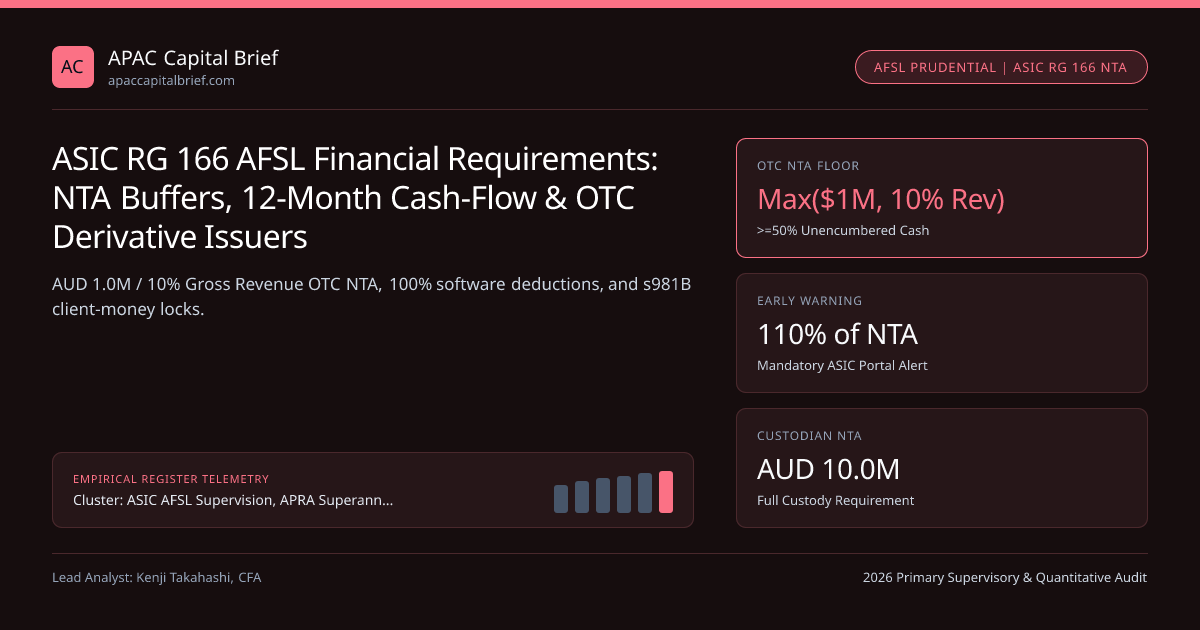
Operating a multi-asset brokerage, wholesale trustee, responsible entity (RE), or over-the-counter (OTC) derivatives dealer in Australia requires an Australian Financial Services Licence (AFSL) under Chapter 7 of the Corporations Act 2001, backed by continuous compliance with *ASIC Regulatory Guide 166 (AFS licensing: Financial requirements* — RG 166) and ASIC legislative instruments (CO 13/760, 13/761, and 2022/709+). While cross-border CFOs familiar with Hong Kong SFC FRR or Singapore MAS CMS rules (compared in our Silo 2 analysis) focus primarily on static capital ratios, ASIC RG 166 pairs balance-sheet Net Tangible Assets (NTA) with rolling forward-looking 3-month and 12-month board-certified cash-flow projections**—a liquidity gate that trips up dozens of under-prepared international entrants every year!
Core Building Blocks of ASIC RG 166: Solvency, Cash Needs, SLF & ASLF#
Every non-APRA-regulated AFSL holder—spanning trustee/advisory boutiques like AussieTrust to OTC FX/CFD market makers such as ACE Markets and BIC Markets—must satisfy base solvency + positive net assets PLUS tailored activity add-ons:
- The Cash-Needs Requirement (Options 1 & 2 vs OTC/RE Mandatory 12-Month Forecast): Standard advisory/arranging AFSLs maintain rolling 3-month cash-flow projections plus a 20% cash buffer; however, Retail OTC Derivative Issuers, Responsible Entities of Managed Investment Schemes, Custodians, and IDPS Platform Operators face mandatory rolling 12-month quarterly-updated cash-flow projections formally approved in board minutes!
- Surplus Liquid Funds (SLF) & Adjusted Surplus Liquid Funds (ASLF):
- SLF (
AUD 50,000 floor): Triggered whenever an AFSL holder holds >=AUD 100,000 in client money or property. - ASLF (
AUD 50,000 + 5% of first AUD 100M Adjusted Liabilities + 1% above AUD 100M, capped at AUD 100M): Triggered when a licensee transacts WITH clients as principal (e.g., bond dealer or non-retail OTC counterparty) incurring >=AUD 100,000 in actual/contingent client liabilities.
Special Regime for Retail OTC Derivative (FX / CFD) Issuers#
Because Principal-to-Principal ("B-Book" or matched-principal) FX and CFD issuers create direct counterparty exposure to retail traders, ASIC Class Order [CO 12/752] / Legislative Instrument imposes strict composition and early-warning replenishment rules audited annually on Form FS70 & FS71:
| AFSL Authorization Category | Statutory NTA / Capital Minimum | Required Asset Quality Composition | Mandatory ASIC Trigger & Trap |
|---|---|---|---|
| Retail OTC Derivative Issuer (ACE Markets, BIC Markets) | max(AUD 1,000,000, 10% of Average Gross Revenue) | >= 50% in Cash/Cash Equivalents + remaining <= 50% in Liquid Assets (zero illiquid receivables!) | <=110% NTA: Board report & halt new positions if <=100%! Client money CANNOT hedge house positions! |
| Responsible Entity (RE) of Registered MIS (External Custody) | max(AUD 150,000, 0.5% of Scheme Assets up to AUD 5M, 10% Avg Rev) | >=50% Cash/Cash Equivalents (min AUD 150k) + Liquid Assets | Software intangibles, deferred tax assets & related-party loans are 100% deducted from NTA! |
| Custodial / Depository Service Provider (AussieTrust peer tier) | AUD 10.0 Million NTA (unless "Incidental Provider" meeting strict outsourcing tests) | Liquid Assets + 12-month board-signed cash-flow forecast | Failing incidental-custody revenue test (<10% of financial-services revenue) triggers instant AUD 10M cliff! |
| NZ Trans-Tasman Comparison: FMA Derivatives Issuer (Blackwell Global) | NZD 1.0M Net Tangible Assets (max(NZD 1M, 10% Avg Rev)) | >=50% Cash + >=50% Liquid Assets under FMC Regulations | Parallel Trans-Tasman NTA design; separate FSPR & FDRS registration |
ASIC RG 166 Retail OTC Derivative Issuer Net Tangible Assets (NTA) & 110% Replenishment Buffer#
- NTAEligible = TotalAssets - TotalLiabilities - IntangibleAssets (Goodwill, Software, DTA) - RelatedPartyLoans - Guarantees
- RequiredNTA = max( AUD 1,000,000 , 0.10 * ( RevGrossY1 + RevGrossY2 + RevGross_Y3 ) / 3 )
- Worked CFO Audit on a Fast-Growing Sydney OTC Multi-Asset Broker:
- 3-Year Gross Trading/Spread Revenue: Y1 = AUD 14M, Y2 = AUD 22M, Y3 = AUD 30M -> Avg Gross Revenue = AUD 22.00 Million
- Required_NTA = max( AUD 1.0M , 0.10 * AUD 22.0M ) = AUD 2.20 Million (of which >=AUD 1.10M MUST sit in unencumbered bank cash!)
- Note the "Gross Revenue" Trap: Even if introducing-broker rebates & marketing eat 85% of revenue, Required_NTA scales off GROSS revenue before rebates!
- 110% Early-Warning Threshold = 1.10 * AUD 2.20M = AUD 2.42 Million (Dropping to AUD 2.38M triggers mandatory s912DAA ASIC reportable situation!)
ASIC RG 166 Capital & Client-Money Segregation Benchmarks#
Critical Operational Rule: Australia's Strict Client-Money Hedging Prohibition!#
Prior to 2018, Australian OTC derivative brokers were infamously allowed to withdraw retail client trust money from s981B accounts to fund their own house liquidity-provider margin hedges! Parliament permanently outlawed that practice: under Corporations Act s981D / Client Money Reporting Rules, 100% of retail derivative client money must remain untouched inside segregated Australian ADI trust accounts reconciled every single business day—meaning prime-of-prime house hedging margins with LPs must be funded 100% out of the AFSL licensee's own proprietary shareholder capital! Pair this prudential analysis with ASIC CFD leverage caps and s761G wholesale investor rules, ASIC crypto MIS licensing precedents, and our Australia ASIC, APRA & AUD rates hub, or explore all APAC licensing dispatches.
Frequently asked questions
Why do FinTech startups frequently fail ASIC RG 166 Net Tangible Asset (NTA) audits?
Founders capitalize AUD millions of in-house app development software and Deferred Tax Assets (DTAs) on their IFRS balance sheet assuming it counts as equity; RG 166 deducts 100% of intangible software assets and DTAs when computing regulatory NTA.
What happens under ASIC rules if a Retail OTC Derivative Issuer drops below 100% of Required NTA?
If NTA falls to <=100% of Required NTA, the licensee is legally prohibited from entering into any new OTC derivative transactions that increase client exposure, must notify its board and ASIC immediately, and must publish disclosures until recapitalized.
Can an Australian AFSL CFD broker use retail client funds to post margin with its offshore liquidity provider?
No. Since the 2018 Client Money reforms and ASIC Client Money Reporting Rules, retail derivative client money must sit segregated in an Australian ADI statutory trust account reconciled daily, and house hedging requires 100% proprietary firm capital.
How does ASIC regulate overseas institutional managers marketing only to Australian super funds?
Wholesale-only foreign managers operate either under a standard wholesale AFSL or under Australia reformed Foreign Financial Services Provider (FFSP) professional-investor / comparable-regulator exemption frameworks without retail RG 166 add-ons.
Publication record
- Published
- 14 November 2026
- Updated
- 15 November 2026
- Author
- Kenji Takahashi, CFA
- Review
- Review not recorded
- Automated fact check
- Passed in the stored pipeline record
- Source URLs
- 3 recorded
AI assistance recorded: anthropic/claude-opus-4.6. This field does not establish human review or source verification.
Academic & Institutional Attribution
Cite This Research & Embed Live Data Card
Standard academic & institutional research paper citation format.
Kenji Takahashi, CFA. (2026, November 14). ASIC RG 166 AFSL Financial Requirements: NTA Buffers, 12-Month Cash-Flow & OTC Derivative Issuers. APAC Capital Brief. https://apaccapitalbrief.com/dispatches/asic-rg-166-afsl-nta-liquidity-otc-derivative-issuer-rulesRegulatory Directory Cross-Reference
Referenced Institutions & Regulatory Registries
Mentioned Regulated Institutions
Referenced Supervisory Authorities
Related ASIC Afsl Australian Superannuation & Institutional Briefings
Explore ASIC Afsl Australian Superannuation Hub (20) →ASIC Afsl Australian Superannuation
ASIC AFSL Supervision, APRA Superannuation Flows & RBA AUD Rates Markets: 2026 APAC GuideASIC Afsl Australian Superannuation
ASIC CFD Product Intervention Order (Extended to 2027) & Section 761G Wholesale Investor ReformASIC Afsl Australian Superannuation
APRA CPS 230 Operational Risk Management: 72-Hour Breach Clocks & Super Administration OutagesASIC Afsl Australian Superannuation
APRA Abolition of Bank AT1 Hybrids (2027–2032): Tier 2 Subordinated Debt & CET1 RepricingASIC Afsl Australian Superannuation
AOFM ACGB Syndications, ASX Cash-Settled 3Y/10Y Bond Futures & EFP Swap-Spread MechanicsASIC Afsl Australian Superannuation
ASIC Private Credit & CRE Loan Surveillance: Fee Skimming, PIK Valuations & Redemption GatesASIC Afsl Australian Superannuation
ASX CHESS Replacement via TCS BaNCS (2026–2029) & Australia T+1 Equity Settlement RoadmapASIC Afsl Australian Superannuation
APRA SPS 530 Unlisted Asset Governance: Out-of-Cycle Revaluations & Member Switching ArbitrageAsean India Sovereign Bond Inclusion
Bank Indonesia SRBI Bills, "Operation Twist" & Foreign Flows Into IndoGB Sovereign Bonds (SBN)Asean India Sovereign Bond Inclusion
Indonesia 100% DHE SDA Export FX Retention Mandate (PP 8/2025): Onshore USD Liquidity & Exporter SwapsAsean India Sovereign Bond Inclusion
Malaysia BNM Onshore FX Rules, Dynamic Hedging, AOOs & 0%-WHT MGS / FTSE WGBI FlowsAsean India Sovereign Bond Inclusion
SEBI FPI Granular Beneficial-Ownership Rules (INR 50,000 Cr Update) & Offshore ODI / P-Note Ban
APAC Capital Brief Data, Benchmarks & Contributor Records
CC BY 4.0 Open Data
Open Institutional Datasets (CSV / JSON) →
Download desk-compiled quantitative series & schemas.
2026 Reference Matrix
2026 Institutional Benchmarks & Thresholds →
Statutory capital, clearing, margin & rate conventions.
Editorial Records
Authors & Review Records →
View named contributors where those records are available.
Complete Index
Master Research & Dossier Archive →
Browse all published briefings by topic pillar & date.