
Asean India Sovereign Bond Inclusion
SEBI FPI Granular Beneficial-Ownership Rules (INR 50,000 Cr Update) & Offshore ODI / P-Note Ban
Born out of minimum-public-shareholding evasion probes, SEBI granular FPI beneficial-ownership rules and December 2024 ODI derivative bans reshaped offshore India hedge funds.
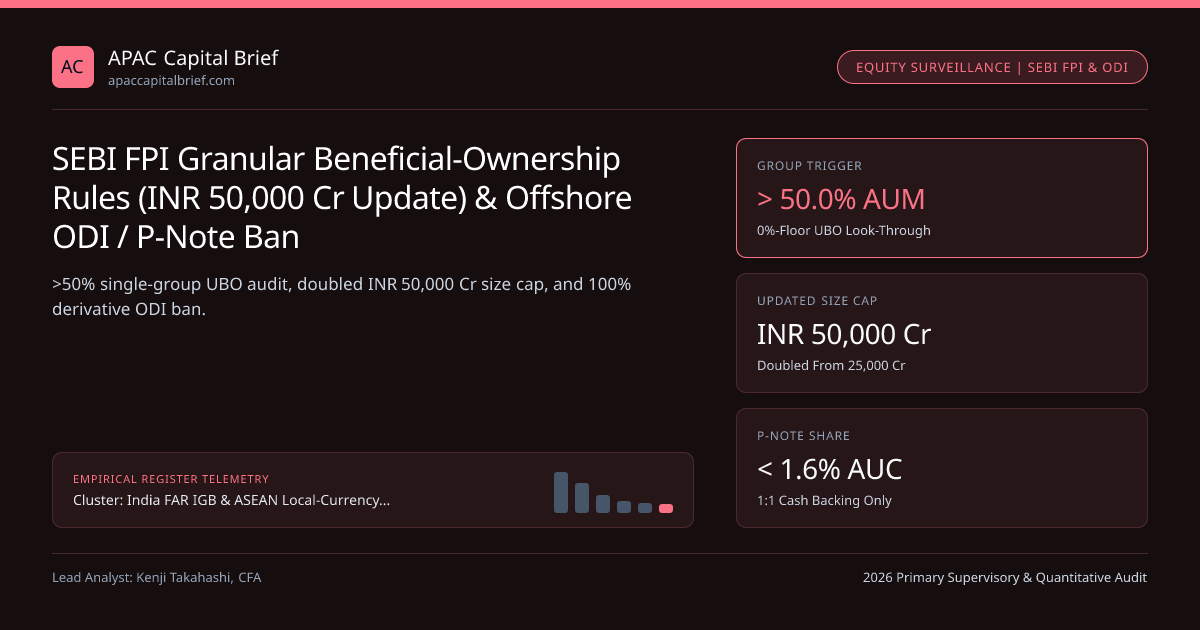
Following high-profile corporate-governance controversies in 2023 alleging offshore funds parked concentrated stakes in Indian conglomerate stocks to skirt India's mandatory 25% Minimum Public Shareholding (MPS) rule (Securities Contracts (Regulation) Rules Rule 19A) and Press Note 3 border-country FDI vetting, the Securities and Exchange Board of India (SEBI) enacted two interconnected compliance earthquakes for Foreign Portfolio Investors (FPIs) and global prime-brokerage desks:
- Granular "Down-to-the-Last-Natural-Person" Beneficial Ownership Disclosures (
August 2023 Circular, updated in 2025 by raising the size-based equity AUM trigger from INR 25,000 crore to INR 50,000 crore [~US$5.9B]!); AND - SEBI's December 2024 Clampdown on Offshore Derivative Instruments (ODIs / "Participatory Notes" — P-Notes)—completely banning FPIs from using Indian equity derivatives to hedge ODIs and forcing all remaining cash-equity/debt ODIs onto segregated FPI registrations!
Trigger 1 vs Trigger 2: Who Must Disclose Every Single LP Down to Zero Threshold?#
Under standard Indian Prevention of Money Laundering Act (PMLA) rules enforced alongside FIU-IND and MCA, ordinary diversified FPIs only report Ultimate Beneficial Owners holding >=10% (companies/trusts) or >=15% (partnerships)! However, SEBI's Granular Disclosure Circular strips away ALL 10%/15% thresholds—forcing the FPI to disclose 100% of every natural person holding ANY economic interest, ownership, or control right through every feeder, LP, and trust layer—if the FPI breaches EITHER of two triggers:
- Trigger 1 — Single Corporate Group Concentration (
>50% of Indian Equity AUM): More than 50.0% of the FPI's Indian equity AUM is invested in a single Indian corporate group! - Trigger 2 — Aggregate Equity Size Threshold (
Raised from >INR 25,000 Cr to >INR 50,000 Cr [~US$5.9B] in 2025!): Recognizing that booming NSE/BSE market caps and daily turnover had pushed diversified global active managers inadvertently past INR 25,000 crore, SEBI doubled the size trigger to INR 50,000 crore across an FPI investor group—while keeping Sovereign Wealth Funds, Central Banks, Public Retail Funds (US 40-Act, EU UCITS), Broad-Based Pension/University Endowments, and Regulated Exchange-Traded Funds EXEMPT (subject to specific conditions on pooled vehicles)!
Closing the Backdoor: SEBI's December 2024 Offshore Derivative Instrument (ODI) Overhaul!#
Why did SEBI target ODIs (P-Notes) right after enforcing FPI UBO rules? Because concentrated offshore players tried to dodge FPI Trigger 1 by closing their direct FPI account and instead buying synthetic swaps (ODIs) from global prime brokers! In December 2024 (phased in across 2025–2026), SEBI shut every synthetic ODI loophole:
| Regulatory Dimension | Pre-Dec 2024 ODI / FPI Rules | 2025–2026 SEBI Enforcement Standard | Impact on Global Prime Brokers & Pods |
|---|---|---|---|
| Underlying Hedge of Equity ODIs | ODI-issuing FPIs could hedge client P-Notes cheaply using NSE Single-Stock Futures/Options (~5x synthetic leverage!) | DERIVATIVE HEDGING BANNED! Every equity ODI MUST be hedged 1-for-1 strictly with cash shares, held inside a dedicated separate ODI-only FPI registration! | Eliminates leveraged synthetic single-stock swaps; raises prime-broker balance-sheet cost by +60–110 bps! |
| Granular UBO Parity on ODI Subscribers | ODI subscribers only faced standard PMLA KYC at the issuing bank | Identical 50% single-group concentration & size UBO disclosure rules now apply directly at the ODI subscriber level! | Zero regulatory arbitrage left between holding an FPI vs holding a P-Note! |
Government Sovereign Bond ODIs (FAR IGB TRS) | Swept into equity ODI anxiety initially | Carved out cleanly: ODIs referencing Indian Government Securities (FAR IGBs) exempted from concentrated equity MPS rules! | Preserves smooth institutional bond index TRS bridging while FPI accounts open |
| GIFT City IFSC ODI Issuance (IFSCA) | Only onshore Cat-I FPI banks issued ODIs | IFSCA-registered GIFT City IBUs/FPIs authorized under harmonized transparency rules alongside NSE IX | Shifts legitimate cash-backed ODI administration into India's own supervised offshore hub |
Prime-Broker Financing Cost Explosion on Indian Single-Stock Equity Swaps#
- AnnualSwapSpreadPre2025 (Futures Hedge) = MarginShare20% * rSOFR + RollBasisNSESSF + cPBAdmin35bps
- AnnualSwapSpread_2026 (1:1 Cash Stock + Segregated FPI + 20% STCG Pass-Through):
- SwapCostCash = 100% * rSOFRFunding + tauSTT0.10%EachWay * Turnover + sBalanceSheetRWA65bps + PassThroughIndian_CGT!
- Worked Comparison on a US$50M Long/Short Pod Buying an Indian Mid-Cap Industrial Held for 4 Months (+15% Gain, Turned Over 3x/Yr):
- 1. Legacy Futures-Backed ODI: Low cash outlay + lower futures STT (0.02%); high leverage efficiency
- 2. Post-SEBI Cash-Only Segregated ODI:
- Full 100% cash balance-sheet funding + 0.10% Buy AND 0.10% Sell Cash Equity STT (3x/yr = -60 bps!) + 20% (+surcharge/cess = ~21.84%) Indian Short-Term Equity CGT deducted directly from swap P&L!
- Result: 80%+ of multi-strategy pods abandoned P-Notes and opened direct Category-I SEBI FPI accounts (using local execution brokers like Bonanza & institutional dealers)!
Decline of Indian P-Notes / ODIs vs Direct FPI Custody (% Share)#
Press Note 3 ("Land-Bordering Country" China/HK Vetting) Trap for Asia Funds!#
One critical operational check for Hong Kong and Singapore pan-Asia hedge funds (see our Silo 2 HK SFC / SG MAS coverage): even if your fund holds only 2% in any single Indian group and sits well below INR 50,000 crore, India's Press Note 3 / FEMA Non-Debt Rules & DDP SOPs scrutinize Beneficial Owners residing in or holding citizenship of countries sharing a land border with India (Mainland China / Hong Kong SAR residents depending on nationality/control thresholds!)! Ensure your DDP custodian pre-clears GP/LP structures before wiring capital! Pair this with SEBI NSE index options tightening, GIFT City IFSC FME structures, and our India FAR & ASEAN bond inclusion hub, or explore all APAC regulatory dispatches.
Frequently asked questions
Why did SEBI double the FPI size-based granular disclosure threshold from INR 25,000 crore to INR 50,000 crore?
Rapid appreciation of Indian equity valuations and daily cash market turnover meant legitimate diversified global asset-management groups risked tripping INR 25,000 crore (~US$3B) purely through market growth; doubling to INR 50,000 crore (~US$5.9B) focused enforcement squarely on systemic pools.
What happens if an FPI breaches the 50% single-corporate-group limit and refuses to name its underlying natural-person LPs?
If the FPI neither rebalances below 50% within 10 trading days nor submits full natural-person UBO disclosures within 30 days, its FPI registration becomes invalid and it must liquidate 100% of its Indian holdings within 180 days (after which unsold shares forfeit to SEBI Investor Protection Fund!).
Can a global hedge fund still buy synthetic single-stock swaps (P-Notes) backed by NSE futures in 2026?
No. Under SEBI December 2024 ODI circular, FPIs are strictly prohibited from issuing ODIs with derivatives as underlying or hedging equity ODIs using derivatives; only 1-for-1 cash-equity or cash-debt ODIs under dedicated segregated FPI licenses are permitted.
Are Sovereign Bond Total Return Swaps on India FAR IGBs banned by the ODI rules?
No. Cash-backed sovereign debt ODIs referencing Government Securities remain permitted under dedicated FPI accounts without triggering the 50% corporate-group equity concentration rule.
Publication record
- Published
- 13 November 2026
- Updated
- 15 November 2026
- Author
- Kenji Takahashi, CFA
- Review
- Review not recorded
- Automated fact check
- Passed in the stored pipeline record
- Source URLs
- 3 recorded
AI assistance recorded: anthropic/claude-opus-4.6. This field does not establish human review or source verification.
Academic & Institutional Attribution
Cite This Research & Embed Live Data Card
Standard academic & institutional research paper citation format.
Kenji Takahashi, CFA. (2026, November 14). SEBI FPI Granular Beneficial-Ownership Rules (INR 50,000 Cr Update) & Offshore ODI / P-Note Ban. APAC Capital Brief. https://apaccapitalbrief.com/dispatches/sebi-fpi-beneficial-ownership-25000-crore-odi-restrictionsRegulatory Directory Cross-Reference
Referenced Institutions & Regulatory Registries
Mentioned Regulated Institutions
Referenced Supervisory Authorities
Related Asean India Sovereign Bond Inclusion & Institutional Briefings
Explore Asean India Sovereign Bond Inclusion Hub (20) →Asean India Sovereign Bond Inclusion
India FAR IGB Index Inclusion, RBI/SEBI Plumbing & ASEAN Local-Currency Bond Guide (2026)Asean India Sovereign Bond Inclusion
SEBI NSE/BSE Index Options Overhaul: INR 15 Lakh Lot Sizes, Weekly Expiry Cap & 2% Expiry ELMAsean India Sovereign Bond Inclusion
ASEAN Local Currency Transaction (LCT) Framework, ACCD FX Dealers & BIS Project Nexus QR RailsAsean India Sovereign Bond Inclusion
Vietnam SSC Circular 68 Non-Prefunding (NPF), KRX Engine & FTSE Emerging Market UpgradeAsean India Sovereign Bond Inclusion
Bank of Thailand 89% Household Debt Overhang, Gold-Trade THB FX Beta & ThaiGB Curve FlatteningAsean India Sovereign Bond Inclusion
Philippines BSP Reserve Requirement (RRR) Cuts to 5%, 28-Day BSP Bills & Retail Treasury BondsAsean India Sovereign Bond Inclusion
Asian NDF vs Onshore Deliverable Forward (DF) Arbitrage: INR, IDR, PHP, KRW & TWD Basis WedgesAsean India Sovereign Bond Inclusion
Malaysia GII Sukuk vs MGS Spreads, Commodity Murabahah Mechanics & Labuan IBFC Wakalah TrustsRegulatory Compliance
ASIC calls for ‘urgent action’ from private credit sector to clean up its act - PEREMonetary Policy
Bank of Japan is expected to hold rates this week — but stay hawkish: CNBC surveyMonetary Policy
BOJ holds rates as underlying inflation aligns with 2% target for first time since 2013Market Insights
Nikkei Flat, Supported by Bank, Pharma Stocks
APAC Capital Brief Data, Benchmarks & Contributor Records
CC BY 4.0 Open Data
Open Institutional Datasets (CSV / JSON) →
Download desk-compiled quantitative series & schemas.
2026 Reference Matrix
2026 Institutional Benchmarks & Thresholds →
Statutory capital, clearing, margin & rate conventions.
Editorial Records
Authors & Review Records →
View named contributors where those records are available.
Complete Index
Master Research & Dossier Archive →
Browse all published briefings by topic pillar & date.