
Asean India Sovereign Bond Inclusion
Bank Indonesia SRBI Bills, "Operation Twist" & Foreign Flows Into IndoGB Sovereign Bonds (SBN)
By issuing over IDR 900 trillion in high-yielding 6M–12M Sekuritas Rupiah Bank Indonesia (SRBI) bills backed by sovereign bonds, Bank Indonesia stabilized USD/IDR across ASEAN markets.
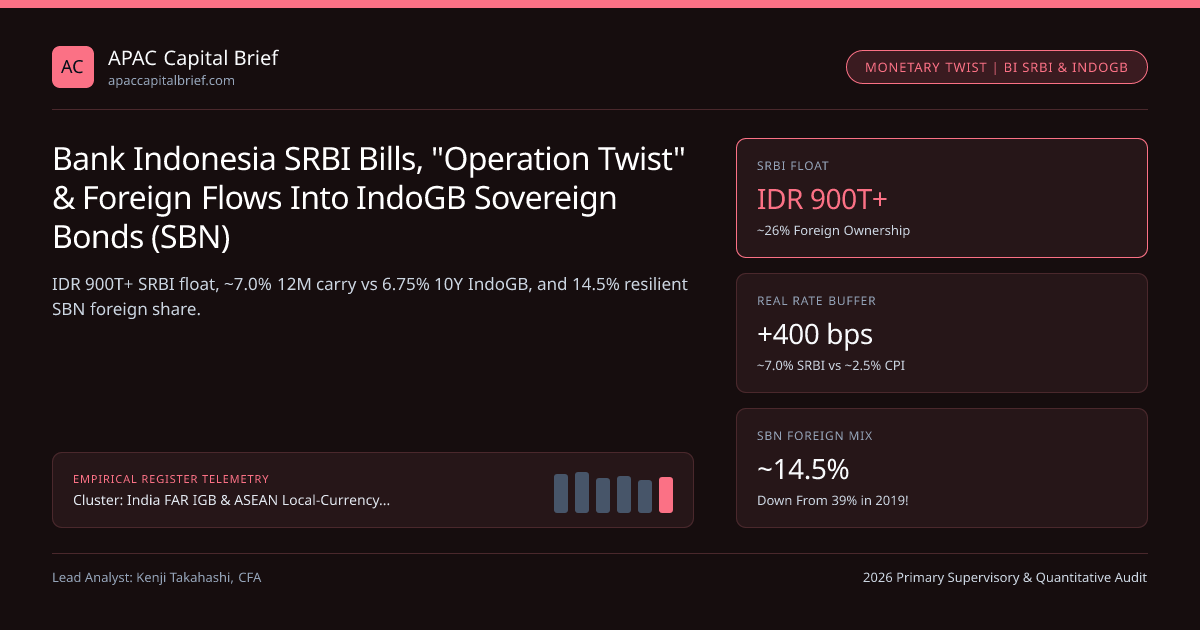
When US Treasury yields spiked and India's 10% JPMorgan GBI-EM entry trimmed passive index weights across Southeast Asia, Indonesia faced its classic external vulnerability: how to defend the Indonesian Rupiah (USD/IDR 15,800–16,400) without hiking the BI-Rate to economy-crushing levels OR watching foreign bondholders dump long-duration *Indonesian Government Bonds (Surat Berharga Negara* — SBN / IndoGBs)? Governor Perry Warjiyo and Bank Indonesia (BI) engineered one of Emerging Markets' boldest balance-sheet innovations: Sekuritas Rupiah Bank Indonesia (SRBI)—a short-term (6-month, 9-month, and 12-month), fully tradable, foreign-eligible discount monetary bill collateralized by BI's own pandemic IndoGB holdings—scaling past IDR 900+ trillion (~US$56 billion, with ~25%–28% snapped up rapidly by offshore foreign funds!)**!
How SRBI Replaced Legacy Reverse Repos & Executed "Pro-Market Operation Twist"#
Prior to September 2023, Bank Indonesia absorbed excess domestic banking liquidity using conventional non-tradable reverse repos that foreign offshore investors could NOT buy—meaning foreigners had zero way to earn short-term 6.75%–7.25% Rupiah carry without taking 5-to-10-year IndoGB duration risk (or trading illiquid offshore IDR DNDFs)!
- SRBI Mechanics: Backed 1-for-1 by BI's existing SBN sovereign bond portfolio, SRBI bills are auctioned twice weekly to primary dealers (including domestic banks alongside institutions like Bank Sinarmas and regional houses like CGS-CIMB), freely transferable in the secondary market to non-resident foreign investors!
- Indonesian "Operation Twist": BI deliberately priced *12-month SRBI auction yields at
6.85% to 7.45%—often +15 to +45 bps ABOVE* 10-year sovereign IndoGB yields (6.65%–7.05%) (an inverted money-market-to-sovereign curve!)! Foreign macro funds poured US$14B–US$17B into 6M–12M SRBIs** (capturing ~7.0% short-duration IDR yield to support the Rupiah!), while BI bought long-end 10Y/15Y IndoGBs in secondary operations to cap Ministry of Finance fiscal borrowing costs!
The Structural Transformation of IndoGB Ownership (39% Foreign -> 14.5% Foreign!)#
Look at KPI #3 above—one of the most under-appreciated structural upgrades in all of ASEAN fixed income, overseen alongside Indonesia's Otoritas Jasa Keuangan (OJK):
- In 2019, non-resident foreigners owned 38.6% of all tradable Rupiah IndoGBs—so every time US yields jumped 30 bps, foreigners dumped billions of 10Y IndoGBs, blowing yields from 7% to 8.5% and crashing IDR!
- By 2026, domestic Indonesian banks, onshore pension/BPJS funds, insurance firms, and retail ORI/SR savers hold >85% of IndoGBs, reducing foreign IndoGB share to a resilient ~14.2%–14.8%—while short-term tactical FX carry traders sit ring-fenced inside 6M–12M SRBIs!
| Indonesian Instrument | Tenor & Issuer | 2026 Gross / Post-Tax Yield (10% WHT) | Liquidity & Crowding-Out Nuance |
|---|---|---|---|
| *SRBI (Sekuritas Rupiah BI)* | 6M, 9M & 12M Discount Bills (Bank Indonesia) | 6.80%–7.25% Gross (~6.15%–6.52% post-10% WHT; lower under SG/UAE DTAA!) | Attracts $15B+ foreign FX inflows, but drains domestic bank CASA liquidity & tightens JIBOR/INDONIA! |
| SVBI & SUVBI | 1M, 3M, 6M USD Bills & USD Sukuk (Bank Indonesia) | Linked to USD SOFR | Paired with 100% DHE SDA resource FX retention to keep onshore USD inside Jakarta! |
| Benchmark 5Y & 10Y IndoGB (FR Series) | 5Y–30Y Fixed Coupon (Ministry of Finance — DJPPR) | 6.65%–6.95% Gross (~6.00%–6.25% post-10% WHT) | 10.0% max weight in JPMorgan GBI-EM; supported by BI KLM macroprudential reserve-ratio incentives |
| SBSN / Green Sovereign Sukuk | Rupiah PBS Series & Global USD Wakalah Sukuk | Trades +5–12 bps over conventional FR bonds due to slightly thinner secondary turnover | Captures captive Middle Eastern & Malaysian Islamic bank liquidity |
Domestic Bank Marginal Loan-vs-SRBI Crowding-Out Hurdle & Foreign 12M SRBI Breakeven IDR Depreciation#
- BankMinCorporateLoanRate = Y12MSRBIRiskFree0%RWA + OpExCredit + ( PDLoan * LGDLoan ) + ( 0.105 * RWA100% * k_ROE )
- ForeignUnhedged12MSRBIFXBreakeven = ( 1 + YSRBI * (1 - tauWHT) ) / ( 1 + rUSDSOFR12M ) - 1
- Worked Jakarta Banking & Foreign Carry Math (Y12MSRBI = 7.00%, 10% WHT -> 6.30% Net; 12M USD SOFR = 4.55%):
- 1. Foreign Carry Cushion:
- Breakeven 12M USD/IDR Depreciation = (1.0630 / 1.0455) - 1 = +1.67% (If Spot = 16,000, foreign fund profits up to USD/IDR = 16,268!)
- 2. Domestic Mid-Tier Bank Crowding-Out (e.g., Tier-2/3 Jakarta banks vs Bank Sinarmas peer cohort):
- Why lend to an SME at 9.5% (carrying 100% RWA = 1.58% equity charge + 1.80% credit cost = 6.12% risk-adjusted net) when buying 12M SRBI yields 7.00% risk-free with ZERO RWA capital charge?!
Indonesia Inverted Front-End "Operation Twist" Curve (2026)#
Key 2026 Risk Watch: The Monthly SRBI Rollover Cliff & Fiscal Deficit Cap (3.0% of GDP)#
Every sovereign EM PM tracks two critical Indonesian risk gauges:
- SRBI Maturity Concentration: Because SRBIs have 6M–12M maturities, IDR 60T–90T (~US$4B–$5.6B) matures every month—meaning if global DXY surges right on a heavy SRBI maturity week and foreigners decline to roll, USD/IDR faces concentrated outflow pressure (prompting BI to taper net SRBI stock gradually as the Fed cuts!).
- Indonesia's Sacred
3.0% of GDP Statutory Fiscal Deficit Ceiling: Investors price IndoGB term premia strictly off Finance Ministry commitment to keep President Prabowo's priority spending inside the 3.0% statutory deficit cap! Pair this with Indonesia's 100% DHE SDA resource export FX lockup, Indonesia P2SK regulatory shift, and our India FAR & ASEAN bond inclusion hub, or explore all ASEAN bond dispatches.
Frequently asked questions
What is the difference between SRBI and IndoGB (SBN) in Indonesia fixed-income market?
IndoGBs (SBN) are fiscal sovereign bonds issued by Indonesia Ministry of Finance to fund the budget; SRBIs are 6M–12M monetary discount bills issued by Bank Indonesia (collateralized by BI existing SBN holdings) purely to manage liquidity and attract FX inflows.
Why did 12-month SRBI bills yield more than 10-year Indonesian Government Bonds?
Bank Indonesia intentionally offered ~6.9%–7.3% clearing yields at SRBI auctions ("Operation Twist") to give foreign macro funds high short-duration Rupiah carry to defend USD/IDR while buying long-end SBNs to keep 10Y fiscal yields anchored near 6.75%.
What withholding tax rate do foreign investors pay on Indonesian IndoGBs and SRBIs?
Under Government Regulation PP No. 9/2021, Indonesia permanently halved base non-resident interest/discount withholding tax from 20% down to 10.0% (further reducible to 0%–10% under specific DTAA treaties such as UAE, Singapore, or Netherlands).
How did high SRBI yields cause "crowding out" inside Indonesia domestic banking sector?
Because SRBIs carry a 0% sovereign risk weight and yielded ~7%, smaller and mid-tier Indonesian banks preferred parking cash in risk-free SRBIs rather than lending interbank or taking 100%-RWA SME credit risk, tightening domestic money-market liquidity.
Publication record
- Published
- 13 November 2026
- Updated
- 16 November 2026
- Author
- Kenji Takahashi, CFA
- Review
- Review not recorded
- Automated fact check
- Passed in the stored pipeline record
- Source URLs
- 3 recorded
AI assistance recorded: anthropic/claude-opus-4.6. This field does not establish human review or source verification.
Academic & Institutional Attribution
Cite This Research & Embed Live Data Card
Standard academic & institutional research paper citation format.
Kenji Takahashi, CFA. (2026, November 15). Bank Indonesia SRBI Bills, "Operation Twist" & Foreign Flows Into IndoGB Sovereign Bonds (SBN). APAC Capital Brief. https://apaccapitalbrief.com/dispatches/bank-indonesia-srbi-bills-operation-twist-indogb-sbn-flowsRegulatory Directory Cross-Reference
Referenced Institutions & Regulatory Registries
Mentioned Regulated Institutions
Related Asean India Sovereign Bond Inclusion & Institutional Briefings
Explore Asean India Sovereign Bond Inclusion Hub (20) →Asean India Sovereign Bond Inclusion
India FAR IGB Index Inclusion, RBI/SEBI Plumbing & ASEAN Local-Currency Bond Guide (2026)Asean India Sovereign Bond Inclusion
Indonesia 100% DHE SDA Export FX Retention Mandate (PP 8/2025): Onshore USD Liquidity & Exporter SwapsAsean India Sovereign Bond Inclusion
Malaysia BNM Onshore FX Rules, Dynamic Hedging, AOOs & 0%-WHT MGS / FTSE WGBI FlowsAsean India Sovereign Bond Inclusion
SEBI FPI Granular Beneficial-Ownership Rules (INR 50,000 Cr Update) & Offshore ODI / P-Note BanAsean India Sovereign Bond Inclusion
SEBI NSE/BSE Index Options Overhaul: INR 15 Lakh Lot Sizes, Weekly Expiry Cap & 2% Expiry ELMAsean India Sovereign Bond Inclusion
ASEAN Local Currency Transaction (LCT) Framework, ACCD FX Dealers & BIS Project Nexus QR RailsAsean India Sovereign Bond Inclusion
Vietnam SSC Circular 68 Non-Prefunding (NPF), KRX Engine & FTSE Emerging Market UpgradeAsean India Sovereign Bond Inclusion
Bank of Thailand 89% Household Debt Overhang, Gold-Trade THB FX Beta & ThaiGB Curve FlatteningMonetary Policy
Japan advisers urge focus on sustaining growth after inflation hits BOJ goal - ReutersMarket Insights
HANG SENG INDEX (^HSI) charts, data and news - Yahoo Finance UKMarket Insights
Japan's Nikkei rises for third day as data, earnings fuel AI optimism -Regulatory Compliance
ASIC calls for ‘urgent action’ from private credit sector to clean up its act - PERE
APAC Capital Brief Data, Benchmarks & Contributor Records
CC BY 4.0 Open Data
Open Institutional Datasets (CSV / JSON) →
Download desk-compiled quantitative series & schemas.
2026 Reference Matrix
2026 Institutional Benchmarks & Thresholds →
Statutory capital, clearing, margin & rate conventions.
Editorial Records
Authors & Review Records →
View named contributors where those records are available.
Complete Index
Master Research & Dossier Archive →
Browse all published briefings by topic pillar & date.