
Boj Jgb Curve Yen Repatriation
Japan 10-Year JGBi Breakeven Inflation (BEI), Deflation Floors & MoF Buybacks
Despite three years of >2.0% realized CPI and 3.68% Shunto wage base-ups, 10-year Inflation-Indexed JGBs (JGBi) price a 1.62% breakeven inflation rate across APAC markets due to balance-sheet liquidity discounts.
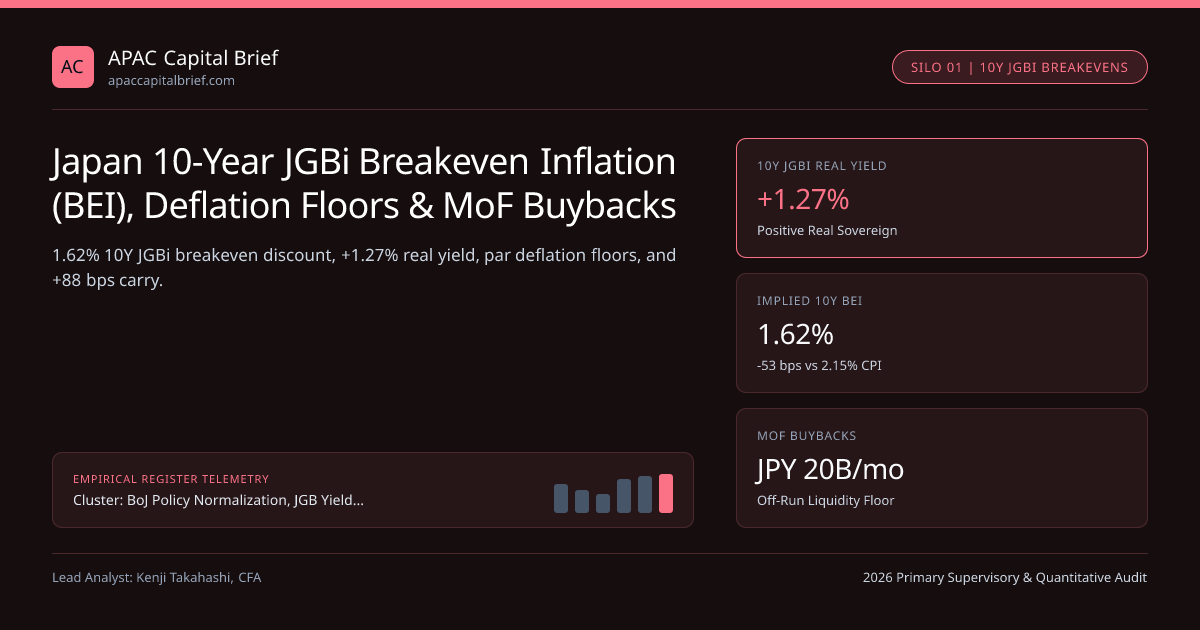
One of the most persistent relative-value anomalies in G10 inflation markets sits squarely in Tokyo: while core-core consumer inflation and Rengo Shunto base-pay settlements track firmly above 2.1%, *10-year Inflation-Indexed Japanese Government Bonds (JGBis / Bukka Rendo Kokusai, Issues #29–#31)* trade at real yields around +1.27% against 2.89% nominal 10-year JGBs—implying a 10-year Breakeven Inflation Rate (BEI) of just 1.62%, roughly 45 to 55 bps cheap to fundamental inflation trajectories!
Post-2013 JGBi Contract Design: Ex-Fresh Food CPI Indexation & Par Deflation Floor#
After the 2008 global financial crisis crushed first-generation JGBis lacking principal protection, the Ministry of Finance relaunched second-generation 10-year JGBis in October 2013 with two investor-friendly contractual pillars:
- Reference Index (
National CPI ex-Fresh Food, 3-Month Lag): Principal accretes daily via an Indexation Coefficient (IC_t = CPI_{t-3m} / CPI_base), matching the exact headline core CPI gauge targeted by the Bank of Japan! - Embedded Par Redemption Deflation Floor (
IC_maturity >= 1.000): At final 10-year maturity, even if cumulative CPI falls over the decade, principal redeems at a statutory floor of 100.00 par (coupons prior to maturity still scale with actualIC_t). Freshly issued on-the-run JGBis withIC_0 ≈ 1.00–1.02therefore grant investors a free 10-year zero-strike deflation put option worth 6–11 bps in yield!
Why Does 10-Year JGBi BEI Trade At a Structural Illiquidity Discount?#
If realized inflation exceeds 2.1%, why hasn't domestic pension demand bid 10-year BEI up to 2.15%? Because Japan's institutional pension liabilities—including GPIF's JPY 258T reserve and corporate defined-benefit plans—are not contractually CPI-escalated in the rigid manner of UK RPI pension schemes! Combined with smaller quarterly auction sizes (4x per year at JPY 250 billion = JPY 1.0T annual gross supply versus JPY 31.2T in nominal 10Y JGBs), the JGBi market relies heavily on MoF balance-sheet stabilization:
| JGBi Market Participant | Role in Linker Ecosystem | Typical Position / Constraint | Impact on BEI Valuation |
|---|---|---|---|
| MoF Monthly JGBi Buyback Auctions | Sovereign Liquidity Stabilizer | Buys back JPY 20B/month of seasoned high-IC off-the-run JGBis | Prevents deep illiquidity discounts during global risk-off VaR sales |
| Bank of Japan Outright JGBi Rinban | Monetary Policy Anchor | Retains dedicated bi-monthly JGBi purchase line (~JPY 50B–60B) | Owns ~52% of outstanding JGBi float, tightening repo borrow |
| GPIF Domestic Bond Active Mandates | Strategic Real-Return Sleeve | Allocates within 25% Domestic Bond bucket to beat Wage + 1.9% | Accumulates on dips when 10Y BEI compresses below 1.45% |
| Daiwa Securities & Foreign Macro Pods | Asset-Swap & Breakeven Desk | Long 10Y JGBi vs Short Nominal 10Y JGB (or OSE Futures) | Captures +53 bps positive carry roll during April/Oct CPI jumps |
| Domestic Retail Inflation Toshin | Aizawa Securities / Bank Channels | Dedicated JGBi mutual funds hedging household purchasing power | Steady inflow as depositors awaken to negative real deposit rates |
Fisher Decomposition & Carry-Adjusted Breakeven Inflation Return (BEI_carry)#
- BEIquoted = Ynom10Y - yrealJGBi = piexpected + Preminflationrisk - Discilliquidity - Valdeflation_floor
- 3MAnnualizedLinkerCarry = yrealJGBi + ( (CPI{t} / CPI{t-3m})^(365/91) - 1 ) - rGC_repo
- Where:
- Ynom10Y = 2.89%
- yrealJGBi = +1.27% -> BEI_quoted = 1.62%
- 3M Core CPI Accretion (Seasonal Spring/Autumn Window) = +0.62% non-annualized (+2.50% annualized)
- rGCrepo = 1.26% (JSCC general-collateral financing cost)
- Worked Calculation (3-Month Leveraged Breakeven Long):
- Annualized JGBi Total Carry = 1.27% + 2.50% - 1.26% = +2.51% net repo carry
- Nominal 10Y Short Carry Drag = -(2.89% - 1.26%) = -1.63%
- Net 3-Month Breakeven Box Carry = +2.51% - 1.63% = +0.88% (+88 bps annualized positive carry while waiting for BEI re-rating!)
Seasonal CPI Indexation Carry: Why May–July and Nov–Jan Favor Long JGBi#
Because JGBi principal indexation lags CPI publication by approximately 2.5 to 3 months (e.g., April fiscal-start corporate price hikes reported in May CPI govern JGBi daily indexation factors across July/August), inflation traders forecast daily JGBi indexation carry with near-deterministic precision two months in advance! Additionally, note that government energy/electricity bill subsidies artificially shave 35–50 bps off headline CPI ex-fresh food when active—and mechanically add +35–50 bps back to JGBi accretion the moment Cabinet subsidies expire!
Structuring Clean 10-Year Breakeven Trades Without CTD Squeeze Exposure#
Rather than shorting scarce off-the-run 10Y cash JGBs against long on-the-run JGBi #30/#31 (which risks BoJ SLF special-repo squeezes), institutional desks hedge nominal duration by paying fixed in 10-year JSCC TONA OIS or shorting fresh on-the-run 10Y cash JGBs. Review how linker breakevens confirm Policy Board rate hikes in our BoJ policy normalization master guide and APAC sovereign fixed-income hub.
Frequently asked questions
Which inflation index determines principal accretion on Japanese JGBi linkers?
JGBis index principal and coupon payments to Japan Nationwide Consumer Price Index excluding Fresh Food (Core CPI) with an approximate 3-month publication lag, matching the Bank of Japan headline forecast gauge.
Why does Japan 10-year breakeven inflation trade near 1.62% when actual inflation is above 2.1%?
Unlike UK pension funds that must hedge statutory RPI-linked liabilities, Japanese corporate pensions lack rigid CPI indexation, leaving JGBis with a ~50 bps liquidity discount relative to nominal JGBs.
What happens to a freshly issued 10-year JGBi if Japan returns to deflation over the next decade?
All JGBis issued since October 2013 carry a maturity deflation floor guaranteeing redemption principal will not fall below par (Indexation Coefficient >= 1.00), whereas seasoned issues trading at IC = 1.10 can decline back toward 1.00.
How do Japanese government energy subsidies distort JGBi short-term carry?
Temporary utility bill subsidies directly depress the National CPI ex-Fresh Food index when introduced—reducing JGBi accretion 3 months later—and mechanically boost JGBi carry by +35–50 bps when phased out.
Publication record
- Published
- 14 November 2026
- Updated
- 15 November 2026
- Author
- Kenji Takahashi, CFA
- Review
- Review not recorded
- Automated fact check
- Passed in the stored pipeline record
- Source URLs
- 3 recorded
AI assistance recorded: anthropic/claude-opus-4.6. This field does not establish human review or source verification.
Academic & Institutional Attribution
Cite This Research & Embed Live Data Card
Standard academic & institutional research paper citation format.
Kenji Takahashi, CFA. (2026, November 14). Japan 10-Year JGBi Breakeven Inflation (BEI), Deflation Floors & MoF Buybacks. APAC Capital Brief. https://apaccapitalbrief.com/dispatches/japan-10y-jgbi-breakeven-inflation-linker-buyback-auctionsRegulatory Directory Cross-Reference
Referenced Institutions & Regulatory Registries
Mentioned Regulated Institutions
Primary Tier-1 Supervisory Registries
Related Boj Jgb Curve Yen Repatriation & Institutional Briefings
Explore Boj Jgb Curve Yen Repatriation Hub (20) →Boj Jgb Curve Yen Repatriation
Bank of Japan Policy Normalization, JGB Curve Steepening & Lifer Repatriation: 2026 APAC GuideBoj Jgb Curve Yen Repatriation
JSCC JGB & TONA IRS Clearing: VaR Initial Margin, Cross-Margining & Repo HaircutsBoj Jgb Curve Yen Repatriation
BoJ Uncollateralized Overnight Call Rate & Reserve Tiering Mechanics at 1.25%Boj Jgb Curve Yen Repatriation
BoJ Rinban JGB Tapering to JPY 2.9T/Month & Primary Dealer DV01 AbsorptionBoj Jgb Curve Yen Repatriation
30Y & 40Y Super-Long JGB Convexity: Japanese Lifer ESR Solvency & ALM MatchingBoj Jgb Curve Yen Repatriation
FX-Hedged UST & OAT Carry Erosion: Quantifying Japanese Lifer Bond RepatriationBoj Jgb Curve Yen Repatriation
Rengo Shunto Base-Pay Hikes, Services PPI & BoJ Taylor-Rule Rate TransmissionBoj Jgb Curve Yen Repatriation
TONA OIS Swap Spreads, JGB Asset Swaps & OSE Futures Cheapest-to-Deliver BasisHkma Sfc Mas Wealth Hub Regimes
Client Money Segregation: HK SFC Cap. 571I Rules vs Singapore MAS CMS Trust AccountsAPAC Semiconductor AI Capex Equities
TSMC US$62B FY2026 Capex & 125,000 wpm CoWoS-L Ramp: Packaged Wafer Margin MechanicsAPAC Semiconductor AI Capex Equities
SK Hynix KRW 48T HBM4 Capex & MR-MUF Yield Lead vs Samsung TC-NCF Hybrid BondingAPAC Semiconductor AI Capex Equities
TSE Prime 1.0x PBR Governance Enforcement: WACC vs ROIC Spread & JPX Name-and-Shame
APAC Capital Brief Data, Benchmarks & Contributor Records
CC BY 4.0 Open Data
Open Institutional Datasets (CSV / JSON) →
Download desk-compiled quantitative series & schemas.
2026 Reference Matrix
2026 Institutional Benchmarks & Thresholds →
Statutory capital, clearing, margin & rate conventions.
Editorial Records
Authors & Review Records →
View named contributors where those records are available.
Complete Index
Master Research & Dossier Archive →
Browse all published briefings by topic pillar & date.