
Boj Jgb Curve Yen Repatriation
Rengo Shunto Base-Pay Hikes, Services PPI & BoJ Taylor-Rule Rate Transmission
Sustained Rengo Shunto base-pay revisions above 3.6% have embedded domestic wage-service inflation across APAC markets, anchoring the Bank of Japan Taylor-rule path toward a 1.50%–1.75% neutral call rate.
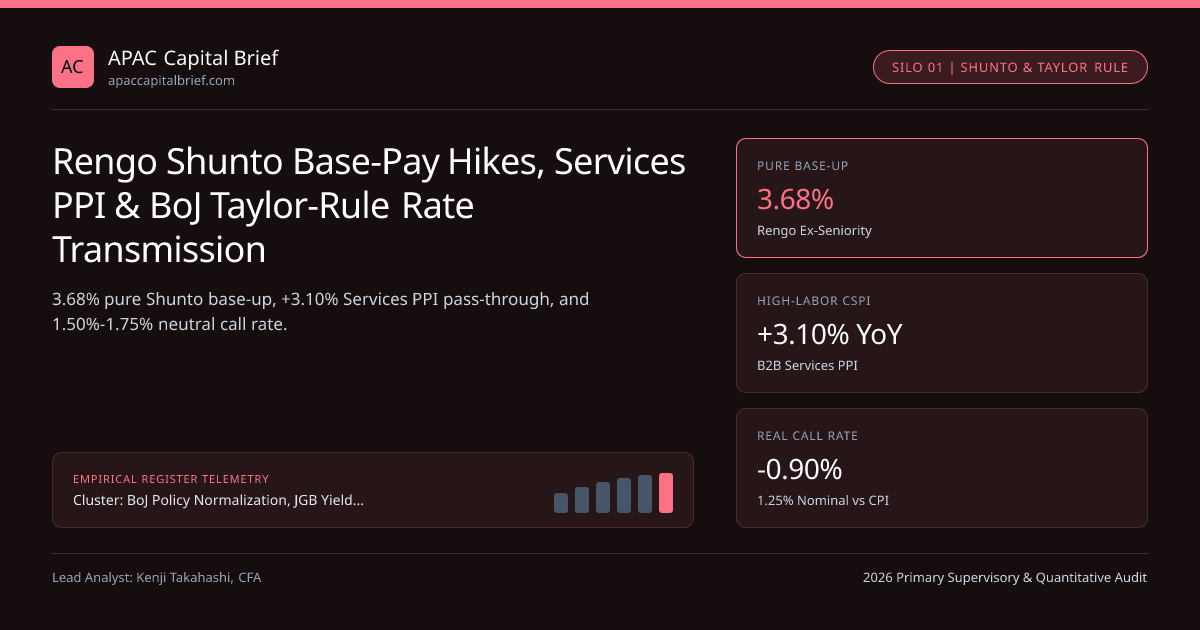
Three consecutive spring labor offensives (Shunto) led by the Japanese Trade Union Confederation (Rengo) delivering headline wage increases above 5.0%—and pure base-pay uplifts (base-up, excluding automatic ~1.65% seniority increments) of 3.62% to 3.85%—have broken Japan's post-1998 zero-norm price-setting equilibrium. For Policy Board economists calibrating the Bank of Japan 1.25% overnight call rate, the decisive confirmation metric is no longer imported energy or food CPI, but the Corporate Services Price Index (CSPI) and high-labor-share services inflation exceeding 2.8% YoY.
Dissecting Rengo Shunto Tallies: Large Caps vs SME Pass-Through#
Headline March first-round Rengo tallies reflect export-rich TSE Prime manufacturers and megabanks enjoying record yen-translated operating profits. However, roughly 69.7% of Japan's private workforce is employed at small and medium-sized enterprises (<300 employees) whose final June–July Rengo tallies and Ministry of Health, Labour and Welfare (MHLW) Monthly Labour Survey scheduled cash earnings determine aggregate household real income.
Acute demographic labor scarcity—reflected in a structural full-time job-to-applicant ratio above 1.28x across logistics, hospitality, construction, IT system integration, and healthcare—has forced SMEs to match 78%–84% of large-enterprise base-up rates to prevent employee attrition. Unlike 2014–2019, SMEs are passing those unit labor cost increases through to B2B contract renewals during April and October fiscal repricing windows.
Econometric Elasticity: Base-Pay Thresholds for 2.0% Sustainable CPI#
Given Japan's trend labor productivity growth of roughly 0.8%–1.0% per annum, macro accounting dictates that nominal scheduled wage growth of 2.8% to 3.0% YoY is structurally consistent with a 2.0% CPI target (Unit Labor Cost Growth = Nominal Wage Growth - Productivity Growth). Let's examine how key macroeconomic data feeds compare across Japan's institutional monitoring calendar:
| Macro & Market Indicator | Publishing Authority | 2026 Empirical Reading | Institutional Threshold for Additional BoJ Hike |
|---|---|---|---|
| Rengo SME Union Sub-Tally (<300 staff) | Rengo Final July Release | +4.65% Headline / +3.24% Base | Pure SME base-up holding >= 3.00% confirms broad diffusion |
| Corporate Services Price Index (CSPI) | Bank of Japan Research & Stats | +2.90% Headline / +3.10% High-Labor | High-labor-ratio services >= 2.75% across Oct/Apr repricing |
| Tokyo Ku-Area Core-Core CPI (Ex-Fresh Food & Energy) | MIC Statistics Bureau (Leading) | +2.15% YoY | Services component outpacing goods inflation for 4+ months |
| Daiwa Securities / Consensus Neutral Rate | Tokyo Sell-Side & BoJ Working Papers | -0.50% to +0.25% Real r* | Implies 1.50%–2.25% nominal terminal call rate at 2% CPI |
| Aizawa Securities Domestic Service Equity Basket | TSE Domestic Demand Cohort | +14.8% YoY Operating Margin | Pricing power exceeding wage cost growth in B2B software/rail |
Modified BoJ Policy Reaction Rate (i_target)#
- itarget = rstarreal + picoreserv + 0.5 * ( picoreserv - pitarget ) + 0.5 * Output_Gap
- Where:
- rstarreal = -0.25% (midpoint of Bank of Japan staff latent real neutral rate estimates: -1.0% to +0.5%)
- picoreserv = 2.15% (trend underlying CPI anchored by +3.10% Services PPI and +2.95% scheduled wages)
- pi_target = 2.00% (Bank of Japan price stability mandate)
- Output_Gap = +0.36% (BoJ positive macroeconomic output gap driven by labor input shortage)
- Worked Calculation:
- i_target = -0.25% + 2.15% + 0.5 * (2.15% - 2.00%) + 0.5 * (0.36%)
- = 1.90% + 0.075% + 0.18% = 2.155% unconstrained Taylor prescription
- Applying BoJ inertia smoothing (rho = 0.65 from prior 1.00%):
- i_smoothed = 0.65 * (1.00%) + 0.35 * (2.155%) = 1.404% -> supports 1.25% current & 1.50% next step
April and October Fiscal Price-Revision Seasonality#
Unlike US corporations that adjust service prices continuously across 12 calendar months, Japanese corporate procurement contracts cluster overwhelmingly on April 1 (fiscal year start) and October 1 (second-half fiscal reset). Consequently, October Tokyo Ku-area CPI—released in the final week of October, days before the Bank of Japan's Outlook Report Monetary Policy Meeting—serves as the highest-beta domestic data release for 2-year JGBs and TONA OIS swap spreads.
Equity and Bond Portfolio Positioning Around Wage-Price Persistence#
In equity portfolios, endogenous wage-led inflation favors domestic reflation beneficiaries—megabanks (examined in our megabank NIM expansion study), enterprise SaaS automating labor shortages, and commercial real estate renegotiating office rents—over low-margin retail importers. Fixed-income allocators cross-referencing our BoJ policy normalization master guide, 10Y JGBi inflation-linker analysis, and APAC macro research hub utilize 2s10s JGB flatteners ahead of October/April service repricing releases when market-implied terminal TONA discounts less than 1.60%.
Frequently asked questions
Why does the Bank of Japan focus on Shunto base-up rather than the headline 5.18% wage number?
Headline Rengo figures include automatic annual seniority increments (teiki shokyu) of ~1.50%–1.65% that leave a firm total wage bill unchanged as older workers retire; only pure base-pay revisions (base-up) raise economy-wide unit labor costs.
What nominal wage growth rate is required to sustain 2.0% inflation in Japan?
With trend Japanese labor productivity expanding roughly 0.8%–1.0% annually, contractual scheduled cash earnings must grow 2.8%–3.0% YoY so unit labor costs advance at ~2.0% in line with the inflation mandate.
Why are April and October Tokyo CPI prints disproportionately important for BoJ rate hikes?
Japanese corporations overwhelmingly reset annual and semi-annual service and B2B procurement prices at the start of fiscal H1 (April 1) and fiscal H2 (October 1), making those two releases the primary gauges of wage pass-through.
What is the Bank of Japan estimate of Japan nominal neutral interest rate (r*)?
Bank of Japan staff working papers estimate Japan latent real neutral rate between -1.0% and +0.5%, which—combined with 2.0% inflation—implies a nominal neutral overnight call rate range of 1.00% to 2.50% (consensus cluster 1.50%–1.75%).
Publication record
- Published
- 15 November 2026
- Updated
- 15 November 2026
- Author
- Kenji Takahashi, CFA
- Review
- Review not recorded
- Automated fact check
- Passed in the stored pipeline record
- Source URLs
- 3 recorded
AI assistance recorded: anthropic/claude-opus-4.6. This field does not establish human review or source verification.
Academic & Institutional Attribution
Cite This Research & Embed Live Data Card
Standard academic & institutional research paper citation format.
Kenji Takahashi, CFA. (2026, November 14). Rengo Shunto Base-Pay Hikes, Services PPI & BoJ Taylor-Rule Rate Transmission. APAC Capital Brief. https://apaccapitalbrief.com/dispatches/rengo-shunto-wage-hikes-boj-service-ppi-taylor-transmissionRegulatory Directory Cross-Reference
Referenced Institutions & Regulatory Registries
Mentioned Regulated Institutions
Primary Tier-1 Supervisory Registries
Related Boj Jgb Curve Yen Repatriation & Institutional Briefings
Explore Boj Jgb Curve Yen Repatriation Hub (20) →Boj Jgb Curve Yen Repatriation
Bank of Japan Policy Normalization, JGB Curve Steepening & Lifer Repatriation: 2026 APAC GuideBoj Jgb Curve Yen Repatriation
TONA OIS Swap Spreads, JGB Asset Swaps & OSE Futures Cheapest-to-Deliver BasisBoj Jgb Curve Yen Repatriation
USD/JPY TONA-SOFR Cross-Currency Basis Swaps & Samurai Bond Issuance ArbitrageBoj Jgb Curve Yen Repatriation
JPY Carry-Trade Unwind VaR Cascades & Nikkei Volatility TransmissionBoj Jgb Curve Yen Repatriation
Japan GPIF JPY 258 Trillion Symmetric 25/25/25/25 Portfolio Rebalancing BandsBoj Jgb Curve Yen Repatriation
BoJ Securities Lending Facility (SLF) Fee Caps & Off-the-Run JGB Repo SqueezesBoj Jgb Curve Yen Repatriation
Japanese Regional Bank JGB Unrealized Losses & JFSA IRRBB Capital SupervisionBoj Jgb Curve Yen Repatriation
MoF Japan JGB Issuance Mix: Shortening Weighted-Average Maturity & Debt ServiceHkma Sfc Mas Wealth Hub Regimes
Northbound Bond Connect vs CIBM Direct: CMU OmniClear, DvP & FX Hedging RulesHkma Sfc Mas Wealth Hub Regimes
Northbound Swap Connect: HKEX OTC Clear, SHCH FR007 IRS & Cross-CCP MarginingHkma Sfc Mas Wealth Hub Regimes
Wealth Management Connect 2.0 (WMC 2.0): RMB 3M Quota & SFC Broker OnboardingHkma Sfc Mas Wealth Hub Regimes
HKEX Chapter 18C Specialist Technology IPOs & Southbound Stock Connect Inclusion
APAC Capital Brief Data, Benchmarks & Contributor Records
CC BY 4.0 Open Data
Open Institutional Datasets (CSV / JSON) →
Download desk-compiled quantitative series & schemas.
2026 Reference Matrix
2026 Institutional Benchmarks & Thresholds →
Statutory capital, clearing, margin & rate conventions.
Editorial Records
Authors & Review Records →
View named contributors where those records are available.
Complete Index
Master Research & Dossier Archive →
Browse all published briefings by topic pillar & date.