
Boj Jgb Curve Yen Repatriation
FX-Hedged UST & OAT Carry Erosion: Quantifying Japanese Lifer Bond Repatriation
Inverted short-to-long forward differentials keep FX-hedged 10-year US Treasuries and French OATs 300+ bps below domestic JGBs, accelerating Japanese bond repatriation across APAC markets.
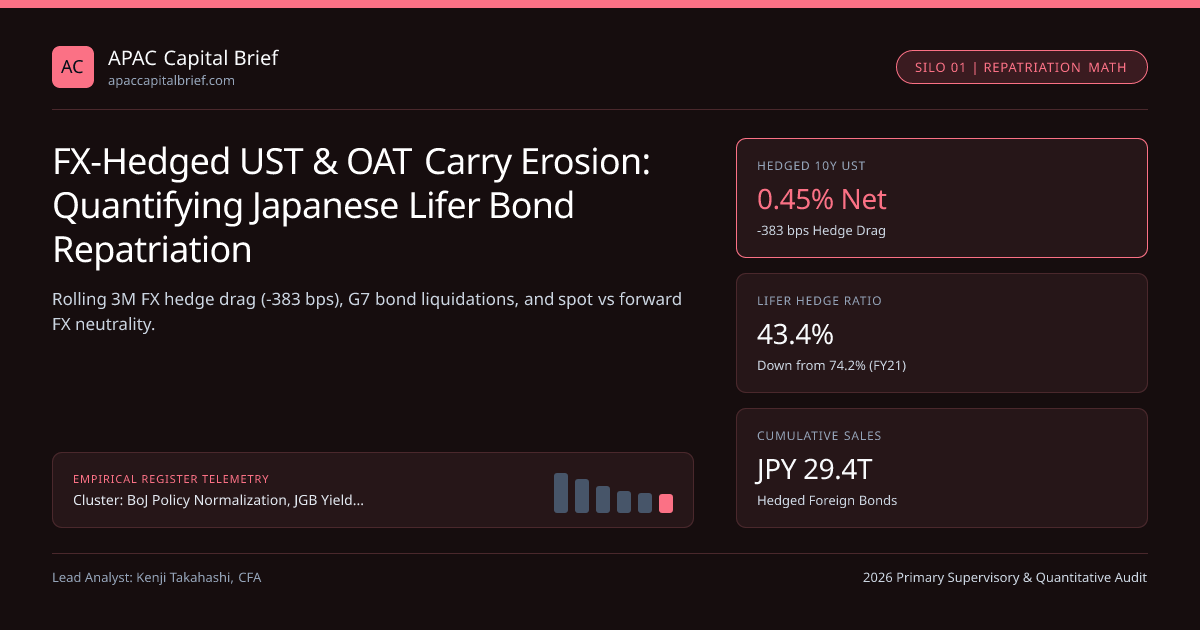
Between FY2022 and late 2026, Japanese institutional investors liquidated more than JPY 29 trillion cumulative of FX-hedged foreign sovereign debt, transforming Tokyo from the marginal buyer of G7 duration into a persistent seller on rallies. Even after Federal Reserve and ECB rate cuts trimmed peak short-rate differentials, a 1.25% Bank of Japan call rate against ~3.65%–4.75% Western money-market rates leaves rolling 3-month currency hedges consuming nearly the entire coupon of 10-year US Treasuries and French OATs—handing unhedged 10-year (2.89%) and 30-year (3.89%) JGBs an insurmountable carry advantage.
Mechanics of Rolling 3-Month FX Forward Hedge Drag#
Japanese life insurers and trust banks rarely lock in 10-year cross-currency asset swaps when buying liquid sovereign benchmarks because matching bond duration with long-dated swaps forfeits tactical liquidation flexibility. Instead, Kampo, Nippon Life, and Dai-ichi Life historically hedged 65%–80% of foreign bond principal via rolling 1-month or 3-month FX forwards (sell USD/JPY 3M forward, buy spot).
By Covered Interest Parity (CIP), the annualized cost of rolling a 3-month FX hedge equals the difference between foreign 3-month funding rates (SOFR or €STR) and Japanese 3-month TONA, magnified by any negative cross-currency basis wedge (b_ccy). Whenever the US or Eurozone yield curve is flat or modestly sloped (10Y - 3M < +95 bps) while Japan's domestic curve is steep (30Y JGB - TONA = +264 bps), hedging foreign duration destroys carry relative to staying home in yen.
Cross-Market Sovereign Carry Comparison for Tokyo Real-Money Desks#
Notice in MoF International Transactions in Securities (weekly and monthly balance-of-payments telemetry) how Japanese lifers differentiated across G10 bond markets rather than selling uniformly. French OATs and semi-core Eurozone bonds—once beloved in 2017–2021 when negative €STR created positive FX hedge pickup for yen buyers—suffered double pressure from positive ECB deposit rates and French fiscal spread volatility.
| Sovereign / Credit Sleeve | Gross Local Yield | Annualized 3M FX Hedge Cost | Net JPY Hedged Yield | Tokyo Lifer Balance-Sheet Verdict (2026) |
|---|---|---|---|---|
| 30-Year Cash JGB (JP) | 3.89% | 0.00% (Domestic JPY) | 3.89% | Core overweight via Daiwa Securities & primary auctions |
| 10-Year US Treasury (US) | 4.28% | -3.83% (SOFR-TONA + Basis) | 0.45% | Structural divestment of hedged book; trading sleeve only |
| 10-Year French OAT (FR) | 3.24% | -2.06% (€STR-TONA + Basis) | 1.18% | Heavy reduction due to fiscal OAS drift + negative carry vs 10Y JGB |
| 10-Year Australian ACGB (AU) | 4.52% | -3.21% (BBSW-TONA + Basis) | 1.31% | Selective hold via RBA/AOFM curve steepeners |
| US 30Y IG Corporate (A-Rated) | 5.64% | -3.83% (3M Roll) / Unhedged | 1.81% / 5.64% | Held primarily inside capped open-FX (unhedged) risk budgets |
Break-Even US 10Y Yield for Lifer Indifference vs 30Y JGB#
- YUST10breakeven = YJGB30 + ( rSOFR3m - rTONA3m ) + |b3m| - Deltaconvadj
- Where:
- Y_JGB30 = 3.89%
- rSOFR3m = 4.90% (assumed 3M USD OIS)
- rTONA3m = 1.25% (3M JPY OIS)
- |b_3m| = 0.18% (annualized 3M USD/JPY cross-currency basis & forward bid-offer)
- Deltaconvadj = 0.25% (duration/convexity preference adjustment for 10Y vs 30Y risk)
- Worked Calculation:
- YUST10breakeven = 3.89% + (4.90% - 1.25%) + 0.18% - 0.25%
- = 3.89% + 3.65% + 0.18% - 0.25% = 7.47%
- Unless Fed cuts collapse rSOFR3m below 2.10%, 10Y UST at 4.28% cannot compete on an FX-hedged basis.
Why Bond Repatriation Does Not Automatically Strengthen Spot USD/JPY#
A frequent macro pitfall in global FX commentary is assuming that JPY 10 trillion of Japanese lifer sales of US Treasuries creates JPY 10 trillion of spot USD selling (yen buying). That distinction hinges entirely on whether the liquidated bond was FX-hedged or unhedged (open-FX):
- Selling an FX-Hedged UST (Zero Net Spot FX Impact): When Nippon Life sells $1 billion of USTs that were already 100% hedged via a short $1 billion 3-month USD/JPY forward, it simultaneously buys back the $1 billion forward hedge against the cash bond sale proceeds. Net USD/JPY spot delta is zero; the impact lands exclusively on US Treasury term premia and 3-month FX swap basis!
- Trimming Unhedged (Open-FX) Foreign Bonds (Direct Spot Yen Buying): Only when USD/JPY approaches Ministry of Finance intervention zones (155–160) and lifers harvest FX capital gains on their 20%–30% unhedged sleeve under JFSA ESR FX-risk caps does liquidation generate outright spot yen buying.
Cross-Linkages Across Sovereign Curves and Cross-Currency Basis#
Because lifer unwinding reduces structural demand to receive JPY / pay USD in 3-month FX swaps, cross-currency basis dynamics have normalized measurably—providing cheaper dollar funding for Samurai bond arbitrageurs analyzed in USD/JPY TONA-SOFR cross-currency basis and Samurai issuance and contrasting with floating-rate credit allocations studied in Kampo and Norinchukin AAA CLO tranches versus super-long JGBs. Review our BoJ policy normalization master guide and APAC capital flow hub for weekly MoF cross-border bond telemetry thresholds.
Frequently asked questions
Why does selling FX-hedged US Treasuries fail to push USD/JPY lower in the spot FX market?
When an insurer sells $1B of FX-hedged Treasuries, it receives $1B cash from the bond buyer and delivers that exact $1B into its maturing short-USD forward hedge—leaving zero net spot currency conversion.
At what Federal Reserve rate level would FX-hedged US Treasuries become attractive to Japanese lifers again?
With 30-year JGBs near 3.89% and TONA at 1.25%, US 3-month SOFR must decline toward 2.00%–2.15% (or the US 3m10y curve must steepen past +260 bps) before FX-hedged 10Y USTs match domestic Japanese sovereign yields.
Why did Japanese insurers cut French OAT holdings aggressively alongside US Treasuries?
Once ECB policy rates turned positive above BoJ rates, Euro hedges switched from yield-enhancing to yield-draining (-206 bps), while French fiscal deficits widened OAT-Bund volatility without compensating yen buyers.
Which foreign fixed-income assets do Japanese life insurers still retain in 2026?
Lifers retain unhedged (open-FX) US investment-grade 30-year corporate bonds within strict ESR currency-risk budgets (~5.64% gross yield) and floating-rate USD AAA CLOs whose quarterly coupons reset with SOFR.
Publication record
- Published
- 15 November 2026
- Updated
- 15 November 2026
- Author
- Kenji Takahashi, CFA
- Review
- Review not recorded
- Automated fact check
- Passed in the stored pipeline record
- Source URLs
- 3 recorded
AI assistance recorded: anthropic/claude-opus-4.6. This field does not establish human review or source verification.
Academic & Institutional Attribution
Cite This Research & Embed Live Data Card
Standard academic & institutional research paper citation format.
Kenji Takahashi, CFA. (2026, November 14). FX-Hedged UST & OAT Carry Erosion: Quantifying Japanese Lifer Bond Repatriation. APAC Capital Brief. https://apaccapitalbrief.com/dispatches/fx-hedged-ust-oat-carry-erosion-japanese-lifer-repatriationRegulatory Directory Cross-Reference
Referenced Institutions & Regulatory Registries
Mentioned Regulated Institutions
Referenced Supervisory Authorities
Related Boj Jgb Curve Yen Repatriation & Institutional Briefings
Explore Boj Jgb Curve Yen Repatriation Hub (20) →Boj Jgb Curve Yen Repatriation
Bank of Japan Policy Normalization, JGB Curve Steepening & Lifer Repatriation: 2026 APAC GuideBoj Jgb Curve Yen Repatriation
Rengo Shunto Base-Pay Hikes, Services PPI & BoJ Taylor-Rule Rate TransmissionBoj Jgb Curve Yen Repatriation
TONA OIS Swap Spreads, JGB Asset Swaps & OSE Futures Cheapest-to-Deliver BasisBoj Jgb Curve Yen Repatriation
USD/JPY TONA-SOFR Cross-Currency Basis Swaps & Samurai Bond Issuance ArbitrageBoj Jgb Curve Yen Repatriation
JPY Carry-Trade Unwind VaR Cascades & Nikkei Volatility TransmissionBoj Jgb Curve Yen Repatriation
Japan GPIF JPY 258 Trillion Symmetric 25/25/25/25 Portfolio Rebalancing BandsBoj Jgb Curve Yen Repatriation
BoJ Securities Lending Facility (SLF) Fee Caps & Off-the-Run JGB Repo SqueezesBoj Jgb Curve Yen Repatriation
Japanese Regional Bank JGB Unrealized Losses & JFSA IRRBB Capital SupervisionHkma Sfc Mas Wealth Hub Regimes
MAS S$NEER Exchange-Rate Band, Appreciation Slope & SORA Bill SterilizationHkma Sfc Mas Wealth Hub Regimes
Northbound Bond Connect vs CIBM Direct: CMU OmniClear, DvP & FX Hedging RulesHkma Sfc Mas Wealth Hub Regimes
Northbound Swap Connect: HKEX OTC Clear, SHCH FR007 IRS & Cross-CCP MarginingHkma Sfc Mas Wealth Hub Regimes
Wealth Management Connect 2.0 (WMC 2.0): RMB 3M Quota & SFC Broker Onboarding
APAC Capital Brief Data, Benchmarks & Contributor Records
CC BY 4.0 Open Data
Open Institutional Datasets (CSV / JSON) →
Download desk-compiled quantitative series & schemas.
2026 Reference Matrix
2026 Institutional Benchmarks & Thresholds →
Statutory capital, clearing, margin & rate conventions.
Editorial Records
Authors & Review Records →
View named contributors where those records are available.
Complete Index
Master Research & Dossier Archive →
Browse all published briefings by topic pillar & date.