
Hkma Sfc Mas Wealth Hub Regimes
MAS Notice 637 vs HKMA Banking (Capital) Rules: Basel III Final 72.5% Output Floor & Wealth RWA
While the US and EU delayed final Basel III Endgame timelines, the Monetary Authority of Singapore (Notice 637) and HKMA implemented revised credit, operational, FRTB, and 72.5% output-floor rules on schedule across APAC markets.
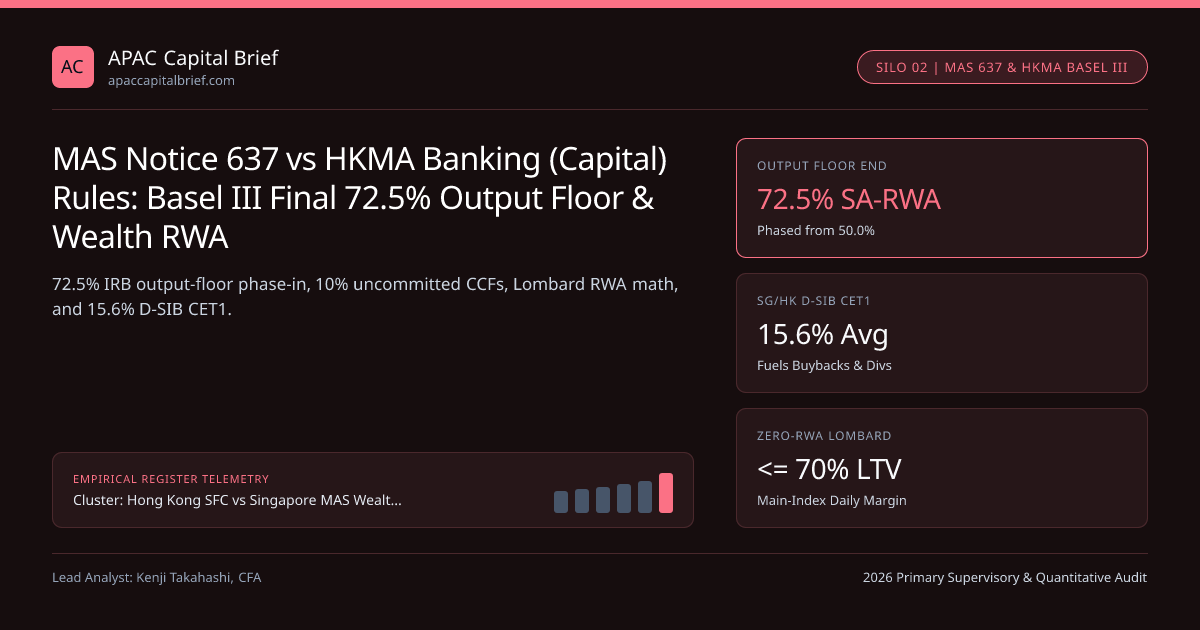
Demonstrating gold-standard prudential discipline ahead of protracted US Basel III Endgame and EU CRR3 FRTB delays, both the Monetary Authority of Singapore (MAS) (under revised MAS Notice 637) and the Hong Kong Monetary Authority (HKMA) (under the Banking (Capital) (Amendment) Rules — BCR) went live with Final Basel III Post-Crisis Reforms starting July 2024–January 2025! For DBS, OCBC, UOB, HSBC Asia, BOCHK, and Standard Chartered HK—which collectively maintain 14.8% to 17.6% CET1 ratios—the transition re-engineered Internal Ratings-Based (IRB) 72.5% Output Floor phase-ins, Fundamental Review of the Trading Book (FRTB) dealer RWA, and private-banking Lombard wealth-lending capital efficiency!
Synchronized Early Adoption With Pragmatic FRTB Capital-Reporting Sequencing#
How did MAS and HKMA implement Basel III Final Reforms without putting Singapore and Hong Kong trading floors at a competitive RWA disadvantage while New York and London delayed FRTB? Through calibrated transitional sequencing:
- Credit Risk (SA-CR & IRB), Operational Risk (SMA), and CVA Reforms: Implemented live across both MAS Notice 637 (from July 1, 2024) and HKMA BCR (from January 1, 2025). Notably, stripping internal modeling (A-IRB) from large corporates (>EUR 500M revenue) and financial institutions in favor of Foundation IRB (F-IRB) or Standardized Credit Risk (SA-CR) actually freed up transitional CET1 at Singapore's three local banks initially by removing conservative legacy 1.06x IRB scaling factors!
- 5-Year Phase-In of the 72.5% Output Floor: Total Risk-Weighted Assets (RWA) of an internal-model bank cannot fall below an escalating percentage (50% -> 55% -> 60% -> 65% -> 70% -> 72.5% by 2029/2030) of RWA computed purely under Standardized Approaches!
- FRTB Market Risk Calibration: Both authorities aligned market-risk binding capital charges vs supervisory reporting timelines pragmatically so regional derivatives desks (trading Swap Connect, FX NDFs, and equity exotics) faced zero unilateral capital cliff prior to G-SIB home-regulator convergence.
Private-Banking Impact: Why Basel III Changed UHNW Lombard Loan Structuring#
For Singapore Section 13O/13U family offices and Hong Kong FIHVs borrowing multi-currency Lombard portfolio margin lines from private banks, Basel III Final Reforms altered collateral-recognition math under the Comprehensive Approach to Credit Risk Mitigation (CRM):
- Higher Supervisory Collateral Haircuts (
H_c) on Equities & Lower-Tier Bonds: Under revised MAS Notice 637 / HKMA BCR supervisory haircut tables (10-business-day holding period baseline, scaled down to 5 business days for daily-remargined liquid Lombard facilities), main-index equities carry a 20% base haircut (vs 15% under Basel II.5) and other listed equities carry 30% (vs 25%), plus an 8% FX mismatch haircut (H_fx) whenever a client pledges USD/HKD tech stocks to borrow low-rate JPY (1.25%) or CHF/SGD (2.52%)! - Unrated UHNW SPV Counterparty Weight: If collateral value after supervisory haircuts falls below loan exposure (
E* > 0), the residual uncollateralized slice attracts a 75%–100% Standardized Risk Weight against an unrated family-office SPV—explaining why private banks aggressively discount loan spreads when clients diversify collateral across >=15 main-index constituents!
| Prudential Parameter | Singapore MAS Notice 637 (D-SIBs) | Hong Kong HKMA BCR (D-SIBs) | Balance-Sheet & Market Consequence |
|---|---|---|---|
| D-SIB Minimum CET1 + Buffers | 6.5% Base (2% above Basel 4.5%!) + 2.5% CCB + CCyB = ~9.0%–10.5%+ | 4.5% Base + 2.5% CCB + 1.0%–2.5% HLA + 0.5% CCyB = ~8.5%–10.0% | MAS embeds an explicit +200 bps D-SIB base floor directly inside Notice 637 |
| Operational Risk Model (SMA) | Standardized Measurement Approach (ILM = 1 conservative setting Option) | Standardized Measurement Approach (Business Indicator + Loss Component) | Penalizes banks with historic conduct/AML fines via Internal Loss Multiplier |
| Residential Mortgage SA-CR | Granular LTV-based Risk Weights (20% to 70%+ by LTV & cash-flow reliance) | LTV-tiered Risk Weights aligned with HKMA macroprudential LTV relaxations | Rewards <60% LTV prime Singapore/HK owner-occupied mortgages under Output Floor |
| Uncommitted Credit Lines (CCF) | 10% Credit Conversion Factor (up from 0%!) on unconditionally cancellable corporate lines | 10% CCF on uncommitted revocable corporate/brokerage facilities | Banks charge 8–15 bps commitment fees on previously "free" uncommitted broker lines (KGI / CGS-CIMB) |
Basel III Comprehensive CRM Exposure-at-Default (E*) on a Cross-Currency Private-Bank Lombard Loan#
- Estar = max( 0 , E * (1 + He) - C * (1 - Hc - Hfx) )
- RWALombard = Estar * RWunratedSFO_SPV
- Where (Family Office Borrows SGD 100M Equivalent in JPY/SGD Against US$100M [SGD 134M] Single-Tech-Stock Basket):
- Loan Exposure (E) = S$100.0M (H_e = 0 cash loan) | Collateral Market Value (C) = S$134.0M (74.6% LTV!)
- Non-Index / Concentrated Equity Haircut (H_c, scaled 5-day daily margining = 30% * sqrt(5/10)) = 21.21%
- Currency Mismatch Haircut (H_fx, USD stock vs SGD/JPY loan, scaled 5-day = 8% * sqrt(5/10)) = 5.66%
- Worked Calculation:
- Recognized Collateral After Haircuts = S$134.0M * (1 - 0.2121 - 0.0566) = S$134.0M * 0.7313 = S$97.99M
- Uncollateralized Exposure (E_star) = max( 0 , S$100.0M - S$97.99M ) = S$2.01 Million (>0 -> consumes bank CET1!)
- Lowering LTV from 74.6% to <= 70.0% (or diversifying into Main-Index 20% base stocks: Hc = 14.14%) drops Estar = S$0.00 (Zero Credit RWA)!
Why Singapore & Hong Kong Banks Turned Basel III Clarity Into Dividend Machines#
Look at the equity-market payoff of early regulatory certainty: while US and European bank boards hoarded capital awaiting final rulemaking twists, DBS, OCBC, UOB, and HSBC Asia quantified their exact fully phased-in 2029 72.5%-Output-Floor CET1 ratios (~14.8%–15.6%) two years early—unlocking multi-billion-dollar share buyback programs and 5.4%–6.8% cash dividend yields that anchored regional equity benchmarks!
Cross-Checking Broker vs Bank Capital Regimes#
Notice the interaction between bank capital (MAS Notice 637 / HKMA BCR) and securities-broker capital (SFC FRR vs MAS CMS): because uncommitted revocable credit lines now attract a 10% Credit Conversion Factor at lending banks, standalone brokerages pay 8–15 bps facility fees on standby IPO/margin liquidity lines—further rewarding capital-light HKEX FINI T+2 plumbing. Review all prudential benchmarks in our Hong Kong SFC vs Singapore MAS master guide and APAC banking dispatches.
Frequently asked questions
What is the Basel III 72.5% Output Floor under MAS Notice 637 and HKMA Banking Capital Rules?
The 72.5% Output Floor ensures that total Risk-Weighted Assets (RWA) calculated by banks using internal risk models (IRB) cannot drop below 72.5% of the RWA calculated using regulator-prescribed Standardized Approaches once fully phased in.
Why did Singapore banks report higher transitional CET1 ratios right after Basel III Final went live?
Day-one adoption removed the legacy 1.06x multiplier previously applied to all Internal Ratings-Based RWA while the Output Floor started at just 50%—temporarily boosting headline CET1 by 100–180 bps before full 72.5% floor phase-in.
How do Basel III Final Rules affect private-banking Lombard loan LTVs for family offices?
Supervisory equity haircuts rose from 15%/25% to 20%/30% (scaled down for daily margining) plus an 8% currency-mismatch haircut; keeping Lombard LTVs <=65%–70% in main-index equities lets private banks assign 0% residual credit RWA and quote tighter spreads.
Why did banks start charging commitment fees on uncommitted revocable corporate credit lines?
Under Basel II/III previously, unconditionally cancellable uncommitted credit lines carried a 0% Credit Conversion Factor (zero capital cost); Final Basel III imposed a mandatory 10% CCF, requiring banks to hold CET1 against unused standby lines.
Publication record
- Published
- 14 November 2026
- Updated
- 15 November 2026
- Author
- Kenji Takahashi, CFA
- Review
- Review not recorded
- Automated fact check
- Passed in the stored pipeline record
- Source URLs
- 3 recorded
AI assistance recorded: anthropic/claude-opus-4.6. This field does not establish human review or source verification.
Academic & Institutional Attribution
Cite This Research & Embed Live Data Card
Standard academic & institutional research paper citation format.
Kenji Takahashi, CFA. (2026, November 14). MAS Notice 637 vs HKMA Banking (Capital) Rules: Basel III Final 72.5% Output Floor & Wealth RWA. APAC Capital Brief. https://apaccapitalbrief.com/dispatches/mas-notice-637-basel-iii-output-floor-vs-hkma-capital-rulesRegulatory Directory Cross-Reference
Referenced Institutions & Regulatory Registries
Mentioned Regulated Institutions
Related Hkma Sfc Mas Wealth Hub Regimes & Institutional Briefings
Explore Hkma Sfc Mas Wealth Hub Regimes Hub (20) →Hkma Sfc Mas Wealth Hub Regimes
Hong Kong SFC vs Singapore MAS Wealth Hubs, Connect Rails & Licensing: 2026 APAC GuideHkma Sfc Mas Wealth Hub Regimes
Client Money Segregation: HK SFC Cap. 571I Rules vs Singapore MAS CMS Trust AccountsHkma Sfc Mas Wealth Hub Regimes
HK SFC Type 1/4/9 FRR Liquid Capital vs Singapore MAS CMS Risk-Based Capital RulesHkma Sfc Mas Wealth Hub Regimes
Singapore MAS Section 13O & 13U Family Office Tax Schemes: Tiered Spend & MultipliersHkma Sfc Mas Wealth Hub Regimes
Hong Kong CIES (HK$30M) & FIHV 0% Tax Concession vs Singapore GIP Option C (S$50M)Hkma Sfc Mas Wealth Hub Regimes
HKMA Linked Exchange Rate (7.75–7.85), Aggregate Balance & HIBOR-SOFR TransmissionHkma Sfc Mas Wealth Hub Regimes
MAS S$NEER Exchange-Rate Band, Appreciation Slope & SORA Bill SterilizationHkma Sfc Mas Wealth Hub Regimes
Northbound Bond Connect vs CIBM Direct: CMU OmniClear, DvP & FX Hedging RulesAPAC Semiconductor AI Capex Equities
US BIS Foreign Direct Product Rule (FDPR), HBM Export Controls & APAC WFE Servicing RiskASIC Afsl Australian Superannuation
APRA Your Future, Your Super (YFYS) -50 bps Performance Test & Benchmark-Hugging MechanicsASIC Afsl Australian Superannuation
Australian Super AUD 1.3T Offshore Equity Outflows, FX Hedge Ratios & AUD/USD Risk-On BetaASIC Afsl Australian Superannuation
RBA Ample-Reserves Corridor, Exchange Settlement (ES) Balances & Full-Allotment OMO Repo
APAC Capital Brief Data, Benchmarks & Contributor Records
CC BY 4.0 Open Data
Open Institutional Datasets (CSV / JSON) →
Download desk-compiled quantitative series & schemas.
2026 Reference Matrix
2026 Institutional Benchmarks & Thresholds →
Statutory capital, clearing, margin & rate conventions.
Editorial Records
Authors & Review Records →
View named contributors where those records are available.
Complete Index
Master Research & Dossier Archive →
Browse all published briefings by topic pillar & date.