
Hkma Sfc Mas Wealth Hub Regimes
Hong Kong SFC vs Singapore MAS Wealth Hubs, Connect Rails & Licensing: 2026 APAC Guide
Hong Kong SFC and HKMA combine Mainland Connect corridors and HK$142.6B Chapter 18C tech listings, while the Monetary Authority of Singapore deploys S$6.5B EQDP equity mandates and Section 13O/13U tax shields across APAC markets.
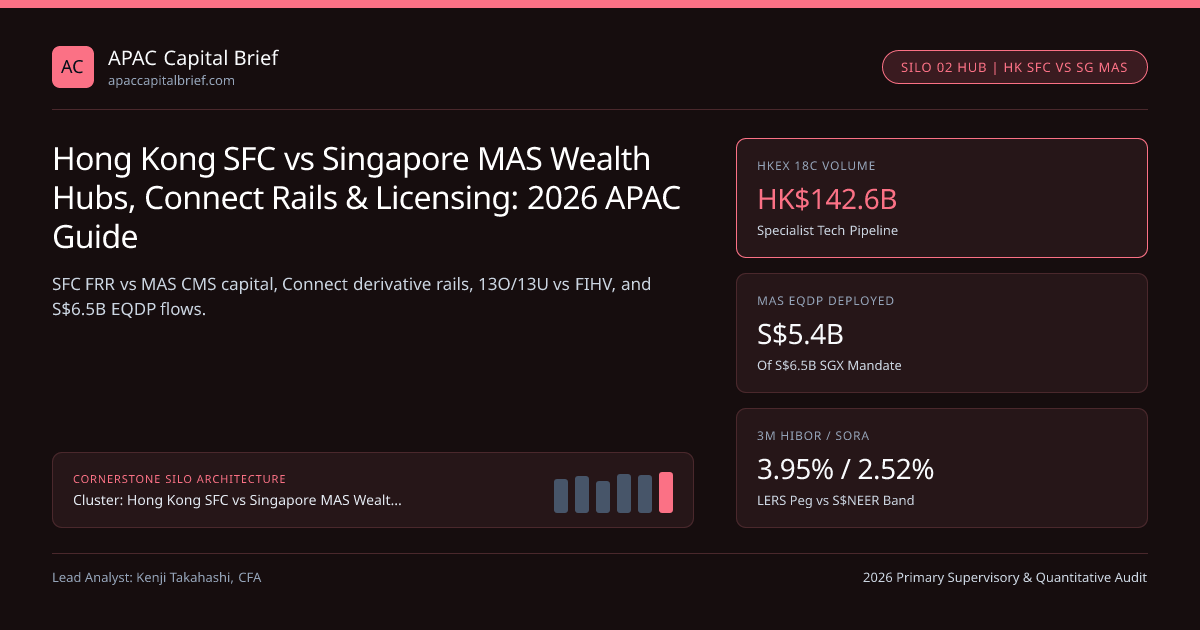
Over US$4.3 trillion in cross-border private wealth and multi-strategy hedge fund capital clears between Central and Marina Bay in 2026, yet Hong Kong and Singapore operate fundamentally complementary rather than interchangeable institutional architectures. Hong Kong—supervised jointly by the Securities and Futures Commission (SFC) and the Hong Kong Monetary Authority (HKMA)—anchors offshore renminbi clearing, PBoC Northbound/Southbound Connect derivatives, and the HK$142.6 billion HKEX Chapter 18C specialist technology IPO pipeline. Singapore—governed by the Monetary Authority of Singapore (MAS) as an integrated central bank and securities supervisor—dominates ASEAN family-office domiciliation, G10/Asian FX NDF liquidity, and active domestic equity revitalization via its S$6.5 billion Equity Market Development Programme (EQDP).
Regulatory Licensing & Prudential Capital: SFC Cap. 571N FRR vs MAS CMS#
Selecting a primary APAC booking center begins with statutory capital and senior-management substance rules. Under Hong Kong's Securities and Futures Ordinance (Cap. 571), firms apply for modular Regulated Activities—most commonly Type 1 (Dealing in Securities), Type 4 (Advising on Securities), and Type 9 (Asset Management)—backed by daily Liquid Capital calculations under Cap. 571N Financial Resources Rules (FRR). In Singapore, intermediaries obtain a Capital Markets Services (CMS) license under the Securities and Futures Act 2001 (or operate as Registered Fund Management Companies migrated into Licensed FMCs following MAS's RFMC regime repeal), subject to Base Capital and risk-based Total Risk Requirement (TRR) buffers. Our granular statutory audit on SFC Type 1/4/9 FRR liquid capital versus MAS CMS risk capital maps exact paid-up share capital floors, haircut schedules, and omnibus versus non-client-asset exemptions.
Individual senior-manager liability and client-asset custody reinforce these balance-sheet standards. Compliance officers weigh SFC Manager-In-Charge (MIC) and Responsible Officer mandates against MAS Individual Accountability and Conduct (IAC) guidelines, reconcile statutory client-money segregation under SFC Cap. 571I versus MAS CMS trust accounts, and align bank-affiliated wealth balance sheets with MAS Notice 637 Basel III output floors versus HKMA Banking Capital Rules. Where mandates extend into tokenized securities or digital payment tokens, desks navigate SFC VATP Type 1 uplifts versus MAS Payment Services Act DPT statutory trusts.
Private Wealth, Family Offices & Fund Vehicles: 13O/13U & VCC vs FIHV/CIES & OFC#
Competition for ultra-high-net-worth (UHNW) principals has shifted from headline zero-tax promises toward local capital-deployment multipliers. Singapore tightened and refined Section 13O (S$20M minimum AUM) and Section 13U (S$50M minimum AUM) under the Income Tax Act—introducing tiered local business spending and concessional capital-deployment multipliers analyzed in Singapore MAS Section 13O and 13U family office rules. For permanent-residency applicants under the Global Investor Programme, EDB Option C now mandates a strict S$50 million allocation into Singapore-listed equities, which we contrast directly with Hong Kong's HK$30 million New CIES and self-executing 0% Family-Owned Investment Holding Vehicle (FIHV) concession in Hong Kong CIES/FIHV versus Singapore GIP S$50M. At the pooled-fund level, sponsors evaluate Singapore Variable Capital Company (VCC) sub-fund ring-fencing against Hong Kong Open-Ended Fund Company (OFC) structures.
| Jurisdiction / Intermediary Cohort | Primary Regulator & Venue | Flagship 2026 Capital / Corridor Anchor | Institutional Execution Edge |
|---|---|---|---|
| KGI Asia Limited | Hong Kong SFC / HKEX | Multi-Type Dealing, Margin & Wealth Connect | Bridges Greater China HNW margin books into HKEX & US equities |
| CGS-CIMB | MAS / SGX & Regional | ASEAN Cross-Border Brokerage & EQDP Research | Deep Malaysia-Singapore-Indonesia institutional equity distribution |
| BOOM Securities | Hong Kong SFC (boom.com) | Multi-Market APAC Electronic Execution | Direct omnibus routing across HKEX, SGX, TSE, and US venues |
| CES Capital | SFC / CSRC Cross-Border | Northbound/Southbound Connect & Macro Strategy | Arbitrages A-H premia and onshore China commodity/rate futures |
| Bank of China Macau | AMCM Macao / HKMA | Greater Bay Area WMC 2.0 & Lusophone RMB | Settles Southbound Wealth Management Connect RMB 3M retail quotas |
Monetary Regimes: HKMA 7.75–7.85 Linked Exchange Rate vs MAS S$NEER Band#
Treasury and FX swap desks operating across both hubs manage two radically distinct exchange-rate regimes—neither of which sets a conventional domestic inflation-targeting policy rate!
- Hong Kong's Currency Board: Under the Linked Exchange Rate System (LERS), the HKMA guarantees USD/HKD convertibility at 7.75 (Strong-Side) and 7.85 (Weak-Side) against the Aggregate Balance (~HK$44.8B), transmitting US Federal Reserve SOFR moves mechanically into 1M/3M HIBOR with occasional IPO or seasonal squeezes—modeled in HKMA 7.75–7.85 LERS and HIBOR-SOFR transmission and offshore CNH HIBOR squeezes via the HKMA RMB Liquidity Facility.
- Singapore's BBC Exchange-Rate Policy: MAS steers the trade-weighted Singapore Dollar Nominal Effective Exchange Rate (S$NEER) within an undisclosed policy band by adjusting its slope, width, and midpoint, sterilizing FX interventions via 4-week and 12-week MAS Bills while letting Compounded SORA float endogenously—detailed in MAS S$NEER band slope and SORA sterilization.
Uncovered/Covered Interest Rate Tether Across HKMA LERS & MAS S$NEER#
- rHIBOR3m ≈ rSOFR3m + ( (FUSDHKD3m - SUSDHKD) / SUSDHKD ) * (365 / 91) - PremABscarcity
- rSORA3m ≈ rBasket3m - E[ CrawlSNEERannual ] + PremSGDliquidity
- Where (Q4 2026 Empirical Calibration):
- rSOFR3m = 4.65%, USD/HKD Spot = 7.7820, 3M Forward = 7.7685 (-135 pips HKD forward discount)
- rBasket3m (weighted USD/EUR/CNY/MYR/JPY rates) = 3.88%, MAS S$NEER Annual Appreciation Slope = +1.50%
- Worked Calculation:
- Implied 3M HIBOR = 4.65% + ( (-0.0135 / 7.7820) * 4.0110 ) = 4.65% - 0.70% = 3.95%
- Implied 3M SORA = 3.88% - 1.50% + 0.14% = 2.52% (explaining why SGD SORA structurally undercuts USD SOFR by >200 bps!)
Mainland China Connect Infrastructure & Equity Market Microstructure Reforms#
Hong Kong's irreplaceable institutional moat lies in its closed-loop settlement bridges into Mainland China's RMB 165 trillion onshore bond and equity markets, overseen alongside the People's Bank of China, CSRC, and SAFE. Fixed-income desks route onshore Chinese Government Bond (CGB) execution through Northbound Bond Connect and CIBM Direct CMU DvP rails, hedge onshore 7-day repo rate risk via Northbound Swap Connect OTC Clear–SHCH FR007 IRS margin interlinks, and distribute Greater Bay Area wealth products under Wealth Management Connect 2.0 RMB 3M broker quotas.
On the cash-equity front, both exchanges overhauled listing and settlement plumbing in 2025–2026. Hong Kong compressed IPO margin lockups to two business days via HKEX FINI T+2 settlement and uninterrupted Severe Weather Trading, narrowed currency spreads through HKD-RMB Dual Counter market-maker stamp-duty exemptions, and catalyzed hard-tech listings under HKEX Chapter 18C and Southbound Connect inclusion. Simultaneously, Singapore addressed historical cash-equity velocity headwinds by deploying MAS's S$6.5B EQDP mandate into SGX mid-caps and inaugurating the SGX–Nasdaq dual-listing bridge for S$2.0B+ APAC growth issuers (examined in Spoke 11). Cross-check intermediary license statuses across all APAC wealth-hub dispatches, our 6D compliance benchmarks, and our supervisory license verification portal.
Frequently asked questions
Why do global multi-strategy hedge funds maintain licensed offices in both Hong Kong and Singapore?
Hong Kong provides irreplaceable proximity to Greater China research, HKEX Chapter 18C IPO cornerstones, and Northbound Bond/Swap Connect rails, while Singapore houses ASEAN macro, Asian NDF FX, India/Indonesia credit, and VCC fund umbrellas.
Why are Singapore SORA interest rates consistently lower than Hong Kong HIBOR and US SOFR?
Under Covered Interest Parity, because MAS conducts monetary policy via a positively sloped (+1.5% annualized appreciation) S$NEER exchange-rate band, investors accept ~150–210 bps lower nominal SGD interest rates in exchange for expected currency appreciation.
What happened to Singapore Registered Fund Management Company (RFMC) regime?
MAS repealed the legacy RFMC notification regime in August 2024, transitioning existing RFMCs into Accredited/Institutional Licensed Fund Management Companies (A/I LFMCs) under a unified Capital Markets Services (CMS) licensing framework.
How does MAS S$6.5 Billion Equity Market Development Programme (EQDP) boost SGX liquidity?
Funded from the Financial Sector Development Fund, EQDP seeds active institutional asset managers with S$6.5B (S$5.4B deployed across 14 managers by late 2026) specifically mandated to crowd-in liquidity across SGX small- and mid-cap equities.
Publication record
- Published
- 15 November 2026
- Updated
- 15 November 2026
- Author
- Kenji Takahashi, CFA
- Review
- Review not recorded
- Automated fact check
- Passed in the stored pipeline record
- Source URLs
- 4 recorded
AI assistance recorded: anthropic/claude-opus-4.6. This field does not establish human review or source verification.
Academic & Institutional Attribution
Cite This Research & Embed Live Data Card
Standard academic & institutional research paper citation format.
Kenji Takahashi, CFA. (2026, November 14). Hong Kong SFC vs Singapore MAS Wealth Hubs, Connect Rails & Licensing: 2026 APAC Guide. APAC Capital Brief. https://apaccapitalbrief.com/dispatches/hong-kong-sfc-vs-singapore-mas-wealth-hub-connect-guideRegulatory Directory Cross-Reference
Referenced Institutions & Regulatory Registries
Mentioned Regulated Institutions
Related Hkma Sfc Mas Wealth Hub Regimes & Institutional Briefings
Explore Hkma Sfc Mas Wealth Hub Regimes Hub (20) →Hkma Sfc Mas Wealth Hub Regimes
HK SFC Type 1/4/9 FRR Liquid Capital vs Singapore MAS CMS Risk-Based Capital RulesHkma Sfc Mas Wealth Hub Regimes
Singapore MAS Section 13O & 13U Family Office Tax Schemes: Tiered Spend & MultipliersHkma Sfc Mas Wealth Hub Regimes
Hong Kong CIES (HK$30M) & FIHV 0% Tax Concession vs Singapore GIP Option C (S$50M)Hkma Sfc Mas Wealth Hub Regimes
HKMA Linked Exchange Rate (7.75–7.85), Aggregate Balance & HIBOR-SOFR TransmissionHkma Sfc Mas Wealth Hub Regimes
MAS S$NEER Exchange-Rate Band, Appreciation Slope & SORA Bill SterilizationHkma Sfc Mas Wealth Hub Regimes
Northbound Bond Connect vs CIBM Direct: CMU OmniClear, DvP & FX Hedging RulesHkma Sfc Mas Wealth Hub Regimes
Northbound Swap Connect: HKEX OTC Clear, SHCH FR007 IRS & Cross-CCP MarginingHkma Sfc Mas Wealth Hub Regimes
Wealth Management Connect 2.0 (WMC 2.0): RMB 3M Quota & SFC Broker OnboardingAPAC Semiconductor AI Capex Equities
Northeast Asia Semiconductor AI Capex, HBM4 Supply Chains & Corporate Governance: 2026 APAC GuideASIC Afsl Australian Superannuation
ASIC AFSL Supervision, APRA Superannuation Flows & RBA AUD Rates Markets: 2026 APAC GuideAsean India Sovereign Bond Inclusion
India FAR IGB Index Inclusion, RBI/SEBI Plumbing & ASEAN Local-Currency Bond Guide (2026)Boj Jgb Curve Yen Repatriation
BoJ Uncollateralized Overnight Call Rate & Reserve Tiering Mechanics at 1.25%
APAC Capital Brief Data, Benchmarks & Contributor Records
CC BY 4.0 Open Data
Open Institutional Datasets (CSV / JSON) →
Download desk-compiled quantitative series & schemas.
2026 Reference Matrix
2026 Institutional Benchmarks & Thresholds →
Statutory capital, clearing, margin & rate conventions.
Editorial Records
Authors & Review Records →
View named contributors where those records are available.
Complete Index
Master Research & Dossier Archive →
Browse all published briefings by topic pillar & date.