
Hkma Sfc Mas Wealth Hub Regimes
MAS S$NEER Exchange-Rate Band, Appreciation Slope & SORA Bill Sterilization
Executing monetary policy via a trade-weighted S$NEER exchange-rate band rather than a domestic policy rate, the Monetary Authority of Singapore anchors APAC lowest G10-peer SORA funding costs.
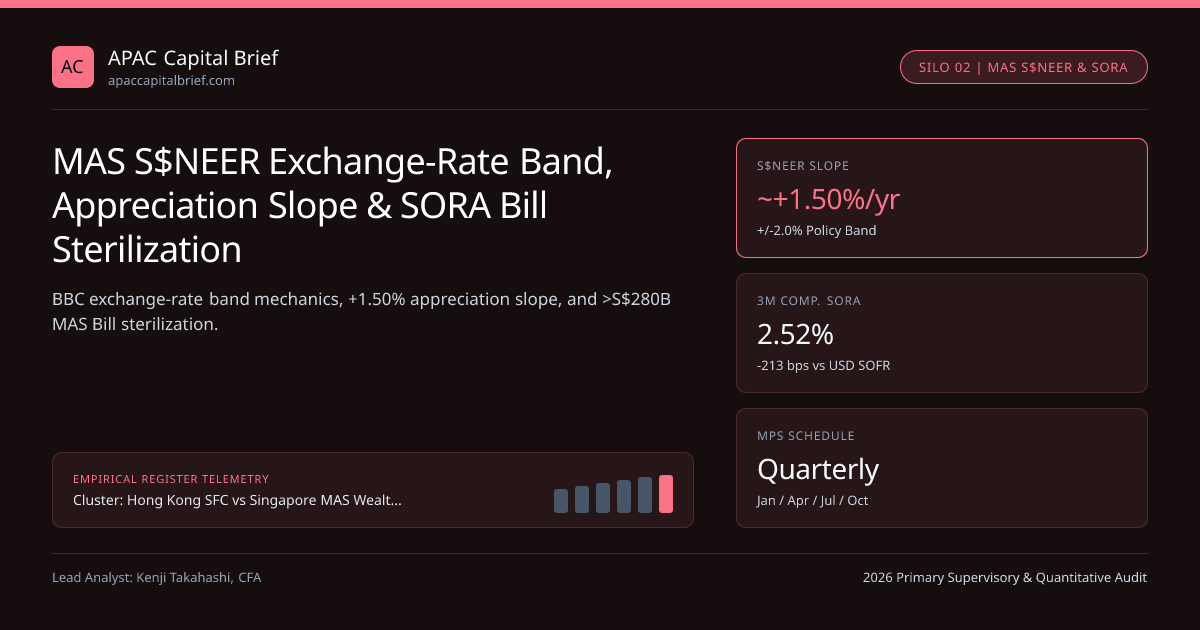
Because gross exports and imports exceed 320% of Singapore's GDP—meaning roughly 40 cents of every S$1 spent domestically goes immediately into imported goods and inputs—the Monetary Authority of Singapore (MAS) is the only developed-market central bank that uses its trade-weighted exchange rate (S$NEER) rather than a short-term interest rate as its intermediate monetary policy instrument. Operating on a quarterly Monetary Policy Statement (MPS) schedule (January, April, July, and October), MAS calibrates three parameters of its BBC (Basket, Band, Crawl) framework while leaving Singapore Overnight Rate Average (SORA) to clear endogenously via Covered Interest Parity and weekly 4-week / 12-week MAS Bill sterilization!
Inside the Three Levers of MAS S$NEER Monetary Policy#
MAS neither discloses the exact currency weights inside the S$NEER basket nor publishes the exact numerical boundaries of the band—forcing sell-side and macro desks in Marina Bay to reverse-engineer basket weights via constrained rolling OLS regressions against major trading partners (CNY ~17%, USD ~16%, MYR ~14%, EUR ~11%, JPY ~8%, TWD/KRW/IDR/INR ~34%):
- Slope of the Policy Band (Primary Cyclical Tool): Controls the annualized appreciation pace (e.g., +1.50% to +2.00% per annum during inflation-fighting regimes, or flattened by 50 bps down to +1.00%–1.50% when core inflation eases toward 1.8% and external AI/trade headwinds emerge).
- Level (Re-Centering the Midpoint): Reserved for sudden regime shifts—immediately shifting the entire band up or down to the prevailing S$NEER market level when inflation or recession shocks overwhelm gradual slope crawl.
- Width of the Band (Typically +/- 2.0% around Midpoint): Widened temporarily (e.g., to +/- 2.5% or +/- 3.0%) only during extreme global FX market dislocations when MAS wants markets to absorb higher two-way volatility without depleting FX intervention firepower.
Why MAS FX Intervention Demands Massive MAS Bill Sterilization#
Watch the money-market plumbing when global safe-haven and Section 13O/13U family-office inflows push S$NEER right up against the upper bound (+1.85% to +2.00% above midpoint) of the policy band:
- To stop S$NEER from breaking out the top of the band, MAS intervenes by selling SGD and buying foreign currency (USD).
- Left unsterilized, flooding Singapore's domestic banking system (DBS, OCBC, UOB) with freshly created SGD reserves would crash overnight SORA toward 0.50% and ignite domestic property/credit bubbles!
- Therefore, MAS drains excess SGD reserves via weekly Tuesday auctions of 4-week and 12-week MAS Bills (plus 6-month MAS Floating Rate Notes and the Overnight Standing Facility), keeping Compounded SORA anchored cleanly to Covered Interest Parity!
| Monetary / Market Instrument | Issuing / Clearing Body | 2026 Empirical Yield / Parameter | Institutional Portfolio Role |
|---|---|---|---|
| S$NEER Policy Band | Monetary Authority of Singapore | ~+1.50% Slope / +/-2.0% Band | Anchors MAS Core Inflation (ex-accommodation & private road transport) at ~1.8% |
| 4-Week & 12-Week MAS Bills | MAS Domestic Money Market | ~2.58% – 2.66% Cut-Off Yield | Institutional bank & MMF sterilization vehicle (>S$280B outstanding) |
| 6-Month Singapore T-Bills | Government of Singapore (via MAS) | ~2.62% Non-Competitive/Comp. | CPF-OA & retail wealth cash benchmark via DBS/OCBC/CGS-CIMB |
| Compounded 1M / 3M SORA | ABS / MAS Benchmark Admin | ~2.52% (vs 4.65% USD SOFR) | Prices all SGD corporate loans, mortgages & SGX REIT debt |
| Reserves Management Gov Securities (RMGS) | Singapore Government -> MAS | Non-marketable Sovereign Transfer | Transfers excess Official Foreign Reserves above S$390B seamlessly to GIC |
S$NEER Implied Spot USD/SGD Ceiling & Covered Interest Parity SORA Anchor#
- ln( SNEERt ) = Sum{i=1}^N [ wi * ln( E{i, SGD, t} ) ] where | ln(SNEERt) - ln(Midt) | <= 0.0200
- rSORA3m = rSOFR3m - E[ d ln(SGD/USD)annual ] + bUSDSGD_3m
- Where (S$NEER trading +1.80% above midpoint, leaving only +20 bps room to the +2.00% ceiling!):
- rSOFR3m = 4.65%
- Expected SGD Appreciation vs USD (Slope +1.50% + Basket Drift +0.45%) = +1.95% annualized
- 3M USD/SGD FX Swap Basis (bUSDSGD3m, flush SGD liquidity) = -0.18% (-18 bps)
- Worked Calculation:
- rSORA3m = 4.65% - 1.95% - 0.18% = 2.52% (213 bps below USD SOFR!)
- Notice the asymmetry: When S$NEER sits at +1.85% (near the +2.00% upper wall), immediate upside on SGD is capped to +15 bps until the band crawls higher at +12.5 bps/month—creating high-sharpe tactical long USD/SGD forward carry trades!
Trading the S$NEER Band Edges: Upper-Bound Fade vs Slope Flattening#
Macro FX pods run realtime S$NEER proxy trackers every 60 seconds. Whenever S$NEER reaches +1.80% to +1.95% above estimated midpoint, buying spot SGD offers terrible risk-reward because MAS intervention walls off +2.00% while shorting SGD incurs negative carry only equal to the slow +12.5 bps/month band crawl. Conversely, if an external semiconductor or ASEAN export slowdown prompts MAS to reduce the S$NEER slope by 50 bps at an April or October MPS, 1-year USD/SGD forward points immediately shift less negative by ~45–50 bps, lifting 1Y SORA OIS relative to SOFR!
Impact on SGX REITs, EQDP Mid-Caps, and Regional Treasury Pooling#
Structural 2.52% SORA rates hand Singapore S-REITs and MAS S$6.5B EQDP mid-cap equities a ~145 bps debt-refinancing advantage over Hong Kong HIBOR borrowers (compared in HKMA 7.75–7.85 LERS), while making Marina Bay the premier low-rate hub for ASEAN corporate cash pooling. Read our Hong Kong SFC vs Singapore MAS master guide and APAC monetary dispatches ahead of quarterly MAS MPS releases.
Frequently asked questions
Why does the Monetary Authority of Singapore target the exchange rate instead of interest rates?
Singapore is a small, ultra-open city-state where gross trade exceeds 320% of GDP and ~40% of consumer spending reflects imported content; managing the trade-weighted S$NEER controls inflation far more directly than domestic interest rates.
What is the difference between MAS Core Inflation and headline Singapore CPI-All Items?
MAS Core Inflation excludes private road transport (Certificate of Entitlement car-quota auctions) and accommodation (imputed owner-occupied housing rents), both of which are driven by administrative supply policies rather than monetary conditions.
What happens to Singapore SORA interest rates if MAS flattens the S$NEER appreciation slope?
Reducing the S$NEER appreciation slope lowers expected SGD appreciation against the USD; by Covered Interest Parity, investors then demand higher nominal SGD interest rates, causing 6M–1Y SORA OIS to rise relative to USD SOFR.
How did Singapore switch from semi-annual to quarterly MAS Monetary Policy Statements?
Starting in 2024, MAS doubled scheduled Monetary Policy Statements from twice yearly (April/October) to four times yearly (January, April, July, and October) to enhance communication agility amid volatile global inflation cycles.
Publication record
- Published
- 14 November 2026
- Updated
- 15 November 2026
- Author
- Kenji Takahashi, CFA
- Review
- Review not recorded
- Automated fact check
- Passed in the stored pipeline record
- Source URLs
- 3 recorded
AI assistance recorded: anthropic/claude-opus-4.6. This field does not establish human review or source verification.
Academic & Institutional Attribution
Cite This Research & Embed Live Data Card
Standard academic & institutional research paper citation format.
Kenji Takahashi, CFA. (2026, November 14). MAS S$NEER Exchange-Rate Band, Appreciation Slope & SORA Bill Sterilization. APAC Capital Brief. https://apaccapitalbrief.com/dispatches/mas-sneer-exchange-rate-band-slope-sora-bill-sterilizationRegulatory Directory Cross-Reference
Referenced Institutions & Regulatory Registries
Mentioned Regulated Institutions
Related Hkma Sfc Mas Wealth Hub Regimes & Institutional Briefings
Explore Hkma Sfc Mas Wealth Hub Regimes Hub (20) →Hkma Sfc Mas Wealth Hub Regimes
Hong Kong SFC vs Singapore MAS Wealth Hubs, Connect Rails & Licensing: 2026 APAC GuideHkma Sfc Mas Wealth Hub Regimes
Northbound Bond Connect vs CIBM Direct: CMU OmniClear, DvP & FX Hedging RulesHkma Sfc Mas Wealth Hub Regimes
Northbound Swap Connect: HKEX OTC Clear, SHCH FR007 IRS & Cross-CCP MarginingHkma Sfc Mas Wealth Hub Regimes
Wealth Management Connect 2.0 (WMC 2.0): RMB 3M Quota & SFC Broker OnboardingHkma Sfc Mas Wealth Hub Regimes
HKEX Chapter 18C Specialist Technology IPOs & Southbound Stock Connect InclusionHkma Sfc Mas Wealth Hub Regimes
Singapore MAS S$6.5B EQDP Mandate: SGX Mid-Cap Liquidity & Tax IncentivesHkma Sfc Mas Wealth Hub Regimes
SGX–Nasdaq Dual-Listing Bridge for S$2.0B+ APAC Growth Issuers: Prospectus & FungibilityHkma Sfc Mas Wealth Hub Regimes
Singapore VCC Sub-Fund Ring-Fencing vs Hong Kong Open-Ended Fund Company (OFC)APAC Semiconductor AI Capex Equities
Korea 60% Chaebol Inheritance Tax, Split-Listings & Commercial Act Article 382-3 ReformAPAC Semiconductor AI Capex Equities
Taiwan Life Insurer US$760B FX Hedging: TWD Offshore NDF Spikes, CS Swaps & Proxy ShortsAPAC Semiconductor AI Capex Equities
Japan Semiconductor WFE Monopolies: Tokyo Electron, Advantest, Lasertec & Disco AI Margin PowerAPAC Semiconductor AI Capex Equities
TSMC Kumamoto JASM & Rapidus Hokkaido: METI Semiconductor Subsidies & Megabank Project Finance
APAC Capital Brief Data, Benchmarks & Contributor Records
CC BY 4.0 Open Data
Open Institutional Datasets (CSV / JSON) →
Download desk-compiled quantitative series & schemas.
2026 Reference Matrix
2026 Institutional Benchmarks & Thresholds →
Statutory capital, clearing, margin & rate conventions.
Editorial Records
Authors & Review Records →
View named contributors where those records are available.
Complete Index
Master Research & Dossier Archive →
Browse all published briefings by topic pillar & date.