
ASIC Afsl Australian Superannuation
ASX CHESS Replacement via TCS BaNCS (2026–2029) & Australia T+1 Equity Settlement Roadmap
After writing off AUD 250M on its abandoned blockchain experiment, ASX is deploying TCS BaNCS across Release 1 (2026) and Release 2 (2029) under joint ASIC and RBA supervision.
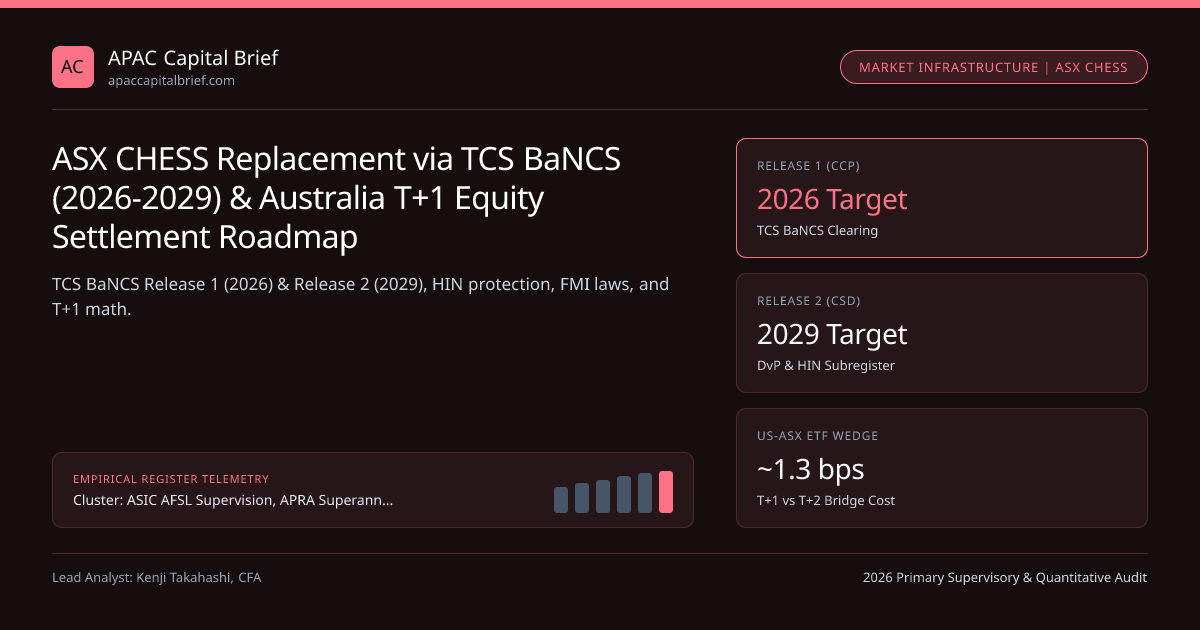
After writing off AUD 250+ million in late 2022 on its failed seven-year Distributed Ledger Technology (blockchain) post-trade rewrite—and subsequently facing a landmark ASIC Federal Court enforcement lawsuit plus special Reserve Bank of Australia (RBA) Financial Stability Standards audits following a December 2024 CHESS batch-settlement incident—ASX Limited pivoted to a proven modular vendor platform: Tata Consultancy Services' TCS BaNCS for Market Infrastructure (the exact engine powering post-trade clearing in Canada, Finland, and major global CSDs!). For institutional global custodians, prime brokers, and APAC execution desks comparing Sydney against North America's T+1 shift and HKEX FINI, ASX's staged Release 1 (2026) -> Release 2 (2029) architecture dictates whether Australia can compress cash equity settlement from T+2 to T+1 before 2030.
Staged Cutover: Decoupling Release 1 (Clearing, 2026) From Release 2 (Settlement & Subregister, 2029)#
Why did the original blockchain project collapse? Because ASX tried to replace central-counterparty clearing, Delivery-versus-Payment (DvP) batch settlement, AND Australia's unique direct-name-on-register Holder Identification Number (HIN) subregister in a single "Big Bang" weekend! Under intense oversight from the ASIC–RBA Joint Supervisory Team and the CHESS Replacement Technical Committee, ASX split TCS BaNCS deployment into two decoupled phases:
- Release 1 — ASX Clear Cash Equity Clearing (
Targeted 2026 Go-Live): Replaces ONLY the central-counterparty (CCP) clearing, real-time trade registration, and margin/novated risk engine using ISO 20022 messaging—requiring minimal disruption for share registries and retail brokers because legacy CHESS continues handling back-end settlement and HIN subregisters transiently! - Release 2 — Settlement, DvP Batch & Electronic Subregister (
Targeted 2029 Go-Live): Migrates Austraclear/RBA RITS interbank DvP batch settlement, corporate actions, mFund/ETF creation-redemption plumbing, and Australia's 6+ million retail CHESS-sponsored HIN accounts onto modern ISO 20022 APIs.
Why Australia's Time Zone (UTC+10 / UTC+11) Makes T+1 Harder for Foreign Funds Than New York!#
When the United States and Canada moved to T+1 in May 2024 (and the UK, EU, and Switzerland scheduled October 11, 2027 for T+1!), why didn't ASX immediately jump to T+1 in 2025? Two massive structural differences explored in ASX's T+1 Whitepaper:
- Legacy CHESS Freeze Until 2029: Modifying 30-year-old COBOL-era CHESS code to compress batch cutoffs while simultaneously building TCS BaNCS Release 2 risked catastrophic settlement outages; ASX and industry participants overwhelmingly prioritized stabilizing legacy CHESS + completing TCS BaNCS first (targeting ~2030 T+1)!
- The GMT+10 Time-Zone & CLS FX Settlement Squeeze: When a Boston or London pension fund buys BHP or CBA shares at the 16:10 AEST ASX closing auction on Monday (
06:10 London / 01:10 New York), under T+1 its custodian must match trade allocations, borrow/convert AUD via CLS Bank (whose FX settlement cutoffs exclude T+0/T+1 cross-border legs!), and fund Sydney RITS cash before Tuesday 11:30 AEST (Monday 20:30 New York!)—leaving barely 14 working hours overnight!
| Post-Trade Dimension | Current Legacy ASX CHESS (T+2) | TCS BaNCS Release 1 & 2 + T+1 Target | Institutional Custodian / Broker Impact |
|---|---|---|---|
| Messaging Protocol | Proprietary 1990s CHESS EIS fixed-length messages | Global standard ISO 20022 + FIX real-time APIs | Eliminates bespoke Australian middleware tax for global prime brokers |
| Share Ownership Model | Direct HIN (Holder Identification Number) legal title + Issuer Sponsored (SRN) | Retains investor-beloved HIN legal safety while adding modern omnibus efficiency | Preserves Australia's zero-broker-insolvency equity loss protection for SMSFs |
| CCP Margin Savings (T+1) | 2-day Value-at-Risk margin period of risk at ASX Clear | T+1 cuts ASX Clear participant default fund & initial margin by ~25%–35%! | Frees hundreds of millions in broker RG 166 / clearing capital (ACE / institutional peers) |
| Dual-Listed ETF & ADR Misalignment | US & Indian markets settle T+1 while ASX ETFs holding S&P 500 settle T+2! | ASX ETF market makers currently finance a 1-day cash/FX funding bridge on US creations! | Moving ASX to T+1 eliminates the US-AU ETF creation funding spread |
Overnight Cross-Border T+1 Funding & CLS FX Cut-Off Window Compression#
- AvailableAffirmationHours (T+2) = (43.3 hours from Mon 16:10 AEST Trade -> Wed 11:30 AEST Batch DvP)
- AvailableAffirmationHours (T+1) = (19.3 hours total; ONLY ~6.5 US/UK overlapping business hours!)
- ETF Market-Maker T+1 vs T+2 Funding Bridge Drag on ASX-Listed S&P 500 ETFs (Current Regime):
- CreationBridgeCostbps = ( rSOFR_overnight * (1 / 360) ) * 10000
- At r_SOFR = 4.65%: Market maker creating an ASX-listed US ETF pays T+1 USD cash in New York while receiving T+2 AUD cash in Sydney ->
- 1-day financing wedge = 4.65% / 360 = 1.29 bps built directly into ASX international ETF creation/redemption spreads!
Global Equity Settlement Cycle Roadmap: T+1 vs T+2 (2026–2030)#
Regulatory Teeth: Competition in Cash-Equity Clearing & RBA FSS Audits#
Following ASX's governance missteps, Parliament passed the Treasury Laws Amendment (Financial Market Infrastructure and Other Measures) Act 2024, empowering RBA with crisis step-in powers over clearing/settlement facilities and empowering ASIC to enforce competitive access rules so rival venues like Cboe Australia aren't held hostage by monopoly post-trade bottlenecks! Pair this infrastructure deep-dive with APRA CPS 230 operational resilience rules, ASIC RG 166 broker capital, and our Australia ASIC, APRA & AUD rates hub, or explore all APAC market-plumbing dispatches.
Frequently asked questions
What is a CHESS HIN (Holder Identification Number) and why do Australian investors defend it fiercely?
Unlike US/UK street-name omnibus brokerage where shares sit pooled in a broker nominee name, an Australian CHESS HIN registers legal share ownership directly in the individual investor name at ASX—meaning if a stockbroker goes bankrupt, client shares are 100% untouched.
Why did ASX split TCS BaNCS deployment into 2026 (Release 1) and 2029 (Release 2)?
Decoupling central-counterparty clearing (Release 1) from DvP settlement and 6.2M+ HIN registry interfaces (Release 2) eliminates single-weekend "Big Bang" systemic risk across dozens of share registries, custodians, and retail brokers.
Why did ASIC sue ASX Limited in the Federal Court in 2024?
ASIC alleged ASX made misleading and deceptive public statements in early 2022 claiming its blockchain CHESS replacement was "on-track for go-live" when internal testing showed severe scalability and latency defects prior to its AUD 250M write-off.
How does the US T+1 settlement cycle affect Australian ETFs that hold US stocks?
When an Authorized Participant creates new units of an ASX-listed S&P 500 ETF on Monday, it must deliver USD cash to settle underlying US shares on Tuesday (T+1) while waiting until Wednesday (T+2) to receive AUD proceeds from ASX buyers, adding ~1.3 bps of financing cost.
Publication record
- Published
- 13 November 2026
- Updated
- 16 November 2026
- Author
- Kenji Takahashi, CFA
- Review
- Review not recorded
- Automated fact check
- Passed in the stored pipeline record
- Source URLs
- 3 recorded
AI assistance recorded: anthropic/claude-opus-4.6. This field does not establish human review or source verification.
Academic & Institutional Attribution
Cite This Research & Embed Live Data Card
Standard academic & institutional research paper citation format.
Kenji Takahashi, CFA. (2026, November 16). ASX CHESS Replacement via TCS BaNCS (2026–2029) & Australia T+1 Equity Settlement Roadmap. APAC Capital Brief. https://apaccapitalbrief.com/dispatches/asx-chess-replacement-tcs-bancs-t-plus-1-settlement-scopeRelated ASIC Afsl Australian Superannuation & Institutional Briefings
Explore ASIC Afsl Australian Superannuation Hub (20) →ASIC Afsl Australian Superannuation
ASIC AFSL Supervision, APRA Superannuation Flows & RBA AUD Rates Markets: 2026 APAC GuideASIC Afsl Australian Superannuation
APRA SPS 530 Unlisted Asset Governance: Out-of-Cycle Revaluations & Member Switching ArbitrageASIC Afsl Australian Superannuation
AUD/USD BBSW–SOFR Cross-Currency Basis Swaps, Big-4 Offshore Debt & Kangaroo Bond ArbitrageASIC Afsl Australian Superannuation
AUSTRAC AML/CTF Amendment Act (2026 Rollout): Tranche-2 Gatekeepers & VASP Travel RuleASIC Afsl Australian Superannuation
ASIC Crypto AFSL Enforcement, Block Earner Precedents & INFO 225 Digital Asset Platform RulesASIC Afsl Australian Superannuation
Australian Non-Bank RMBS Issuance, Warehouse Facility Mechanics & APRA APS 120 SecuritisationASIC Afsl Australian Superannuation
RBNZ OCR vs RBA Cash Rate Divergence: AUD/NZD Cross, BKBM–BBSW & Trans-Tasman Mortgage TransmissionASIC Afsl Australian Superannuation
Australia Mandatory AASB S2 Climate Reporting (Group 1 & 2), Scope 3 Safe Harbor & ASIC Greenwashing SuitsAsean India Sovereign Bond Inclusion
Vietnam SSC Circular 68 Non-Prefunding (NPF), KRX Engine & FTSE Emerging Market UpgradeAsean India Sovereign Bond Inclusion
Bank of Thailand 89% Household Debt Overhang, Gold-Trade THB FX Beta & ThaiGB Curve FlatteningAsean India Sovereign Bond Inclusion
Philippines BSP Reserve Requirement (RRR) Cuts to 5%, 28-Day BSP Bills & Retail Treasury BondsAsean India Sovereign Bond Inclusion
Asian NDF vs Onshore Deliverable Forward (DF) Arbitrage: INR, IDR, PHP, KRW & TWD Basis Wedges
APAC Capital Brief Data, Benchmarks & Contributor Records
CC BY 4.0 Open Data
Open Institutional Datasets (CSV / JSON) →
Download desk-compiled quantitative series & schemas.
2026 Reference Matrix
2026 Institutional Benchmarks & Thresholds →
Statutory capital, clearing, margin & rate conventions.
Editorial Records
Authors & Review Records →
View named contributors where those records are available.
Complete Index
Master Research & Dossier Archive →
Browse all published briefings by topic pillar & date.