
Asean India Sovereign Bond Inclusion
Philippines BSP Reserve Requirement (RRR) Cuts to 5%, 28-Day BSP Bills & Retail Treasury Bonds
Slashing bank Reserve Requirement Ratios from 9.5% toward 5.0%, Bangko Sentral ng Pilipinas unlocked PHP 650B+ in domestic bond demand while sterilizing via 28-day BSP Bills.
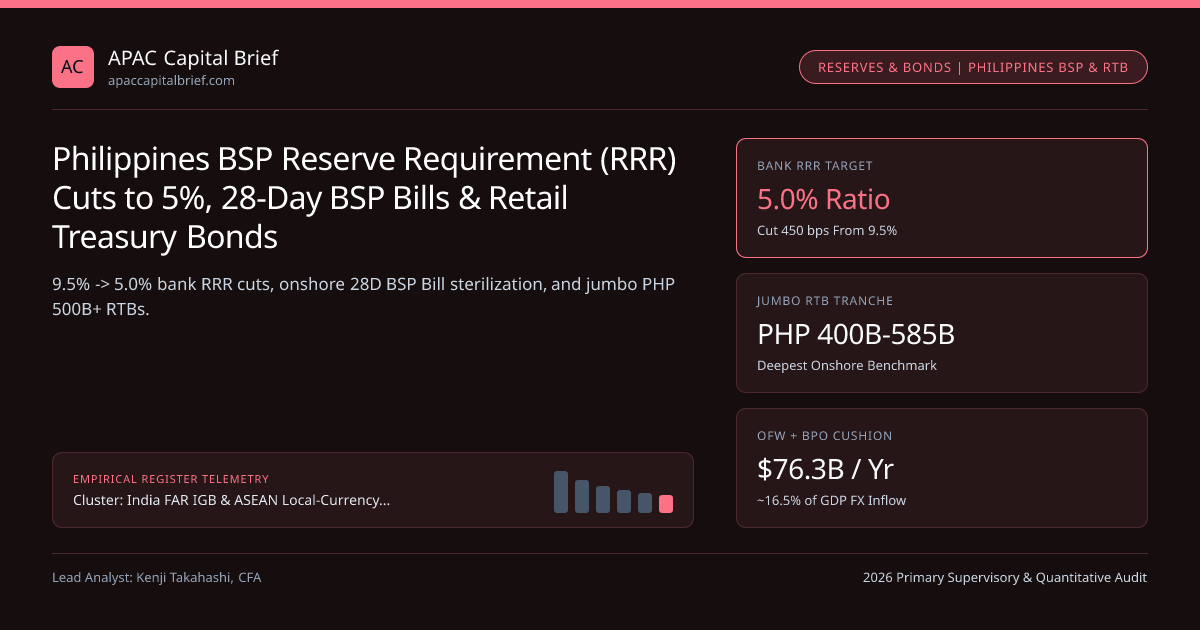
For decades, universal and commercial banks in Manila operated under the most punitive statutory Reserve Requirement Ratio (RRR) in all of Asia (sitting at 20.0% in 2018 and still 9.5% entering Q4 2024—compared with 4.0% in Malaysia, 3.0% in Singapore, and 4.5% in India!), forcing Philippine banks (BDO, BPI, Metrobank, LandBank) to park trillions of Pesos in 0.0%-interest statutory vault reserves at the central bank! Between October 2024 and 2026, Governor Eli Remolona's Bangko Sentral ng Pilipinas (BSP) executed a landmark multi-step structural overhaul: slashing universal/commercial bank RRR by 250 bps from 9.5% to 7.0% (October 2024) and again by 200 bps to 5.0% (effective March 28, 2025)—injecting PHP 650 billion to PHP 780 billion (~US$11.5B–$13.5B) of unremunerated bank cash directly into the Philippine money market and RPGB (Republic of the Philippines Peso Government Bond) curve!
How BSP Cuts Bank RRR by 450 bps Without Igniting Peso Inflation: The 28-Day BSP Bill!#
Naive macro commentators often confuse a Reserve Requirement Ratio (RRR) cut with an overnight Target Reverse Repo (RRP) policy rate cut. Under BSP's modernized Interest Rate Corridor (IRC) framework, RRR cuts are structural financial-intermediation reforms (narrowing Philippine bank net-interest-margin tax friction), sterilized cleanly at the front end through two market-based monetary tools:
- Weekly 28-Day and 56-Day BSP Securities (
BSP Bills / BSPB) Auctions: Whenever an RRR cut frees PHP 330B–400B of cash, BSP scales up its Friday 28-day and 56-day BSP Bill auctions and Overnight RRP variable-rate auctions (eligible strictly for onshore banks and trust entities—foreigners are barred from buying BSP Bills directly so hot money cannot game BSP sterilization!). - Belly-of-the-Curve RPGB Bid (
3Y–7Y Fixed Rate Treasury Notes — FXTNs): Whatever freed PHP liquidity Philippine banks don't place in 28-day BSP Bills or corporate loans flows straight into Bureau of the Treasury (BTr) 3-year, 5-year, and 7-year FXTNs and Retail Treasury Bonds (RTBs)—bull-steepening the Peso sovereign curve!
Onshore RPGBs vs Jumbo RTBs vs USD ROPs: Foreign Tax & Index-Inclusion Roadmap#
Why was the Philippines historically absent from JPMorgan's flagship local-currency GBI-EM Global Diversified Index (despite sovereign BBB+/Baa2 credit ratings stronger than several existing constituents!), and how did BTr + BSP rebuild foreign access between 2024 and 2026? The historical culprit was 20% final withholding tax + awkward BIR tax-treaty paperwork + fragmented ISIN liquidity:
| Philippine Sovereign Instrument | Target Investor Cohort | Settlement & Tax Treatment (2026) | Yield & Liquidity Profile |
|---|---|---|---|
Fixed Rate Treasury Notes (FXTNs / RPGBs) | Domestic banks, trusts, insurers & returning foreign EM funds | NRosS (National Registry of Scripless Securities) + Euroclear bridge; 20% base WHT reduced to 10%–15% at source via streamlined BTr/BIR treaty tags! | 5.85% – 6.25% gross (~5.0%–5.3% net post-15% treaty WHT); placed on JPMorgan GBI-EM Watchlist radar! |
Retail Treasury Bonds (RTB 30 / RTB 31) | Philippine households (min PHP 5,000 via GCash/PDAX/Banks!) + domestic bank treasuries | Quarterly coupons; single-tranche size PHP 400B–585B (~$7B–$10B!) makes benchmark RTBs the most liquid points on the Peso curve! | Trades 3–8 bps tighter than off-the-run FXTNs due to superior two-way dealer depth |
28-Day & 56-Day BSP Bills (BSPB) | Strictly onshore banks & trust departments (Foreigners prohibited!) | Zero credit risk; priced tightly at +5 to +15 bps over BSP Target RRP | Sterilizes RRR cuts without attracting volatile offshore hot-money carry trades |
USD Sovereign Global Bonds (ROPs) | Global IG/EM hard-currency bond funds & Asian private banks | Euroclear / Clearstream USD; 0% Philippine withholding tax! | Tight +85 to +115 bps over US Treasuries thanks to sticky onshore Philippine bank USD deposit bids! |
Quantitative Bank Net-Interest-Margin (NIM) Release & OFW Remittance FX Cushion#
- ImplicitRRRTaxDrag (bps) = [ RRRRatio / (1 - RRRRatio) ] * rDepositCostPHP
- At 2018 RRR (20.0%) & 4.0% Time Deposit Cost: Implicit Tax = (0.20 / 0.80) * 4.00% = 100.0 bps funding penalty!
- At 2025–2026 RRR (5.0%) & 4.0% Deposit Cost: Implicit Tax = (0.05 / 0.95) * 4.00% = 21.1 bps (-78.9 bps structural relief!)
- Foreign Investor Net Peso Yield & Structural USD Current-Account Buffer:
- YRPGBNetPHP = Y10YFXTN (6.15%) * ( 1 - tauDTAA_15% ) = 5.228% Net Peso Yield
- Structural USD Inflow Floor = Cash_ + PersonalOFWRemittances (~$38.3B/yr) + ITBPMService_Exports (~$38.0B/yr) = ~$76.3B/yr (~16.5% of Philippine GDP!)
Bangko Sentral ng Pilipinas (BSP) RRR Modernization Trajectory#
Watching PHP 59.00: How BSP Manages USD/PHP & Offshore Peso NDFs#
Just like the RBI in Mumbai and Bank Indonesia in Jakarta, BSP actively smooths abrupt moves near psychological USD/PHP thresholds (notably the PHP 59.00/USD resistance zone)—backed by >US$106 billion in gross international reserves (~7.8 months of import cover) and December seasonal Overseas Filipino (OFW) remittance surges! Because onshore USD/PHP forward buying by non-residents requires documented peso asset exposure (Bangko Sentral FX Manual), offshore macro funds price risk through 1M–3M USD/PHP NDFs settled against the Bankers Association of the Philippines (BAP) spot fix—analyzed directly next in Asian NDF vs onshore deliverable forward CIP basis wedges alongside Bank Indonesia SRBI sterilization! Return to our India FAR & ASEAN bond inclusion hub or explore ASEAN sovereign debt dispatches.
Frequently asked questions
Does cutting the Philippine Reserve Requirement Ratio (RRR) to 5.0% automatically mean an aggressive monetary easing stance?
No. BSP treats RRR reductions as structural efficiency reforms removing an implicit intermediation tax on bank deposits; BSP simultaneously drains excess liquidity via 28-day/56-day BSP Bills to keep overnight rates aligned with its Target RRP policy rate.
Can foreign hedge funds buy high-yielding 28-day BSP Bills like they buy Bank Indonesia SRBIs?
No! Unlike Bank Indonesia SRBI bills (which explicitly court foreign portfolio buyers), BSP restricts 28-day and 56-day BSP Securities strictly to onshore banks and trust entities, channeling foreign bond investors into BTr sovereign FXTNs and RTBs instead.
Why are Philippine Retail Treasury Bonds (RTBs) heavily traded by institutional banks despite the "Retail" name?
While RTBs allow Filipinos to invest from PHP 5,000 via apps like GCash, BTr also accepts massive institutional bank tenders and bond switches—creating PHP 400B–585B ($7B–$10B) mega-tranches with the tightest secondary bid-ask spreads on the Peso curve.
How was the 20% Philippine withholding tax hurdle modernized for foreign sovereign bond investors?
BTr, BSP, and the Bureau of Internal Revenue streamlined NRoSS tax-treaty tagging so eligible foreign institutional investors from treaty jurisdictions (10% or 15% DTAA rate) receive reduced withholding upfront at coupon payment without multi-year refund filings.
Publication record
- Published
- 13 November 2026
- Updated
- 15 November 2026
- Author
- Kenji Takahashi, CFA
- Review
- Review not recorded
- Automated fact check
- Passed in the stored pipeline record
- Source URLs
- 3 recorded
AI assistance recorded: anthropic/claude-opus-4.6. This field does not establish human review or source verification.
Academic & Institutional Attribution
Cite This Research & Embed Live Data Card
Standard academic & institutional research paper citation format.
Kenji Takahashi, CFA. (2026, November 14). Philippines BSP Reserve Requirement (RRR) Cuts to 5%, 28-Day BSP Bills & Retail Treasury Bonds. APAC Capital Brief. https://apaccapitalbrief.com/dispatches/philippines-bsp-rrr-cuts-28-day-bills-rtb-sovereign-curveRegulatory Directory Cross-Reference
Referenced Institutions & Regulatory Registries
Mentioned Regulated Institutions
Referenced Supervisory Authorities
Related Asean India Sovereign Bond Inclusion & Institutional Briefings
Explore Asean India Sovereign Bond Inclusion Hub (20) →Asean India Sovereign Bond Inclusion
India FAR IGB Index Inclusion, RBI/SEBI Plumbing & ASEAN Local-Currency Bond Guide (2026)Asean India Sovereign Bond Inclusion
Asian NDF vs Onshore Deliverable Forward (DF) Arbitrage: INR, IDR, PHP, KRW & TWD Basis WedgesAsean India Sovereign Bond Inclusion
Malaysia GII Sukuk vs MGS Spreads, Commodity Murabahah Mechanics & Labuan IBFC Wakalah TrustsAsean India Sovereign Bond Inclusion
India Overnight Money Markets: CCIL TREPS Tri-Party Repo, FBIL MIBOR OIS & RBI VRR AuctionsAsean India Sovereign Bond Inclusion
Indonesia UU P2SK Financial Omnibus Law: January 2025 Crypto & Derivatives Shift From Bappebti to OJK & BIAsean India Sovereign Bond Inclusion
Singapore EDB Finance & Treasury Centre (FTC) 8% Tax Incentive, Pillar Two & ASEAN Trapped-Cash SweepsAsean India Sovereign Bond Inclusion
JPMorgan GBI-EM 10% India FAR Cap, FTSE EMGBI Entry & Onshore NDS-OM / CCIL SettlementAsean India Sovereign Bond Inclusion
CCIL QCCP Supervisory Standoff: ESMA vs Bank of England Recognition & European Bank RWA ImpactMonetary Policy
Monetary Base and the Bank of Japan's Transactions (Oct.)Monetary Policy
Market Operations by the Bank of Japan (Oct.)Monetary Policy
Japanese Government Bonds Held by the Bank of JapanMarket Insights
(IMES Newsletter) 2026 BoC - Philadelphia Fed - BOJ Joint Workshop
APAC Capital Brief Data, Benchmarks & Contributor Records
CC BY 4.0 Open Data
Open Institutional Datasets (CSV / JSON) →
Download desk-compiled quantitative series & schemas.
2026 Reference Matrix
2026 Institutional Benchmarks & Thresholds →
Statutory capital, clearing, margin & rate conventions.
Editorial Records
Authors & Review Records →
View named contributors where those records are available.
Complete Index
Master Research & Dossier Archive →
Browse all published briefings by topic pillar & date.