
Asean India Sovereign Bond Inclusion
ASEAN Local Currency Transaction (LCT) Framework, ACCD FX Dealers & BIS Project Nexus QR Rails
Bypassing USD correspondent triangulation, ASEAN Local Currency Transaction (LCT) bank networks and Singapore-headquartered Project Nexus rewire cross-border APAC FX.
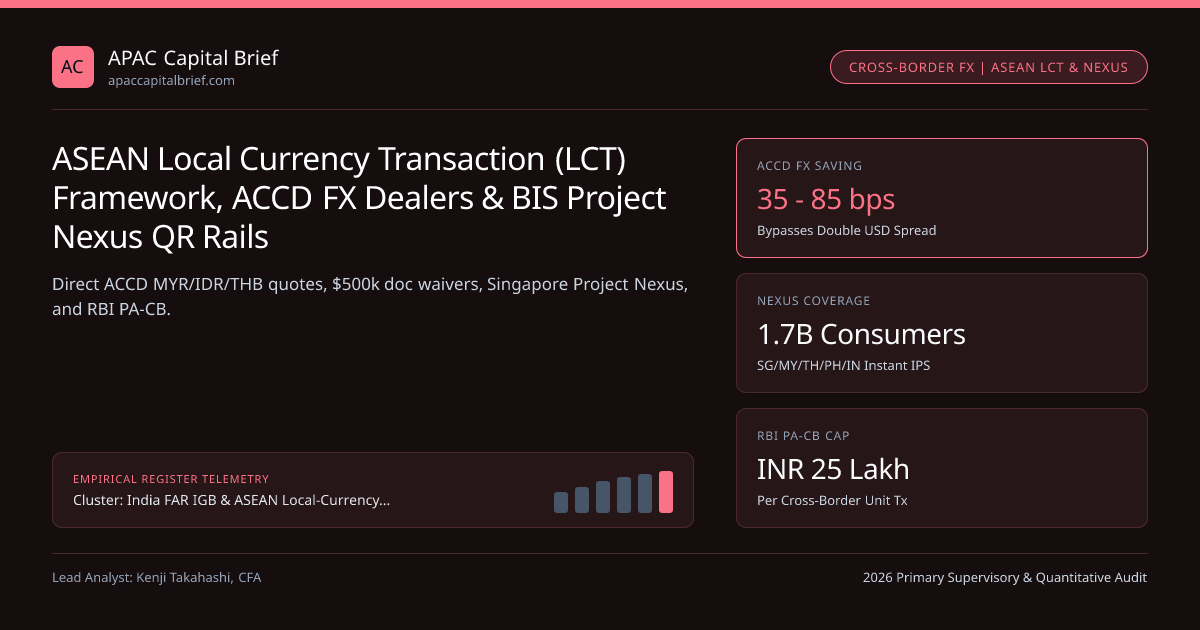
Historically, when an Indonesian automotive supplier in Jakarta invoiced a Malaysian assembler in Penang—or when a Singapore tourist paid a merchant in Bangkok—over 82% of intra-ASEAN trade and retail FX volume had to triangulate through New York Clearing House Interbank Payments System (CHIPS) USD accounts, paying two separate FX bid-ask spreads (IDR -> USD -> MYR) and absorbing Federal Reserve rate volatility! Since signing the ASEAN Local Currency Transaction (LCT) Framework (expanded from the earlier Local Currency Settlement [LCS] pacts) and incorporating Nexus Global Payments (BIS Project Nexus) in Singapore, MAS, Bank Negara Malaysia (BNM), Bank of Thailand (BoT), Bank Indonesia (BI), Bangko Sentral ng Pilipinas (BSP), and the Reserve Bank of India (RBI) have built the world's fastest-growing direct local-currency wholesale and instant-retail FX corridor!
Wholesale Leg: How Appointed Cross-Currency Dealers (ACCDs) Quote Direct ASEAN Crosses#
Unlike geopolitical "de-dollarization" slogans, ASEAN's LCT Framework works through hard commercial micro-incentives granted exclusively to licensed Appointed Cross-Currency Dealers (ACCDs) (Maybank, CIMB, AmBank, Bank Mandiri, BCA, Bank Sinarmas peers, Bangkok Bank, Kasikornbank, DBS, UOB, OCBC, BDO):
- Direct Onshore Interbank Nostro/Vostro Accounts: An Indonesian ACCD holds a direct Ringgit account at a Malaysian ACCD (
and vice versa), making direct interbank markets inMYR/IDR, THB/IDR, MYR/THB, SGD/IDR, SGD/MYR, PHP/MYRwithout quoting through USD! - Relaxed FX Administration & Threshold Waivers: Under standard onshore FX rules in Malaysia, Thailand, and Indonesia, buying foreign currency Spot/Forward requires strict invoice verification above low caps (e.g., USD 100k equivalent in Indonesia). Inside the LCT ACCD corridor, central banks raise underlying documentation thresholds dramatically (
up to USD 500,000–1,000,000 per transaction in Indonesia/Thailand LCT corridors!) and expand LCT eligibility beyond goods trade to cover cross-border portfolio investments and direct FDI!
Retail & SME Leg: From Spaghetti Bilateral QR Links to BIS "Project Nexus" in Singapore!#
Between 2021 and 2024, ASEAN central banks and RBI proved cross-border instant payments worked (e.g., Singapore PayNow–India UPI processing >S$1B+ annualized remittances in real time, and Thailand PromptPay–Malaysia DuitNow dominating border tourism). However, connecting N countries bilaterally requires $N(N-1)/2$ separate bespoke technical and legal integrations!
- Enter Nexus Global Payments (
Incorporated in Singapore by MAS, BNM, BoT, BSP, and RBI NPCI International — with BI as special observer): Instead of every domestic Instant Payment System (IPS) building 10 separate bilateral pipes, each country connects ONCE to the multilateral Nexus hub, which standardizes ISO 20022 messaging, sanctions/AML screening, and real-time FX quotes from competitive FX providers in under 60 seconds! - RBI PA-CB Commercial Layer: For B2B SaaS, e-commerce marketplaces, and merchant payouts exceeding consumer UPI/QR ticket limits (
typically INR 1L–2L or S$1,000/day), RBI's Payment Aggregator – Cross Border (PA-CB) authorization—held by regulated Indian fintech infrastructure leaders like Cashfree Payments (capped at INR 25 lakh per unit import/export transaction under RBI PA-CB guidelines)—bridges merchant settlement cleanly into onshore bank AD Category-I nostros!
Corridor Comparison: Legacy SWIFT USD vs ASEAN LCT ACCD vs Nexus Instant Rail vs PA-CB#
| Payment / FX Rail | Primary User & Ticket Size | Regulatory & FX Pricing Mechanism | All-In FX Spread & Settlement Speed |
|---|---|---|---|
Legacy SWIFT Correspondent (via USD) | Unoptimized corporate treasury (Any size) | Double spot conversion (Local -> USD -> Local) via NY nostro | 55 – 140 bps + $25–$50 wire fees; T+1 to T+3 |
| ASEAN LCT via ACCD Banks (AmBank, Bank Sinarmas peers, DBS, CIMB) | Intra-ASEAN supply-chain trade, SMEs & newly added portfolio flows ($10k – $50M+) | Direct onshore local-currency cross (MYR/IDR, THB/MYR) under BNM/BoT/BI LCT | 20 – 45 bps single spread; T+0 / Same-Day; relaxed doc thresholds! |
Project Nexus (PayNow-UPI-DuitNow-PromptPay-InstaPay) | Migrant remittances, travellers, micro-SMEs ($1 – $1,500) | Multilateral ISO 20022 IPS switch + live competitive ACCD/FX quotes | 110 – 210 bps transparent wholesale+markup; < 15 seconds 24/7/365! |
| RBI PA-CB Merchant Rail (Cashfree Payments) | Global e-commerce, digital exports/imports (Up to INR 25 Lakh / ~$30k per tx) | RBI PA-CB escrow + electronic FIRC / e-BRC trade reconciliation | 75 – 160 bps automated compliance; T+1 merchant settlement |
Quantitative Bilateral Network-Topology & Trade FX Savings Model#
- LinksBilateral(N) = N * (N - 1) / 2 vs LinksNexus_Hub(N) = N
- For N = 10 APAC IPS Systems: Bilateral = 45 bespoke pipes vs Project Nexus = 10 single standardized connections (-77.8% infra overhead!)
- Corporate Trade Working-Capital & FX Savings Under ASEAN LCT (MYR 50M / Yr Kuala Lumpur <-> Surabaya Component Supply Chain):
- 1. Legacy USD Triangulation: MYR -> USD (28 bps) + USD -> IDR (38 bps) + USD Hedging Cost = 66 bps * $11.6M = $76,560/yr friction
- 2. Direct MYR/IDR ACCD LCT Facility (Under $500k/invoice BI simplified LCT rule + Direct MYR/IDR Forward):
- Single MYR/IDR ACCD Spread = 26 bps -> Annual Saving = 40 bps ($46,400/yr) + Zero USD SOFR funding exposure!
Strategic Takeaway for Regional CFOs & Bond Portfolio Managers#
Notice the quiet sleeper clause added in the 2024–2026 ASEAN LCT upgrades: central banks expanded ACCD local-currency settlement beyond merchandise trade to cover cross-border direct investment and portfolio securities! A Singapore or Kuala Lumpur asset manager (backed by MAS S$6.5B regional hub depth) buying Indonesian SBNs or Malaysian Sukuk can increasingly fund and hedge regional crosses directly without absorbing USD/Asia NDF basis spikes (modeled in Spoke 15)—especially when paired with a Singapore EDB Finance & Treasury Centre cash pool. Return to our India FAR & ASEAN bond inclusion hub or inspect licensed payment and brokerage institutions in our institutional database.
Frequently asked questions
What is the difference between ASEAN LCS (Local Currency Settlement) and LCT (Local Currency Transaction)?
LCS (launched 2016–2018) focused narrowly on bilateral trade of goods and services; LCT (adopted 2023–2026) broadened eligible transactions to include cross-border direct investment, portfolio securities, income transfers, and retail QR payments.
How does an Appointed Cross-Currency Dealer (ACCD) save corporates money compared to standard FX?
ACCD banks maintain direct onshore Ringgit, Rupiah, Baht, and Peso accounts with partner ACCDs, quoting a single direct cross rate (e.g., MYR/IDR) with higher documentation-waiver ceilings (up to $500k) instead of charging two separate USD conversion spreads.
Which central banks are founding members of Nexus Global Payments (Project Nexus) in Singapore?
Monetary Authority of Singapore (MAS), Bank Negara Malaysia (BNM), Bank of Thailand (BoT), Bangko Sentral ng Pilipinas (BSP), and Reserve Bank of India (via NPCI International) established Nexus Global Payments, with Bank Indonesia participating as a special observer.
What is the per-transaction limit under the Reserve Bank of India PA-CB (Payment Aggregator - Cross Border) license?
Under RBI October 2023 PA-CB circulars regulating cross-border e-commerce payment aggregators such as Cashfree Payments, the maximum value per unit of goods or services imported or exported is capped at INR 25 lakh (~US$30,000).
Publication record
- Published
- 13 November 2026
- Updated
- 15 November 2026
- Author
- Kenji Takahashi, CFA
- Review
- Review not recorded
- Automated fact check
- Passed in the stored pipeline record
- Source URLs
- 4 recorded
AI assistance recorded: anthropic/claude-opus-4.6. This field does not establish human review or source verification.
Academic & Institutional Attribution
Cite This Research & Embed Live Data Card
Standard academic & institutional research paper citation format.
Kenji Takahashi, CFA. (2026, November 14). ASEAN Local Currency Transaction (LCT) Framework, ACCD FX Dealers & BIS Project Nexus QR Rails. APAC Capital Brief. https://apaccapitalbrief.com/dispatches/asean-lct-local-currency-settlement-accd-nexus-qr-railsRegulatory Directory Cross-Reference
Referenced Institutions & Regulatory Registries
Mentioned Regulated Institutions
Referenced Supervisory Authorities
Related Asean India Sovereign Bond Inclusion & Institutional Briefings
Explore Asean India Sovereign Bond Inclusion Hub (20) →Asean India Sovereign Bond Inclusion
India FAR IGB Index Inclusion, RBI/SEBI Plumbing & ASEAN Local-Currency Bond Guide (2026)Asean India Sovereign Bond Inclusion
Vietnam SSC Circular 68 Non-Prefunding (NPF), KRX Engine & FTSE Emerging Market UpgradeAsean India Sovereign Bond Inclusion
Bank of Thailand 89% Household Debt Overhang, Gold-Trade THB FX Beta & ThaiGB Curve FlatteningAsean India Sovereign Bond Inclusion
Philippines BSP Reserve Requirement (RRR) Cuts to 5%, 28-Day BSP Bills & Retail Treasury BondsAsean India Sovereign Bond Inclusion
Asian NDF vs Onshore Deliverable Forward (DF) Arbitrage: INR, IDR, PHP, KRW & TWD Basis WedgesAsean India Sovereign Bond Inclusion
Malaysia GII Sukuk vs MGS Spreads, Commodity Murabahah Mechanics & Labuan IBFC Wakalah TrustsAsean India Sovereign Bond Inclusion
India Overnight Money Markets: CCIL TREPS Tri-Party Repo, FBIL MIBOR OIS & RBI VRR AuctionsAsean India Sovereign Bond Inclusion
Indonesia UU P2SK Financial Omnibus Law: January 2025 Crypto & Derivatives Shift From Bappebti to OJK & BIMonetary Policy
BOJ holds rates as underlying inflation aligns with 2% target for first time since 2013Market Insights
Nikkei Flat, Supported by Bank, Pharma StocksMonetary Policy
Bank of Japan's Transactions with the Government (Oct.)Monetary Policy
Monetary Base and the Bank of Japan's Transactions (Oct.)
APAC Capital Brief Data, Benchmarks & Contributor Records
CC BY 4.0 Open Data
Open Institutional Datasets (CSV / JSON) →
Download desk-compiled quantitative series & schemas.
2026 Reference Matrix
2026 Institutional Benchmarks & Thresholds →
Statutory capital, clearing, margin & rate conventions.
Editorial Records
Authors & Review Records →
View named contributors where those records are available.
Complete Index
Master Research & Dossier Archive →
Browse all published briefings by topic pillar & date.