
Asean India Sovereign Bond Inclusion
Malaysia GII Sukuk vs MGS Spreads, Commodity Murabahah Mechanics & Labuan IBFC Wakalah Trusts
Commanding over 36% of global Sukuk outstanding, Malaysia 0%-WHT Government Investment Issues (GII) and Labuan IBFC USD Wakalah structures anchor global Islamic fixed income.
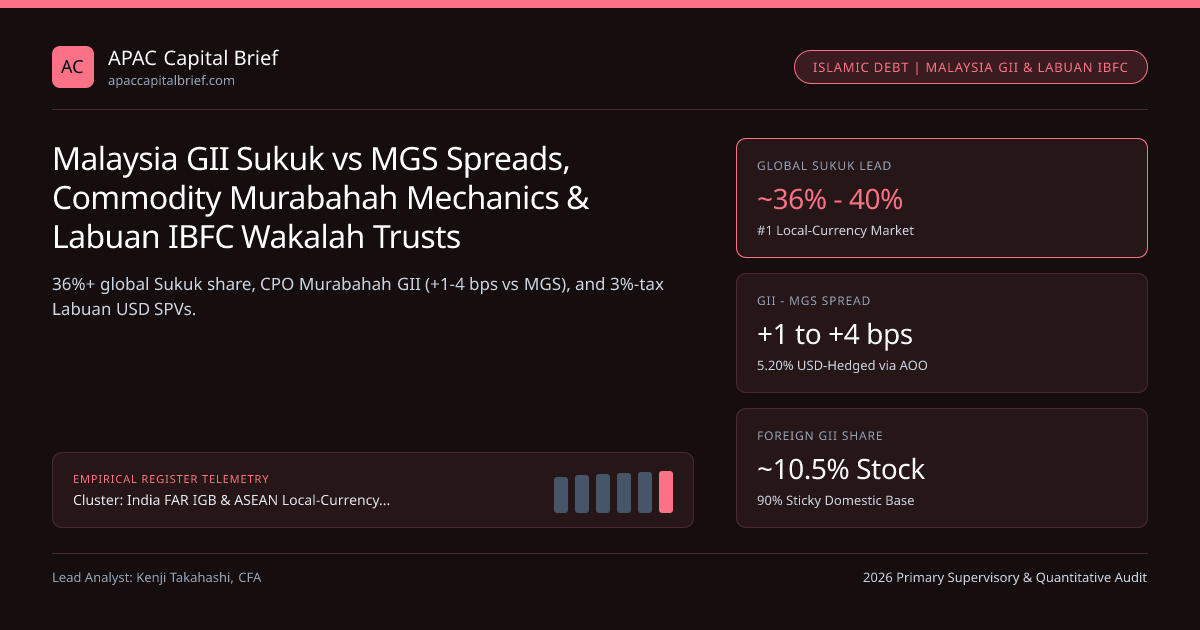
Malaysia is the undisputed global superpower of *Islamic fixed-income capital markets (Sukuk)—accounting for ~36% to 40% of total global Sukuk outstanding across all currencies and >60% of non-GCC local-currency Sukuk, supervised jointly by the Securities Commission Malaysia (SC) Shariah Advisory Council (SAC)* and Bank Negara Malaysia (BNM)! Even for purely secular global bond funds tracking FTSE WGBI, JPMorgan GBI-EM, or Bloomberg Global Aggregate, understanding Malaysian Government Investment Issues (MGII / GII) is non-negotiable: GII Sukuk represent nearly half of Malaysia's sovereign Ringgit issuance, enjoy the exact same 0.00% foreign withholding tax and Sovereign A3/A- credit backing as conventional Malaysian Government Securities (MGS), and routinely trade within +1 to +5 bps (and occasionally INSIDE!) conventional MGS!
How Malaysia's Sovereign GII Uses "Commodity Murabahah" (Tawarruq) via Bursa Suq Al-Sila'#
Because Islamic Shariah law prohibits interest (Riba) and trading pure debt at a discount (Bai' al-Dayn constraints under GCC interpretations), how does Malaysia's Ministry of Finance issue a fixed-coupon 10-year sovereign Government Investment Issue (GII) that settles seamlessly on RENTAS / Euroclear and qualifies for both FTSE WGBI AND global Islamic indices?
- Since 2013, Malaysia shifted all new sovereign GII issuances onto *Shariah-compliant Commodity Murabahah* (
via Tawarruq) executed instantaneously over Bursa Malaysia's Bursa Suq Al-Sila' (BSAS)—the world's first regulated Shariah-compliant crude palm oil (CPO) and plastic resin Murabahah commodity platform**:
- Investors (
arranged via principal dealers such as Maybank Islamic, CIMB Islamic, andAmBankIslamic) appoint the Government as agent to purchase Shariah-compliant commodities on BSAS at spot cash. - The Government buys the commodities from investors on *deferred-payment cost-plus-profit terms (Murabahah* price = Principal + Scheduled Semi-Annual Profit Coupons!)**.
- The Government immediately sells the physical CPO commodity title back to BSAS commodity suppliers for cash—leaving zero physical commodity storage risk while establishing a direct, unconditional sovereign obligation of Malaysia!
Why Do GII–MGS Spreads Compress to Zero—And What Is the "AAOIFI Standard 62" Debate?#
Two structural forces govern relative value across Malaysian Ringgit GII and cross-border USD corporate/sovereign Wakalah Sukuk:
- Captive Onshore Islamic Bank LCR Squeeze: Over 43% of total Malaysian domestic banking assets (
led by Maybank Islamic, CIMB Islamic, Bank Islam, RHB Islamic, and AmBank Islamic) plus Tabung Haji (Pilgrims Fund) and EPF Simpanan Shariah are legally restricted from holding interest-bearing conventional MGS! They must hold GII Sukuk to satisfy BNM Basel III Liquidity Coverage Ratio (LCR) High-Quality Liquid Asset (HQLA) buffers—compressing 10-year GII yields to within 1–4 bps of MGS (and occasionally -2 bps richer than MGS during heavy Islamic deposit inflows!). - Malaysia SC SAC Flexibility vs GCC AAOIFI Standard 62: In the USD cross-border Sukuk market (
where Khazanah, Petronas, and sovereigns issue via Malaysia orLabuan IBFC), Middle Eastern standard-setter AAOIFI's proposed Shariah Standard 62 pushed to treat Sukuk more like true asset-backed equity/title transfers (requiring real stamp-duty-triggering asset sales rather than asset-based Wakalah/Ijarah repurchase undertakings!). Crucially, SC Malaysia's Shariah Advisory Council and Labuan FSA maintain *pragmatic, legally certain asset-based* Wakalah bi al-Istithmar and Murabahah frameworks** (minimum 33%–51% tangible asset ratios without destructive legal title forfeiture)—cementing Malaysia and Labuan as Asia's premier USD & MYR Sukuk issuance hub!
| Instrument / Structure | Supervisor & Shariah Framework | Tax & Index Eligibility | Investor Base & Pricing Dynamics |
|---|---|---|---|
Malaysian Gov Investment Issues (MGII / GII) | MoF + BNM (Commodity Murabahah) | 0% Foreign WHT; FTSE WGBI + JPMorgan GBI-EM + Bloomberg Sukuk | 3.84% gross (~5.19% USD-hedged via AOO!); anchored by 43% Islamic banking system + EPF Shariah |
SRI / Sustainability Sukuk (Green Wakalah) | SC Malaysia SRI Sukuk & ASEAN Green Bond Standards | Tax deduction on issuance costs + SRI grant up to MYR 300,000 (90% of external review cost)! | Issued by Tenaga, Cagamas, AmBank & sovereign; 2–5 bps "greenium" + Shariah overlap |
| Labuan IBFC USD Sukuk SPV & Captives | Labuan FSA (Labuan Islamic Financial Services and Securities Act) | 0% WHT on Sukuk distributions; 3% corporate tax on substantive Labuan trading/captive underwriting | Mid-shore USD Wakalah / Mudharabah SPVs, Protected Cell Captive (PCC) Takaful, and family foundations |
| GCC AAOIFI-Aligned USD Sukuk | UAE / Bahrain / Saudi issuers (AAOIFI SS 59 / SS 62 debate) | 0% Euroclear USD; tangibility-breach delisting clauses scrutinized | Wider documentation dispersion around<51% tangibility covenants vs clean Malaysian sovereign GII |
Quantitative Relative-Value Model: Switching MGS Into GII + USD Forward Pickup#
- SpreadGIIvsMGS (bps) = ( Y10YGII - Y10Y_MGS ) * 100
- Y10YGIIUSDHedged = Y10YGII (3.85%, 0% WHT) + Annualized3MAOOForwardPickup (+1.35%) = 5.20% in USD!
- Worked Relative-Value Switch ($100M FTSE WGBI Real-Money Sleeve):
- Sell $100M 10Y Conventional MGS @ 3.82% -> Buy $100M 10Y Benchmark MGII @ 3.85% (+3.0 bps yield pickup, identical Sovereign of Malaysia risk, 0% WHT!)
- Downside Tail Cushion: During global EM bond selloffs (foreigners own ~34% of MGS vs ONLY ~9.5%–11% of GII!), domestic Islamic banks MUST step in to buy GII, cutting GII drawdown beta by ~28% vs MGS!
Malaysia GII Sukuk vs Conventional MGS Ownership & Beta#
Structuring Note on Labuan IBFC Substance Rules (No Brass-Plate Shells!)#
Corporate treasurers and private-wealth advisors using Labuan FSA mid-shore structures (Labuan Islamic Foundations, Protected Cell Captive Takaful, or regional leasing SPVs) must adhere strictly to Malaysia's post-BEPS Labuan Economic Substance Regulations: to qualify for the 3% net-profit tax (or 0% pure equity/Sukuk holding exemption), the entity must maintain minimum full-time employees (2–4 FTEs located physically in Labuan) and minimum annual local operating expenditure (MYR 50,000–200,000+ depending on license)—otherwise profits default to Malaysia's standard 24% onshore corporate income tax! Pair this analysis with BNM Dynamic Hedging & AOOs, Singapore EDB 8% FTC treasury hubs, and our India FAR & ASEAN bond inclusion hub.
Frequently asked questions
Can a conventional (non-Islamic) Western pension fund or UCITS bond fund buy Malaysian Government Investment Issues (GII)?
Yes! GII Sukuk settle identically to conventional MGS on RENTAS and Euroclear, carry 0% foreign withholding tax, are included in FTSE WGBI and JPMorgan GBI-EM, and frequently offer +2 to +4 bps higher yield with lower volatility.
How does Commodity Murabahah (Tawarruq) generate fixed semi-annual coupons on a Malaysian GII without charging interest?
Executed digitally on Bursa Suq Al-Sila using crude palm oil certificates, investors purchase Shariah-compliant commodities spot and sell them to the Government of Malaysia on deferred cost-plus-profit installments matching principal and semi-annual profit coupons.
Why did Middle Eastern AAOIFI Standard 62 proposals spark debate across global USD Sukuk markets?
AAOIFI proposed requiring true legal sale and ownership risk transfer of underlying assets to Sukuk holders—which could trigger punitive real-estate stamp duties and sovereign asset-alienation bans—whereas Malaysia SC SAC preserves clean asset-based Wakalah structures.
What happens if a Labuan IBFC company fails Labuan FSA minimum employee and local expenditure substance tests?
Under Malaysia BEPS-compliant Labuan Business Activity Tax Act amendments, any Labuan entity failing required physical Labuan FTE headcount and local operating-spend thresholds forfeits the 3% tax rate and is taxed at 24% under Malaysia Income Tax Act.
Publication record
- Published
- 13 November 2026
- Updated
- 15 November 2026
- Author
- Kenji Takahashi, CFA
- Review
- Review not recorded
- Automated fact check
- Passed in the stored pipeline record
- Source URLs
- 3 recorded
AI assistance recorded: anthropic/claude-opus-4.6. This field does not establish human review or source verification.
Academic & Institutional Attribution
Cite This Research & Embed Live Data Card
Standard academic & institutional research paper citation format.
Kenji Takahashi, CFA. (2026, November 14). Malaysia GII Sukuk vs MGS Spreads, Commodity Murabahah Mechanics & Labuan IBFC Wakalah Trusts. APAC Capital Brief. https://apaccapitalbrief.com/dispatches/malaysia-gii-sukuk-murabahah-spreads-labuan-ibfc-wakalahRegulatory Directory Cross-Reference
Referenced Institutions & Regulatory Registries
Mentioned Regulated Institutions
Referenced Supervisory Authorities
Related Asean India Sovereign Bond Inclusion & Institutional Briefings
Explore Asean India Sovereign Bond Inclusion Hub (20) →Asean India Sovereign Bond Inclusion
India FAR IGB Index Inclusion, RBI/SEBI Plumbing & ASEAN Local-Currency Bond Guide (2026)Asean India Sovereign Bond Inclusion
India Overnight Money Markets: CCIL TREPS Tri-Party Repo, FBIL MIBOR OIS & RBI VRR AuctionsAsean India Sovereign Bond Inclusion
Indonesia UU P2SK Financial Omnibus Law: January 2025 Crypto & Derivatives Shift From Bappebti to OJK & BIAsean India Sovereign Bond Inclusion
Singapore EDB Finance & Treasury Centre (FTC) 8% Tax Incentive, Pillar Two & ASEAN Trapped-Cash SweepsAsean India Sovereign Bond Inclusion
JPMorgan GBI-EM 10% India FAR Cap, FTSE EMGBI Entry & Onshore NDS-OM / CCIL SettlementAsean India Sovereign Bond Inclusion
CCIL QCCP Supervisory Standoff: ESMA vs Bank of England Recognition & European Bank RWA ImpactAsean India Sovereign Bond Inclusion
RBI Two-Front Rupee Defense: US$700B FX Reserves, Forward Swap Books & Offshore INR NDF InterventionAsean India Sovereign Bond Inclusion
India FAR Sovereign Bond Taxation: 20% Section 196D FPI Withholding, DTAA Treaties & Capital GainsMonetary Policy
Japanese Government Bonds Held by the Bank of JapanMarket Insights
(IMES Newsletter) 2026 BoC - Philadelphia Fed - BOJ Joint WorkshopRegulatory Benchmarks
Asia-Pacific Capital Markets & Cross-Border Brokerage 2026 Licensing Benchmark: 6D Prudential Scorecard Across 105 Audited EntitiesCompliance Forensics
How to Verify Asia-Pacific Capital Markets & Cross-Border Brokerage Licences & Detect Clone Firms: 2026 Supervisory Lookup Playbook
APAC Capital Brief Data, Benchmarks & Contributor Records
CC BY 4.0 Open Data
Open Institutional Datasets (CSV / JSON) →
Download desk-compiled quantitative series & schemas.
2026 Reference Matrix
2026 Institutional Benchmarks & Thresholds →
Statutory capital, clearing, margin & rate conventions.
Editorial Records
Authors & Review Records →
View named contributors where those records are available.
Complete Index
Master Research & Dossier Archive →
Browse all published briefings by topic pillar & date.