
APAC Semiconductor AI Capex Equities
Korea FSS NSDS Electronic Short-Selling System, Penalty Laws & KOSPI 200 Futures Basis
Following South Korea longest short-selling ban, FSS and KRX deployed the real-time Naked Short-Selling Detection System (NSDS), reshaping KOSPI 200 cash-futures arbitrage.
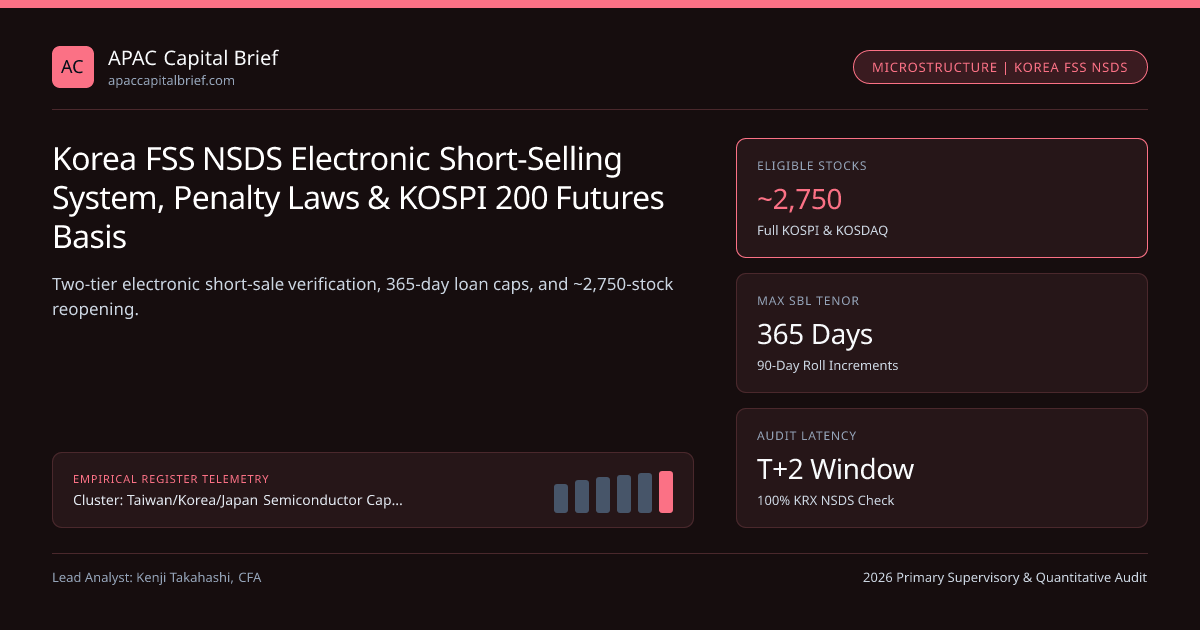
When South Korea lifted its 17-month blanket equity short-selling ban in March 2025 across KOSPI and KOSDAQ, the Financial Services Commission (FSC) and Financial Supervisory Service (FSS) conditioned market reopening on the world's most stringent centralized electronic borrow-verification infrastructure: the KRX Naked Short-Selling Detection System (NSDS) paired with mandatory internal Institutional Balance-Management Systems and criminal penalties up to life imprisonment for illicit gains exceeding KRW 5.0 billion! For global stat-arb pods, prime brokers, and equity-derivatives desks trading SK Hynix and KRX Value-Up constituents, NSDS fundamentally permanently altered Korean stock-loan friction and KOSPI 200 futures-to-cash basis dynamics.
Inside the Two-Tier NSDS & Internal Balance-Management Architecture#
Prior to 2024, FSS investigations fined over a dozen global investment banks hundreds of billions of won after discovering that offshore prime-brokerage desks aggregated long and short books across internal sub-units or relied on manual locate emails without verifying settled Korea Securities Depository (KSD) / Korea Securities Finance Corp (KSFC) stock-loan inventory. The post-2025 legal architecture eliminates manual discretion via dual-ledger reconciliation:
- Tier 1 — Institutional Internal Balance-Management System: Every institutional or corporate investor holding a short balance
>= 0.01% of outstanding shares (or >= KRW 1.0 billion)(and all market makers / liquidity providers) MUST build an automated real-time pre-trade system that physically blocks any short order exceeding confirmed settled/contracted stock borrow across every single fund/omnibus sub-unit, audited annually by their executing Korean broker! - Tier 2 — KRX Centralized NSDS: Every corporate/institutional short seller is assigned a unique Short-Selling Registration Number (ID). Within T+2, NSDS ingests every buy, sell, borrow, recall, and OTC swap hedge linked to that ID, running automated flow-conservation algorithms that flag 100% of unlocated inventory discrepancies within 3 days!
Leveling the Retail-Institutional Playing Field: 90-Day Repayment & 105% Margin#
A major political catalyst behind Korea's historic short-selling bans was retail investor anger (Donghak Ants) over perceived asymmetric rules between foreign hedge funds and domestic individuals (who also trade high-volatility digital assets on venues like Bithumb). To forge durable political consensus so short selling is never abruptly banned mid-cycle again, FSC unified repayment and collateral terms:
- 90-Day Repayment Cycle (Capped at 12 Months Total): Institutional SBL stock loans for short selling—previously open-ended indefinitely unless recalled—are now capped at 90-day tenors, extendable in 90-day increments up to a hard 12-month (365-day) maximum, forcing structural shorts to physically cover and re-establish annually!
- 105% Cash Collateral Parity: Retail short-selling margin ratios were lowered from 120% to 105% to match institutional SBL cash-collateral haircuts (while maintaining 120% on non-cash equity collateral).
| Microstructure Metric | Pre-Ban Legacy Regime (Pre-Nov 2023) | During 17-Month Short Ban (2023–Q1 2025) | Post-NSDS Reopening Regime (2025–2026) |
|---|---|---|---|
| Scope of Eligible Stocks | Restricted solely to KOSPI 200 & KOSDAQ 150 (350 stocks) | 0 Stocks (Except market-maker hedging, later restricted too) | Full All-Stock Reopening (~2,700+ KOSPI & KOSDAQ stocks!) |
| Institutional Loan Tenor | Indefinite open-ended SBL until lender recall | Frozen / Forced Buy-Ins | 90-Day Tenor + Extensions Capped at 12 Months Max |
| KOSPI 200 Cash-Futures Basis | Tight +-15 bps fair-value arbitrage band | Wild -65 to +90 bps mispricings; retail ETF LP spreads widened | Restored +-18 bps fair-value band; ETF NAV tracking errors collapsed |
| Penalty on Naked Short Violation (FSS) | Administrative fine -> Upgraded to up to 100% of order value | Retroactive multi-year prime-brokerage audits | 4x–6x Illicit Profit Fines + Up to Life Imprisonment + Director Bans |
KOSPI 200 Cash-Futures Fair-Value No-Arbitrage Band With NSDS SBL Borrow & 0.15% Transaction Tax#
- FUpper = S0 * [ 1 + (rKRW - ddiv) * (T / 365) ] + S0 * ( ccomm + c_slippage )
- FLower = S0 * [ 1 + (rKRW - ddiv - bSBLNSDS) * (T / 365) ] - S0 * ( tauSTT + ccomm + cslippage )
- Where (90-Day Contract T = 90, rKRW = 3.10%, Dividend Yield ddiv = 2.15%, SBL Fee + NSDS IT Cost bSBL = 0.85%, Securities Transaction Tax tauSTT = 0.15%):
- 1. During Short Ban (b_SBL -> Infinity on cash basket short leg):
- Reverse Cash-and-Carry Arbitrage (Buy Cheap Futures + Short Expensive Cash Basket) was IMPOSSIBLE -> Futures traded at persistent -75 bps backwardation!
- 2. Post-NSDS Reopening:
- Upper Bound = S0 * (1 + 0.0095 * 0.2466 + 0.0008) = S0 * 1.00314 (+31.4 bps)
- Lower Bound = S0 * (1 + 0.0010 * 0.2466 - 0.0015 - 0.0008) = S0 * 0.99795 (-20.5 bps) -> Restores tight institutional liquidity!
KOSPI & KOSDAQ Liquidity Metrics Post-NSDS Launch (2026)#
Why NSDS Unlocked Korea's MSCI Developed Market Bid#
Ironically, while building Tier-1 internal balance systems cost global prime brokers US$2M–US$5M apiece in compliance IT, opening all ~2,750 KOSPI/KOSDAQ stocks (up from just 350 pre-ban!) directly resolved MSCI's #1 accessibility complaint against South Korea! Read our next dispatch on MSCI Korea Developed Market watchlist and RFI FX reform, compare with KRX Corporate Value-Up, and return to our Northeast Asia semiconductor & governance hub or APAC equity dispatches.
Frequently asked questions
Why were global investment banks fined in South Korea before NSDS if they thought their shorts were covered?
Under Korea Capital Markets Act, netting long positions in Trading Pod A against short sales in Pod B inside the same offshore legal entity without formal external stock borrow constitutes illegal naked shorting—a distinction now enforced pre-trade by Tier-1 software.
What happens when an institutional short seller hits the new 12-month (365-day) stock-loan cap in Korea?
Because 90-day SBL extensions cannot exceed 365 cumulative days, the short seller must buy shares in the market to repay the maturing stock loan before initiating any fresh borrow contract, creating predictable annual short-covering windows.
How did the 2023–2025 short-selling ban hurt retail Korean ETF investors?
Without the ability to short overvalued cash baskets or hedge newly created ETF units efficiently, liquidity providers widened bid-ask spreads and KOSPI 200 futures traded in deep backwardation, penalizing domestic pension and ETF savers.
Does a multi-manager hedge fund need one Short-Selling Registration ID or one per pod?
Registration IDs are issued at the legal entity/fund level, and the entity Tier-1 internal balance-management system must track real-time stock borrow independently across every segregated sub-unit that is prohibited from internal netting.
Publication record
- Published
- 14 November 2026
- Updated
- 15 November 2026
- Author
- Kenji Takahashi, CFA
- Review
- Review not recorded
- Automated fact check
- Passed in the stored pipeline record
- Source URLs
- 3 recorded
AI assistance recorded: anthropic/claude-opus-4.6. This field does not establish human review or source verification.
Academic & Institutional Attribution
Cite This Research & Embed Live Data Card
Standard academic & institutional research paper citation format.
Kenji Takahashi, CFA. (2026, November 14). Korea FSS NSDS Electronic Short-Selling System, Penalty Laws & KOSPI 200 Futures Basis. APAC Capital Brief. https://apaccapitalbrief.com/dispatches/fss-korea-nsds-naked-short-selling-system-kospi-200-basisRegulatory Directory Cross-Reference
Referenced Institutions & Regulatory Registries
Top Regulated Institutions in This Coverage Slice
Referenced Supervisory Authorities
Related APAC Semiconductor AI Capex Equities & Institutional Briefings
Explore APAC Semiconductor AI Capex Equities Hub (20) →APAC Semiconductor AI Capex Equities
Northeast Asia Semiconductor AI Capex, HBM4 Supply Chains & Corporate Governance: 2026 APAC GuideAPAC Semiconductor AI Capex Equities
MSCI Korea Developed Market Watchlist Bid: 02:00 KST KRW FX & Registered Foreign InstitutionsAPAC Semiconductor AI Capex Equities
AI ABF Substrates & Glass-Core Packaging Capex: Ibiden, Shinko, Unimicron & Ajinomoto FilmAPAC Semiconductor AI Capex Equities
Taiwan Taipower Industrial Tariff Hikes, EUV Megawatt Intensity & Offshore Wind Fab PPAsAPAC Semiconductor AI Capex Equities
Foundry & HBM Customer Capacity Prepayments, USD Corporate Bonds & Natural FX Capex HedgingAPAC Semiconductor AI Capex Equities
JPX Growth Market JPY 10B Thresholds, METI Unsolicited Takeover Guidelines & MBO Carve-OutsAPAC Semiconductor AI Capex Equities
Nikkei 225 Price-Divisor Skew vs TOPIX Next-Generation ~1,200-Stock Float ReductionAPAC Semiconductor AI Capex Equities
Taiwan NT$5.8T Retail High-Dividend ETF Crowding, Income Equalization & FSC SITCA ReformsASIC Afsl Australian Superannuation
APRA SPS 530 Unlisted Asset Governance: Out-of-Cycle Revaluations & Member Switching ArbitrageASIC Afsl Australian Superannuation
AUD/USD BBSW–SOFR Cross-Currency Basis Swaps, Big-4 Offshore Debt & Kangaroo Bond ArbitrageASIC Afsl Australian Superannuation
AUSTRAC AML/CTF Amendment Act (2026 Rollout): Tranche-2 Gatekeepers & VASP Travel RuleASIC Afsl Australian Superannuation
ASIC Crypto AFSL Enforcement, Block Earner Precedents & INFO 225 Digital Asset Platform Rules
APAC Capital Brief Data, Benchmarks & Contributor Records
CC BY 4.0 Open Data
Open Institutional Datasets (CSV / JSON) →
Download desk-compiled quantitative series & schemas.
2026 Reference Matrix
2026 Institutional Benchmarks & Thresholds →
Statutory capital, clearing, margin & rate conventions.
Editorial Records
Authors & Review Records →
View named contributors where those records are available.
Complete Index
Master Research & Dossier Archive →
Browse all published briefings by topic pillar & date.