
APAC Semiconductor AI Capex Equities
Taiwan NT$5.8T Retail High-Dividend ETF Crowding, Income Equalization & FSC SITCA Reforms
Domestic retail assets in Taiwan ETFs surged past NT$5.8 trillion, prompting FSC Taiwan and SITCA to clamp down on Income Equalization yields and mid-cap constituent crowding.
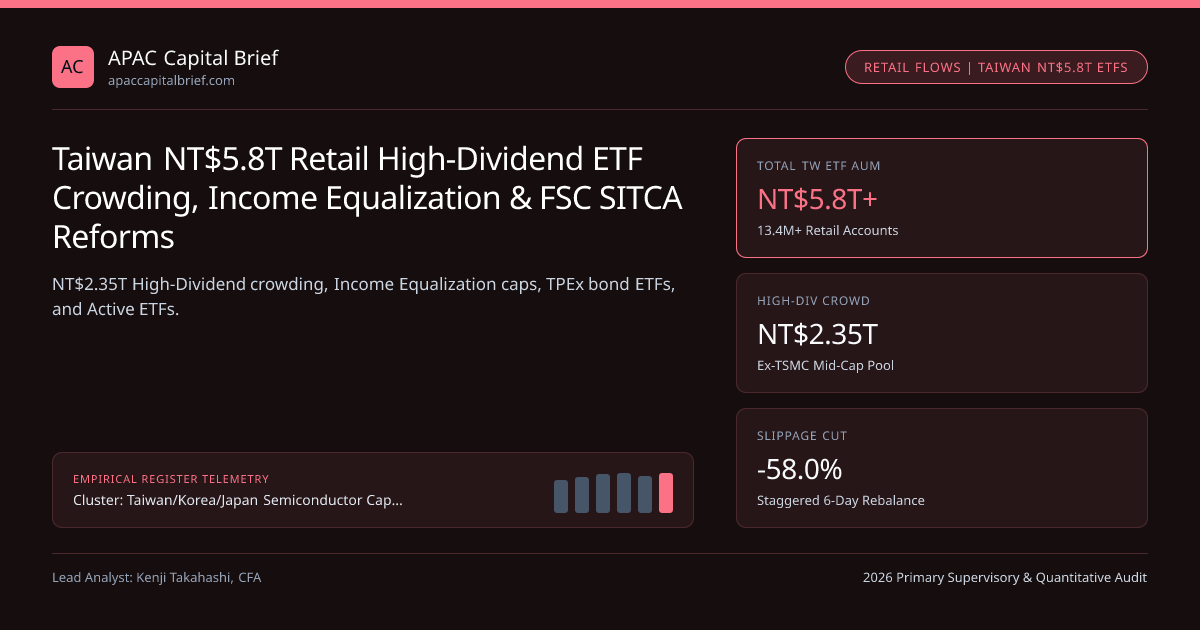
A domestic retail savings phenomenon of extraordinary scale now rivals Foreign Institutional Investors (FINIs) as the swing liquidity force across Taiwan's TWSE and Taipei Exchange (TPEx): total onshore Taiwanese ETF assets surged past NT$5.8 trillion (~US$182 billion)—more than quadrupling since 2020—with over NT$2.3 trillion concentrated in domestic "High-Dividend" monthly and quarterly payout equity ETFs (such as Yuanta 0056/00940, Cathay 00878, Capital 00919, and Fubon/KGI wrappers distributed across networks affiliated with groups like KGI Asia Limited)! When a single IPO of a monthly-dividend ETF (00940) raised NT$175.2 billion in five days from retail savers mortgaging homes and shifting 1.5% TWD time deposits, the Financial Supervisory Commission (FSC Taiwan) and SITCA enacted sweeping yield-calculation, constituent-liquidity, and Income Equalization Reserve reforms that every Taiwan quant and long/short desk must model.
Anatomy of a Retail Crowding Squeeze: Overlapping Top-30 Mid-Cap Baskets#
Why did Taiwan's High-Dividend ETF boom distort cash equity valuations so severely across mature tech ODMs, IC design houses, shipping lines, and local banks?
- Because TSMC reinvests US$62B into N2/CoWoS-L capex and pays only a ~1.4%–1.8% cash dividend yield, almost ZERO High-Dividend ETFs hold TSMC!
- Instead, 20+ competing High-Dividend ETFs all fish inside the exact same pool of ~60–80 mid-cap Taiwanese PC/server ODMs, IC designers (Novatek, MediaTek, Realtek, Himax/Phison peers), container shippers (Evergreen), and financial holdcos offering >5% trailing/forecast yields! By mid-2025, combined passive High-Dividend ETFs owned 18% to 34% of total free float in multiple mid-cap electronics names—turning semi-annual May/June and November/December index rebalances into multi-day +12%/-12% mechanical liquidity squeezes front-run aggressively by offshore stat-arb hedge funds!
Stopping "Fake 10% Yields": FSC's Income Equalization Reserve Clampdown#
How were Taiwanese High-Dividend ETFs advertising 9% to 12% annualized cash distributions when the underlying Taiwan equity basket only yielded 4.2% to 5.1% in actual corporate dividends? Through aggressive deployment of *Income Equalization Reserves (Shouyi Pingzhunjin)* and realized capital-gains distributions!
- The Accounting Trick: Whenever a fund's AUM doubled overnight ahead of an ex-dividend date, managers allocated a percentage of new subscribers' own principal cash into an Income Equalization Reserve (originally designed merely so incoming investors wouldn't dilute existing holders' accrued dividend per unit)—and some funds paid that principal straight back out to boast headline 10%+ yields!
- FSC Taiwan Mandatory Distribution Hierarchy: FSC banned marketing exaggerated annualized single-month yields and imposed a strict 4-rule statutory regime: (1) ETF cash payout rates cannot exceed the underlying reference index's actual dividend yield without detailed justification, (2) distributions MUST exhaust real cash dividends and realized capital gains FIRST before touching Income Equalization Reserves, (3) Equalization triggers require an explicit AUM dilution threshold (e.g., >10% unit growth pre-record date), and (4) index compilers must enforce strict constituent free-float & ADV capacity caps!
| Regulatory / Microstructure Pillar | Pre-Reform Retail Frenzy (2023–2024) | FSC Taiwan & SITCA 2025–2026 Regime | Trading Impact for Institutional Desks |
|---|---|---|---|
| Yield Marketing & Equalization | Funds advertised 10%–12% annualized payouts padded with subscriber principal | Capped to index dividend reality; strict Dividend -> Cap Gain -> Equalization waterfall | Normalized headline yields to 5.0%–6.8%, cooling leveraged mortgage-to-ETF arbitrage |
| Rebalance Front-Running | Public deterministic index rules let hedge funds buy additions 3 weeks early | Multi-day 5-to-8-day staggered execution windows + ADV liquidity caps per stock | Compressed mechanical Day-T rebalance slippage from +-9.5% toward +-3.8% |
| FINI Counter-Cyclical Cushion | FINI tech selloffs caused sharp TAIEX gaps | Retail ETF dip-buying ("valuations drop -> dividend yield rises -> automatic retail inflow!") | Dampens TAIEX downside beta during US Nasdaq selloffs! |
| Product Innovation (FSC / TPEx) | Passive-only index ETF rules | Active Equity & Active Fixed-Income ETFs launched across TWSE & TPEx | Channels domestic SITC cash back into growth & TSMC ecosystem without crowding rules |
Passive ETF Rebalance Market-Impact Cost & Staggered Execution Compression#
- PriceImpactbps = lambdaKyle * sqrt( OrderSizeNTD / DailyADVNTD ) * sigmadaily_bps
- Worked Mid-Cap IC Design Deletion/Addition Case (Order Size = NT$14.4B across 4 ETFs, Daily Stock ADV = NT$3.2B, Daily Vol sigma = 240 bps, lambda = 0.65):
- 1. Single-Day Unstaggered Rebalance (NT$14.4B / NT$3.2B = 4.50x Daily ADV!):
- Impact = 0.65 * sqrt(4.50) * 240 bps = 0.65 * 2.121 * 240 = 330.9 bps (3.31% pure execution drag lost to front-runners!)
- 2. FSC/TWSE 6-Day Staggered Execution + Liquidity Cap (NT$2.4B/day = 0.75x Daily ADV):
- Daily Marginal Impact = 0.65 * sqrt(0.75) * 240 = 135.1 bps (cutting retail unitholder rebalance slippage by >58%!)
Taiwan NT$5.8T Onshore ETF Ecosystem Breakdown (2026)#
Bonus Insight: Taipei Exchange (TPEx) Is Asia's #1 Bond ETF Venue!#
Notice the second bar in our chart: alongside equity High-Dividend ETFs, Taipei Exchange (TPEx) hosts over NT$2.15 trillion (~US$67B) in USD Treasury and IG Corporate Bond ETFs—making Taiwan the largest bond ETF market in Asia, originally seeded by Taiwanese life insurers bypassing foreign-quota headaches and now dominated by 2M+ retail rate-cut speculators! Pair this with TAIEX single-stock concentration & FINI rules, Taiwan lifer TWD NDF hedging, and our Northeast Asia semiconductor & governance hub, or explore all APAC capital dispatches.
Frequently asked questions
What is an Income Equalization Reserve (Shouyi Pingzhunjin) in Taiwanese ETFs?
It is an accounting mechanism that sets aside a portion of new subscribers purchase cash equal to accrued undistributed income per unit so rapid AUM inflows right before ex-dividend dates do not dilute existing investors payout per share.
Why did FSC Taiwan intervene in Income Equalization Reserve distributions?
Several fast-growing monthly-dividend ETFs used Equalization Reserves and capital-gains reserves to advertise unsustainable 10%–12% annualized payouts when underlying stocks yielded <5%, misleading retail borrowers into taking home-equity loans to buy ETFs.
Why are High-Dividend ETFs a counter-cyclical stabilizer for TAIEX during foreign tech selloffs?
When foreign FINIs sell Taiwanese tech ODMs during global risk-off episodes, falling share prices mechanically elevate forward dividend yields, triggering automatic retail systematic investment plan (SIP) inflows and May/Nov ETF additions.
Why is Taipei Exchange (TPEx) the largest Bond ETF listing venue in Asia?
Taiwanese life insurers initially seeded NTD-traded US Treasury/IG corporate bond ETFs on TPEx to capture USD yields in NTD accounting wrappers; since 2023, over 2 million Taiwanese retail investors piled into 20-year US Treasury ETFs on TPEx.
Publication record
- Published
- 14 November 2026
- Updated
- 15 November 2026
- Author
- Kenji Takahashi, CFA
- Review
- Review not recorded
- Automated fact check
- Passed in the stored pipeline record
- Source URLs
- 3 recorded
AI assistance recorded: anthropic/claude-opus-4.6. This field does not establish human review or source verification.
Academic & Institutional Attribution
Cite This Research & Embed Live Data Card
Standard academic & institutional research paper citation format.
Kenji Takahashi, CFA. (2026, November 14). Taiwan NT$5.8T Retail High-Dividend ETF Crowding, Income Equalization & FSC SITCA Reforms. APAC Capital Brief. https://apaccapitalbrief.com/dispatches/taiwan-high-dividend-etf-boom-fsc-sitca-weight-cap-rulesRegulatory Directory Cross-Reference
Referenced Institutions & Regulatory Registries
Mentioned Regulated Institutions
Referenced Supervisory Authorities
Related APAC Semiconductor AI Capex Equities & Institutional Briefings
Explore APAC Semiconductor AI Capex Equities Hub (20) →APAC Semiconductor AI Capex Equities
Northeast Asia Semiconductor AI Capex, HBM4 Supply Chains & Corporate Governance: 2026 APAC GuideAPAC Semiconductor AI Capex Equities
US BIS Foreign Direct Product Rule (FDPR), HBM Export Controls & APAC WFE Servicing RiskAPAC Semiconductor AI Capex Equities
TSMC US$62B FY2026 Capex & 125,000 wpm CoWoS-L Ramp: Packaged Wafer Margin MechanicsAPAC Semiconductor AI Capex Equities
SK Hynix KRW 48T HBM4 Capex & MR-MUF Yield Lead vs Samsung TC-NCF Hybrid BondingAPAC Semiconductor AI Capex Equities
TSE Prime 1.0x PBR Governance Enforcement: WACC vs ROIC Spread & JPX Name-and-ShameAPAC Semiconductor AI Capex Equities
TOPIX JPY 18.4 Trillion Share Buybacks & Mochiai Cross-Shareholding Unwind MechanicsAPAC Semiconductor AI Capex Equities
KRX Corporate Value-Up Index, Dividend Tax Separation & Treasury-Share Cancellation RulesAPAC Semiconductor AI Capex Equities
Korea 60% Chaebol Inheritance Tax, Split-Listings & Commercial Act Article 382-3 ReformASIC Afsl Australian Superannuation
Australian Superannuation Decumulation Wave: Retirement Income Covenant & AUD Bond/Annuity RotationAsean India Sovereign Bond Inclusion
JPMorgan GBI-EM 10% India FAR Cap, FTSE EMGBI Entry & Onshore NDS-OM / CCIL SettlementAsean India Sovereign Bond Inclusion
CCIL QCCP Supervisory Standoff: ESMA vs Bank of England Recognition & European Bank RWA ImpactAsean India Sovereign Bond Inclusion
RBI Two-Front Rupee Defense: US$700B FX Reserves, Forward Swap Books & Offshore INR NDF Intervention
APAC Capital Brief Data, Benchmarks & Contributor Records
CC BY 4.0 Open Data
Open Institutional Datasets (CSV / JSON) →
Download desk-compiled quantitative series & schemas.
2026 Reference Matrix
2026 Institutional Benchmarks & Thresholds →
Statutory capital, clearing, margin & rate conventions.
Editorial Records
Authors & Review Records →
View named contributors where those records are available.
Complete Index
Master Research & Dossier Archive →
Browse all published briefings by topic pillar & date.