
APAC Semiconductor AI Capex Equities
JPX Growth Market JPY 10B Thresholds, METI Unsolicited Takeover Guidelines & MBO Carve-Outs
JPX tightened Growth Market continued-listing rules to JPY 10 billion within 5 years while METI Corporate Takeover Guidelines dismantled board entrenchment across TOPIX.
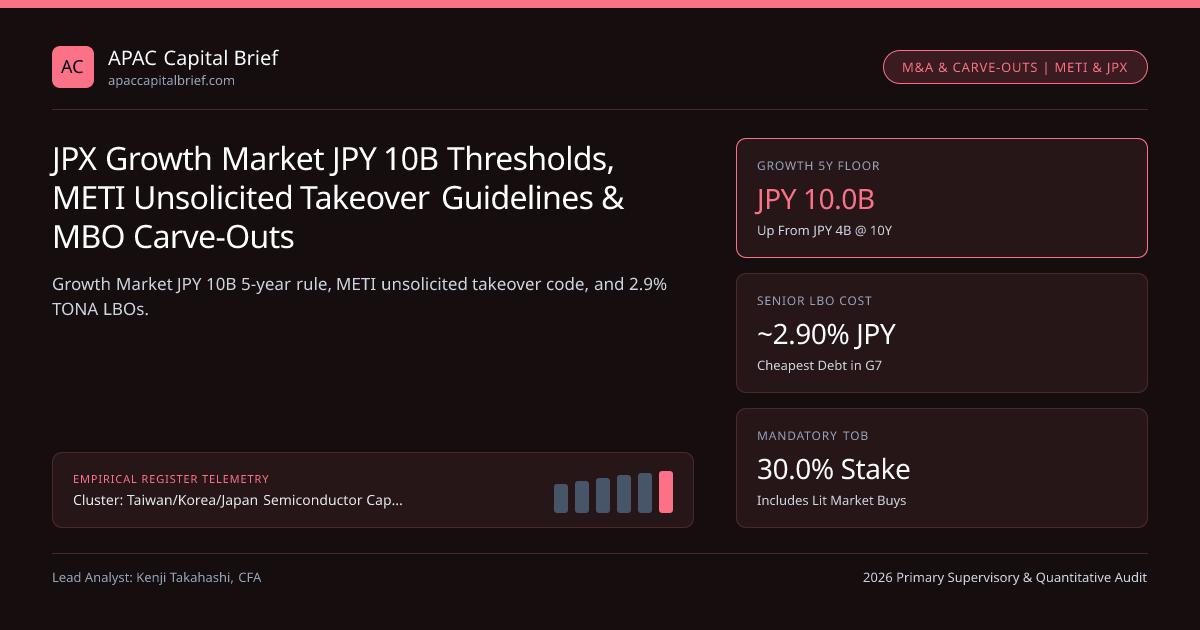
For two decades, Japan suffered from a structural "Small-IPO Trap": hundreds of domestic startups went public prematurely on TSE Mothers / Growth Market at tiny JPY 3–5 billion valuations, saw founder motivation stall post-IPO, lost sell-side research coverage, and languished forever as illiquid micro-caps—while large TOPIX conglomerates simultaneously refused legitimate buyout offers behind vague "corporate value" excuses. Across 2024–2026, two synchronized regulatory sledgehammers from Japan Exchange Group (JPX) / JFSA and METI's Guidelines for Corporate Takeovers shattered both dysfunctions, unleashing an all-time record wave of unsolicited M&A, private-equity carve-outs, and founder Management Buyouts (MBOs) advised by houses such as Daiwa Securities and SMID specialists like Aizawa Securities (aizawa.co.jp) and Ichiyoshi (ichiyoshi.co.jp).
Hammer 1: JPX Growth Market's New "JPY 10B Within 5 Years" Rule#
Under legacy TSE Growth Market rules, a company only needed to reach JPY 4.0 billion in market capitalization 10 years after listing—allowing 70%+ of Growth Market stocks to drift below institutional investability thresholds! JPX's reformed Growth Market Continued-Listing Standard raises the bar2.5x faster:
- New Threshold: Listed Growth Market companies must achieve >= JPY 10.0 billion market capitalization within 5 years of listing (replacing JPY 4.0B at 10 years)!
- Strategic Consequence: Hundreds of profitable-but-sub-scale Japanese SaaS, robotics, semiconductor-subsystem, and healthcare companies stuck between JPY 3B and JPY 9.5B market cap face a binary choice: execute accretive roll-up M&A to scale past JPY 15B+, sell themselves to a strategic corporate acquirer, or partner with domestic PE funds for a take-private MBO!
Hammer 2: METI Guidelines for Corporate Takeovers & JFSA 30% TOB Reform#
When Nidec launched an unsolicited bid for Takisawa Machine Tool, Dai-ichi Life outbid M3 for Benefit One, Brother Industries bid against Roland DG's MBO, and Alimentation Couche-Tard approached Seven & i Holdings, corporate Japan realized hostile / unsolicited M&A is no longer taboo! METI's Guidelines for Corporate Takeovers established three game-changing rules enforced by Japanese courts and institutional proxy voters:
- Principle of Sincere Consideration: Whenever management receives a bona fide (concrete, credible, financed) acquisition proposal—even completely unsolicited!—management cannot dismiss it unilaterally; it MUST promptly submit the offer to the Board of Directors / Independent Special Committee for rigorous evaluation against standalone intrinsic value.
- Shareholder Will on Poison Pills: Takeover defense measures ("poison pills") deployed during a contest generally require shareholder-meeting approval (frequently "Majority-of-Minority" excluding interested parties) rather than unilateral board warrant allotments!
- JFSA Financial Instruments and Exchange Act (FIEA) Tender Offer Overhaul: Closed the notorious "1/3 On-Market Accumulation Loophole" (where activists bought >33.4% rapidly on TSE lit books without launching a public Tender Offer!) by lowering the mandatory TOB threshold to 30% across both off-market and on-market acquisitions!
| M&A / Buyout Category | Representative 2024–2026 Precedents | Regulatory / Valuation Catalyst | Alpha Strategy for SMID Equity Funds |
|---|---|---|---|
| Unsolicited / Competing Corporate Bids | Nidec -> Takisawa; Dai-ichi Life -> Benefit One; Brother -> Roland DG | METI Sincere Consideration rule forces open auctions once an MBO underprices a target! | Hold lowball MBO targets for "bumpitrage" / competing strategic overbids! |
| Conglomerate Carve-Outs & Listed-Sub Buyouts | JIC/Daiwa -> Shinko Electric; Fujitsu, Hitachi, Panasonic, Sony spin-outs | TSE 1.0x PBR & ROIC > WACC division hurdles | Screen listed subsidiaries where parent holds 40%–65% stake trading <1.2x P/B |
| Founder / PE MBOs (Aizawa & ichiyoshi.co.jp universe) | Taisho Pharma, Benesse, Snow Peak, Outsourcing + dozens of sub-JPY 30B SMIDs | Avoid TOPIX float reduction & JPX Growth JPY 10B delisting pressure | Screen founder-owned (>25% stake), net-cash (>30% of cap), >12% EBITDA margin SMIDs |
| Inbound Global PE LBOs (Bain, KKR, Blackstone, EQT) | JPY 1.25% BoJ rates still provide world's cheapest ~2.4%–3.2% LBO senior debt! | Positive spread between 8%–10% target FCF yield and ~2.8% TONA senior LBO loans | Target orphaned industrial/software leaders with zero CEO succession heir |
Japanese Private Equity LBO Equity IRR Advantage Under Low-Rate TONA Senior Debt#
- CashonCashYieldYear1 = [ EBITDA0 * (1 - Capexpct) - ( DebtLBO * rTONASenior ) - Tax ] / EquityCheck
- Worked JPY 50.0B Enterprise-Value Carve-Out LBO (Entry Multiple = 7.5x EBITDA -> EBITDA_0 = JPY 6.67B):
- Capital Structure: 55% Senior Megabank Debt = JPY 27.5B @ r_TONA + 165 bps = 2.90% all-in interest! | 45% PE Equity = JPY 22.5B
- Year-1 Cash Flow: EBITDA (JPY 6.67B) - Maint. Capex (JPY 1.00B) - Interest (JPY 0.80B) - Cash Tax (JPY 1.49B) = JPY 3.38B Free Cash Flow to Debt Paydown!
- Even with ZERO valuation multiple expansion (Exit at 7.5x Year-5 EBITDA growing +6%/yr -> Exit EV = JPY 67.0B, Remaining Debt = JPY 9.2B):
- Exit Equity = JPY 57.8B on JPY 22.5B Initial Check -> 2.57x MOIC / 20.8% Gross IRR!
Japan Corporate Control & MBO Wave by Deal Archetype (2026)#
Linking SMID Buyouts to TOPIX Phase-2 Float Reduction#
This M&A boom also intersects directly with TOPIX Phase-2 index weight reduction (2026–2028), which cuts ~1,200 smaller TSE constituents out of TOPIX—creating our next quantitative alpha trade analyzed in Nikkei 225 price-divisor skews versus TOPIX float reduction. Compare with TSE Prime 1.0x PBR enforcement and our Northeast Asia semiconductor & governance hub, or browse all APAC governance dispatches.
Frequently asked questions
Why did JPX raise TSE Growth Market continued-listing criteria to JPY 10 billion at 5 years?
Over 70% of Japanese startups listed at sub-JPY 5B market caps and stagnated without institutional liquidity; forcing a JPY 10B hurdle at Year 5 redirects venture exits toward pre-IPO M&A and pushes listed micro-caps to consolidate.
What is "bumpitrage" in Japanese Management Buyouts (MBOs)?
Previously, founders took Japanese companies private at lowball valuations unhindered; under METI MBO Fairness Guidelines and Takeover Guidelines, activists buy stakes post-announcement to demand higher tender prices or invite strategic counter-bidders (as Brother did at Roland DG).
What loophole did the JFSA 30% Tender Offer (TOB) reform close?
Legacy FIEA rules exempted continuous on-exchange TSE purchases from mandatory Tender Offer rules even past 33.4% voting control, leading to coercive creeping takeovers; the amended law applies a unified 30% mandatory TOB trigger to on-market accumulations.
Why is Japan currently the most attractive LBO financing market in the G7 for global private equity?
While US SOFR and European EURIBOR leveraged loans cost 6.5%–9.5%, Japanese megabanks eagerly underwrite 5x–6x EBITDA senior LBO facilities at ~2.75%–3.25% yen interest against cash-generative industrial carve-outs.
Publication record
- Published
- 14 November 2026
- Updated
- 15 November 2026
- Author
- Kenji Takahashi, CFA
- Review
- Review not recorded
- Automated fact check
- Passed in the stored pipeline record
- Source URLs
- 3 recorded
AI assistance recorded: anthropic/claude-opus-4.6. This field does not establish human review or source verification.
Academic & Institutional Attribution
Cite This Research & Embed Live Data Card
Standard academic & institutional research paper citation format.
Kenji Takahashi, CFA. (2026, November 14). JPX Growth Market JPY 10B Thresholds, METI Unsolicited Takeover Guidelines & MBO Carve-Outs. APAC Capital Brief. https://apaccapitalbrief.com/dispatches/jpx-growth-market-thresholds-meti-takeover-mbo-carveoutsRegulatory Directory Cross-Reference
Referenced Institutions & Regulatory Registries
Mentioned Regulated Institutions
Primary Tier-1 Supervisory Registries
Related APAC Semiconductor AI Capex Equities & Institutional Briefings
Explore APAC Semiconductor AI Capex Equities Hub (20) →APAC Semiconductor AI Capex Equities
Northeast Asia Semiconductor AI Capex, HBM4 Supply Chains & Corporate Governance: 2026 APAC GuideAPAC Semiconductor AI Capex Equities
Nikkei 225 Price-Divisor Skew vs TOPIX Next-Generation ~1,200-Stock Float ReductionAPAC Semiconductor AI Capex Equities
Taiwan NT$5.8T Retail High-Dividend ETF Crowding, Income Equalization & FSC SITCA ReformsAPAC Semiconductor AI Capex Equities
US BIS Foreign Direct Product Rule (FDPR), HBM Export Controls & APAC WFE Servicing RiskAPAC Semiconductor AI Capex Equities
TSMC US$62B FY2026 Capex & 125,000 wpm CoWoS-L Ramp: Packaged Wafer Margin MechanicsAPAC Semiconductor AI Capex Equities
SK Hynix KRW 48T HBM4 Capex & MR-MUF Yield Lead vs Samsung TC-NCF Hybrid BondingAPAC Semiconductor AI Capex Equities
TSE Prime 1.0x PBR Governance Enforcement: WACC vs ROIC Spread & JPX Name-and-ShameAPAC Semiconductor AI Capex Equities
TOPIX JPY 18.4 Trillion Share Buybacks & Mochiai Cross-Shareholding Unwind MechanicsASIC Afsl Australian Superannuation
RBNZ OCR vs RBA Cash Rate Divergence: AUD/NZD Cross, BKBM–BBSW & Trans-Tasman Mortgage TransmissionASIC Afsl Australian Superannuation
Australia Mandatory AASB S2 Climate Reporting (Group 1 & 2), Scope 3 Safe Harbor & ASIC Greenwashing SuitsASIC Afsl Australian Superannuation
Australian Superannuation Decumulation Wave: Retirement Income Covenant & AUD Bond/Annuity RotationAsean India Sovereign Bond Inclusion
JPMorgan GBI-EM 10% India FAR Cap, FTSE EMGBI Entry & Onshore NDS-OM / CCIL Settlement
APAC Capital Brief Data, Benchmarks & Contributor Records
CC BY 4.0 Open Data
Open Institutional Datasets (CSV / JSON) →
Download desk-compiled quantitative series & schemas.
2026 Reference Matrix
2026 Institutional Benchmarks & Thresholds →
Statutory capital, clearing, margin & rate conventions.
Editorial Records
Authors & Review Records →
View named contributors where those records are available.
Complete Index
Master Research & Dossier Archive →
Browse all published briefings by topic pillar & date.