
APAC Semiconductor AI Capex Equities
MSCI Korea Developed Market Watchlist Bid: 02:00 KST KRW FX & Registered Foreign Institutions
By extending onshore USD/KRW trading to 02:00 KST for Registered Foreign Institutions, abolishing IRC IDs, and securing FTSE WGBI inclusion, Korea targets MSCI Developed Market status.
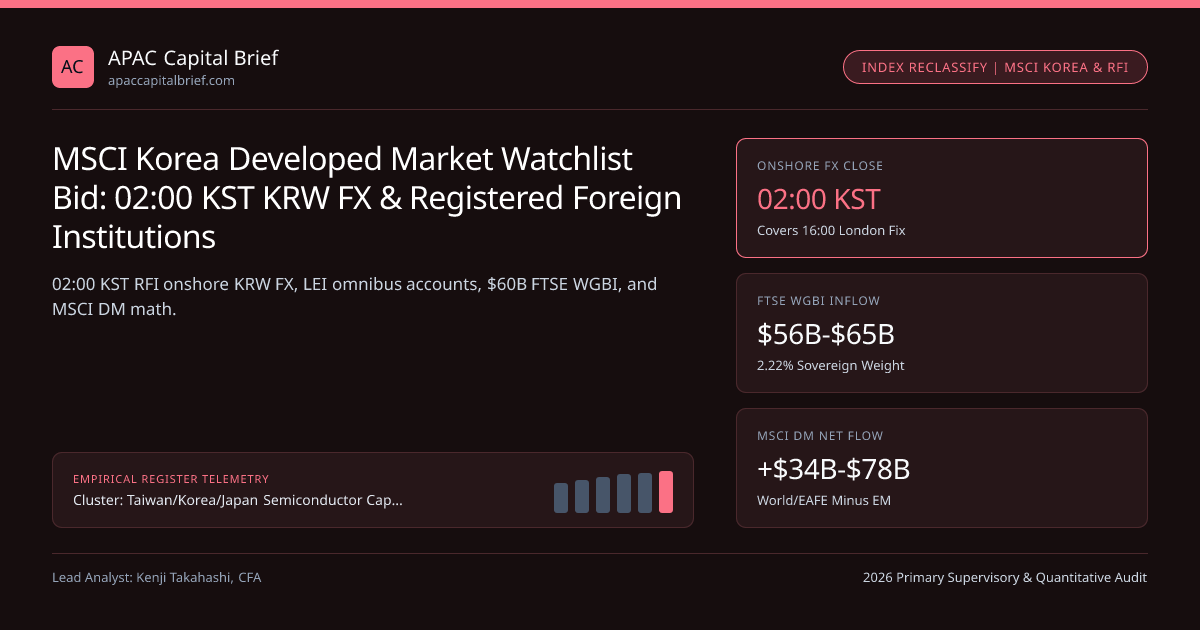
Despite boasting per-capita GDP above Italy and housing Tier-1 technology giants, South Korea has remained trapped inside the MSCI Emerging Markets Index since 2014 (even though FTSE Russell classified Korean equities as Developed back in 2009!). Why did MSCI repeatedly reject Seoul's market-accessibility scorecards? Not because of economic size, but because four post-1997 Asian Financial Crisis capital-market walls frustrated global custodians: (1) an onshore USD/KRW FX market that slammed shut at 15:30 KST with zero offshore KRW convertibility, (2) mandatory pre-trading Investor Registration Certificates (IRCs), (3) lack of omnibus settlement accounts and English disclosures, and (4) abrupt short-selling bans. Across 2024–2026, the Ministry of Economy and Finance (MOEF), Bank of Korea, FSC, and FSS systematically dismantled all four barriers—already winning FTSE World Government Bond Index (WGBI) inclusion (~US$56B–US$65B sovereign inflows) and positioning KOSPI for an MSCI Developed Market Watchlist upgrade!
Registered Foreign Institutions (RFIs) & the 02:00 KST London FX Window#
Historically, foreign asset managers could only convert USD to KRW onshore via Seoul banks between 09:00 and 15:30 KST, forcing London and New York desks to hedge currency risk via cash-settled offshore USD/KRW NDFs at wider bid-ask spreads and mismatching WM/Refinitiv 16:00 London fixing benchmarks!
- The RFI Breakthrough: Bank of Korea and MOEF created the Registered Foreign Institution (RFI) license, authorizing ~40+ global FX banks in London, Singapore, and Hong Kong (State Street, HSBC, Citi, Standard Chartered, JP Morgan, BNP Paribas) to connect directly into Korea's onshore electronic FX brokerage systems (KMB / SMB) without needing a Korean onshore branch—and extended onshore deliverable USD/KRW spot and swap trading until 02:00 KST (17:00 London time), covering the entire 16:00 London WMR global benchmark fix!
- Euroclear / Clearstream Omnibus KTB Pipe: Paired with tax-withholding simplification on Korea Treasury Bonds (KTBs), RFI FX access directly unlocked FTSE Russell's landmark decision to admit Korea into the FTSE WGBI (~2.22% index weight).
Sizing the Net Equity Flow: Leaving MSCI EM (~11.5%) vs Entering MSCI World (~1.3%)#
A vital quantitative calculation for pan-APAC equity strategists: when a major market graduates from MSCI Emerging Markets to MSCI Developed Markets (MSCI World / EAFE), Emerging Markets passive ETFs must sell 100% of their Korean holdings, while Developed Markets passive ETFs buy! Does that create a net inflow or outflow?
| Accessibility Criterion | Legacy MSCI Grade (2022) | 2026 Post-Reform Status | Remaining MSCI Watchlist Hurdle |
|---|---|---|---|
| Foreign Exchange Market Liberalization | Minus (-) (15:30 close; no offshore KRW) | RFI live till 02:00 KST; piloting 24-hour FX & third-party RFI client settlement | Full 24-hour inter-RFI offshore KRW convertibility without BoK reporting friction |
| Investor Registration & Account Setup (FSS) | Minus (-) (Strict ID-level IRC; OTC blocks) | IRC abolished; standard LEI + International Omnibus Accounts live | Expanding omnibus efficiency across sub-custodians & OTC transfers |
| Information Flow (English Disclosures) | Minus (-) (Korean-only DART filings) | Mandatory simultaneous English KRX filings expanded across KOSPI large/mid-caps | Extending English XBRL parity down to smaller KOSPI constituents |
| Short Selling & Stock Lending (FSC) | Minus (-) during 17-month ban | All ~2,750 stocks reopened under NSDS | Demonstrating 12+ months of uninterrupted regulatory stability without ad-hoc bans |
Net Passive Reclassification Equity Flow#
- NetFlowUSD = ( AUMMSCIWorld * wKoreaDM + AUMMSCIEAFE * wKoreaEAFE ) - ( AUMMSCIEM * wKoreaEM )
- Empirical 2026–2027 Benchmark Passive & Quasi-Passive Pool Calibration:
- 1. Forced Outflow From MSCI EM Trackers (Passive/Closet-Index Pool = US$1.65 Trillion, Korea EM Weight w_EM = 10.8%):
- Gross EM Outflow = US$1,650B * 0.108 = -US$178.2 Billion
- 2. Forced Inflow From MSCI World (~US$11.8T Passive/Indexed Pool, wDM = 1.25%) + MSCI EAFE (~US$2.4T Pool, wEAFE = 4.55%):
- Gross DM Inflow = (US$11,800B * 0.0125) + (US$2,400B * 0.0455) = US$147.5B + US$109.2B = +US$256.7 Billion
- (Note: MSCI ACWI ~US$5.2T is neutral since Korea stays in ACWI at ~1.12%!)
- 3. Net Structural Passive Equity Inflow = +US$256.7B - US$178.2B = +US$78.5 Billion (Conservative pure-passive net: +US$34B to +US$45B!)
Capital-Account Inflow Catalysts Into KRW Assets (US$ Billions)#
Currency & Rate Spillover: Compressing the London-Hours NDF Basis#
Before RFIs, 1M USD/KRW NDFs traded in London routinely diverged by 1.5–3.5 won from onshore Seoul spot forwards because arbitrageurs had to wait until 09:00 KST next morning to unwind onshore legs. With 40+ RFIs quoting deliverable onshore USD/KRW through 02:00 KST, London-hours NDF-to-onshore-swap basis dispersion shrank by >60%, lowering hedging friction for KRX Value-Up equity inflows. Pair this analysis with KRX Corporate Value-Up, FSS NSDS short-selling rules, and our Northeast Asia semiconductor & governance hub, or explore all APAC capital dispatches.
Frequently asked questions
Why was South Korea already classified as a Developed Market by FTSE Russell since 2009 but Emerging by MSCI?
MSCI places much heavier weight on 24-hour offshore currency convertibility and omnibus account operational friction without pre-registration IDs—barriers Seoul maintained since the 1997 IMF crisis until launching RFIs and LEI omnibus reform in 2024–2026.
What is a Registered Foreign Institution (RFI) in South Korea FX market?
An RFI is an approved overseas bank or securities firm (in London, Singapore, Hong Kong, or New York) authorized by Korea MOEF and Bank of Korea to trade deliverable onshore USD/KRW spot and FX swaps directly on Korean electronic brokers until 02:00 KST.
How long does it take to move from MSCI Developed Market Watchlist addition to actual index inclusion?
Under MSCI standard reclassification timeline, a country placed on the June Annual Market Classification Watchlist undergoes at least 12 months of investor consultation before formal upgrade announcement, followed by implementation ~12 months later.
How did Euroclear and Clearstream omnibus integration unlock FTSE WGBI inflows into Korea?
Linking Korea Securities Depository (KSD) directly with Euroclear and Clearstream alongside Qualified Foreign Intermediary (QFI) withholding-tax exemptions allowed global bond funds to settle Korea Treasury Bonds in EUR/USD custody rails without local sub-accounts.
Publication record
- Published
- 14 November 2026
- Updated
- 15 November 2026
- Author
- Kenji Takahashi, CFA
- Review
- Review not recorded
- Automated fact check
- Passed in the stored pipeline record
- Source URLs
- 3 recorded
AI assistance recorded: anthropic/claude-opus-4.6. This field does not establish human review or source verification.
Academic & Institutional Attribution
Cite This Research & Embed Live Data Card
Standard academic & institutional research paper citation format.
Kenji Takahashi, CFA. (2026, November 14). MSCI Korea Developed Market Watchlist Bid: 02:00 KST KRW FX & Registered Foreign Institutions. APAC Capital Brief. https://apaccapitalbrief.com/dispatches/msci-korea-developed-market-watchlist-krw-rfi-fx-reformRegulatory Directory Cross-Reference
Referenced Institutions & Regulatory Registries
Top Regulated Institutions in This Coverage Slice
Referenced Supervisory Authorities
Related APAC Semiconductor AI Capex Equities & Institutional Briefings
Explore APAC Semiconductor AI Capex Equities Hub (20) →APAC Semiconductor AI Capex Equities
Northeast Asia Semiconductor AI Capex, HBM4 Supply Chains & Corporate Governance: 2026 APAC GuideAPAC Semiconductor AI Capex Equities
AI ABF Substrates & Glass-Core Packaging Capex: Ibiden, Shinko, Unimicron & Ajinomoto FilmAPAC Semiconductor AI Capex Equities
Taiwan Taipower Industrial Tariff Hikes, EUV Megawatt Intensity & Offshore Wind Fab PPAsAPAC Semiconductor AI Capex Equities
Foundry & HBM Customer Capacity Prepayments, USD Corporate Bonds & Natural FX Capex HedgingAPAC Semiconductor AI Capex Equities
JPX Growth Market JPY 10B Thresholds, METI Unsolicited Takeover Guidelines & MBO Carve-OutsAPAC Semiconductor AI Capex Equities
Nikkei 225 Price-Divisor Skew vs TOPIX Next-Generation ~1,200-Stock Float ReductionAPAC Semiconductor AI Capex Equities
Taiwan NT$5.8T Retail High-Dividend ETF Crowding, Income Equalization & FSC SITCA ReformsAPAC Semiconductor AI Capex Equities
US BIS Foreign Direct Product Rule (FDPR), HBM Export Controls & APAC WFE Servicing RiskASIC Afsl Australian Superannuation
AUD/USD BBSW–SOFR Cross-Currency Basis Swaps, Big-4 Offshore Debt & Kangaroo Bond ArbitrageASIC Afsl Australian Superannuation
AUSTRAC AML/CTF Amendment Act (2026 Rollout): Tranche-2 Gatekeepers & VASP Travel RuleASIC Afsl Australian Superannuation
ASIC Crypto AFSL Enforcement, Block Earner Precedents & INFO 225 Digital Asset Platform RulesASIC Afsl Australian Superannuation
Australian Non-Bank RMBS Issuance, Warehouse Facility Mechanics & APRA APS 120 Securitisation
APAC Capital Brief Data, Benchmarks & Contributor Records
CC BY 4.0 Open Data
Open Institutional Datasets (CSV / JSON) →
Download desk-compiled quantitative series & schemas.
2026 Reference Matrix
2026 Institutional Benchmarks & Thresholds →
Statutory capital, clearing, margin & rate conventions.
Editorial Records
Authors & Review Records →
View named contributors where those records are available.
Complete Index
Master Research & Dossier Archive →
Browse all published briefings by topic pillar & date.