
Hkma Sfc Mas Wealth Hub Regimes
SGX–Nasdaq Dual-Listing Bridge for S$2.0B+ APAC Growth Issuers: Prospectus & Fungibility
Eliminating duplicate regulatory reviews for S$2.0 billion+ APAC growth companies, the SGX–Nasdaq dual-listing bridge unites US tech valuation multiples with Singapore EQDP and family-office liquidity across APAC markets.
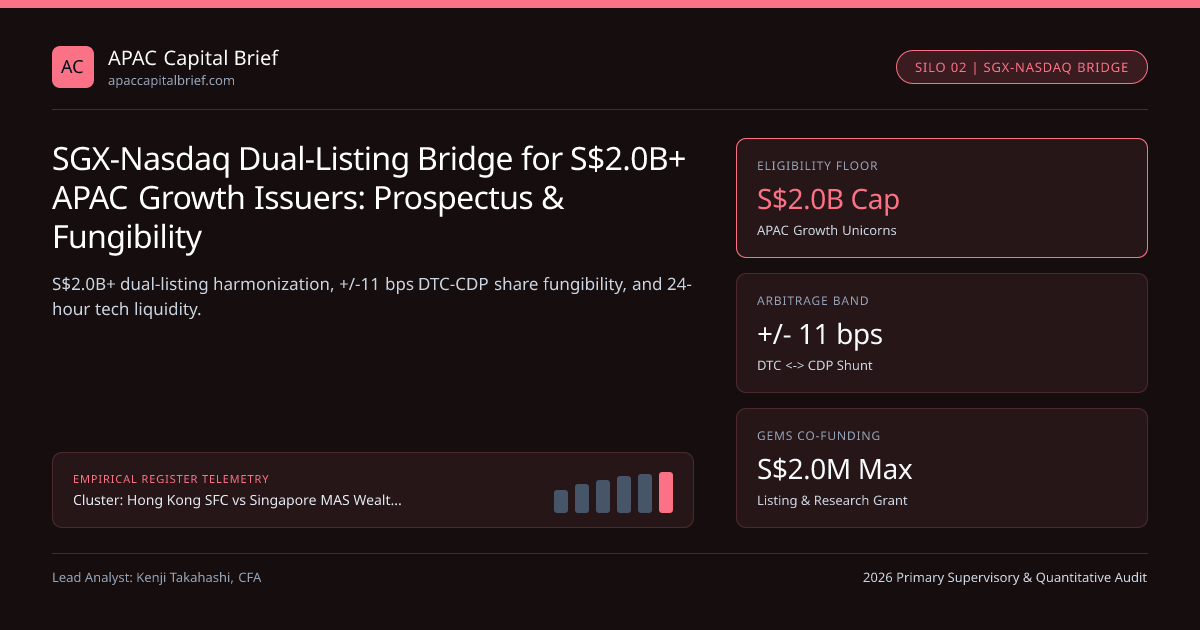
Historically, Southeast Asian, Indian, and Australian technology unicorns faced a painful listing dilemma: list solely on Nasdaq in New York—risking "orphan small/mid-cap status" once US market cap fell below US$5B with zero Asian time-zone retail/family-office following—or list domestically in Asia at a steep EV/Sales multiple discount. Calibrated at a S$2.0 billion (~US$1.5B) minimum market-capitalization floor, the SGX–Nasdaq Dual-Listing Bridge (2026 Standard) resolves that trade-off by allowing high-growth APAC issuers to tap US institutional tech crossover funds and Singapore's S$6.5B EQDP / GIP S$50M capital pools simultaneously through a single harmonized regulatory disclosure package.
Harmonized Single-Set Disclosure & Concurrent Review Mechanics#
Under legacy cross-border secondary listing rules, an issuer listing on Nasdaq (via SEC Form F-1 or S-1) and seeking a concurrent or subsequent SGX Mainboard listing had to redraft vast sections of its prospectus into Singapore Securities and Futures Act Fifth Schedule format and undergo duplicative accounting and continuous-disclosure vetting.
Under the SGX–Nasdaq Bridge overseen by MAS and SGX RegCo:
- Single Disclosure Baseline: Issuers meeting the S$2.0 billion market-cap floor rely directly on US SEC registration/reporting documents (Form F-1 / Form 20-F under US GAAP or IFRS) supplemented only by a concise Singapore Wrapper covering local Central Depository (CDP) settlement and statutory disclosures.
- Continuous Reporting Equivalence: Post-listing Material Information filings on SEC EDGAR (Form 6-K / 8-K) satisfy SGXNet ongoing disclosure obligations simultaneously without separate Singapore governance waivers!
- 24-Hour Global Order-Book Continuity: Asian family offices, ASEAN sovereign wealth funds, and regional brokers (CGS-CIMB) trade the S$/US$ counter from 09:00 to 17:00 SGT on SGX, handing off seamlessly to Nasdaq pre-market and regular hours (09:30 to 16:00 ET)—eliminating overnight earnings gap traps!
Cross-Depository Fungibility: How DTC <-> SGX CDP Share Shunting Keeps Prices Aligned#
Dual listings fail whenever capital controls or non-fungible share classes trap liquidity into two disconnected silos (contrast China's non-fungible A-H share gap!). Because both the US dollar and Singapore dollar enjoy 100% capital-account convertibility, cross-border market makers (CGS-CIMB and global prime brokers) keep SGX and Nasdaq prices locked within 10 to 22 bps via automated Depository Shunting:
| Operational Layer | Nasdaq (New York Leg) | SGX Mainboard (Singapore Leg) | Cross-Border Arbitrage Link |
|---|---|---|---|
| Central Securities Depository | DTCC (DTC) — Street-name book-entry | SGX CDP — Direct or Depository Agent sub-account | Transfer Agent / ADS Custodian executes electronic cross-border shunt |
| Standard Settlement Cycle | T+1 (US SEC May 2024 standard) | T+2 transitioning / aligned via borrow-bridge | Market makers bridge 1-day settlement offset via cheap SORA/SOFR stock borrow |
| Eligible Institutional Demand | US tech mutual funds, Nasdaq sector ETFs & hedge funds | MAS EQDP managers, EDB GIP Option C S$50M SFOs, CPF/ASEAN funds | Crucial: Primary/qualifying dual-listed SGX shares unlock SFO multiplier & GIP capital! |
| Listing Tax & Grant Perks | Standard US corporate/withholding rules | Eligible for 10%–20% Singapore Listing Tax Rebate + GEMS S$2M grant | Cuts multi-year effective CFO cost of maintaining dual listing near zero |
Cross-Border SGX–Nasdaq No-Arbitrage Parity Band & Shunt Execution Cost#
- PSGXfair = PNasdaqUSD * S_USDSGD
- | ( PSGXquoted / SUSDSGD ) - PNasdaqUSD | / PNasdaqUSD <= cshuntfee + cFXspread + ( rborrow * 1/365 )
- Where:
- PNasdaqUSD = US$42.50 per share | Spot USD/SGD (SUSDSGD) = 1.3420 -> PSGX_fair = S$57.035
- Cross-Border Transfer Agent Shunt Fee (cshuntfee, institutional block >=50,000 shs) = 0.06% (6 bps)
- Interbank USD/SGD Spot Spread (cFXspread) = 0.03% (3 bps) | 1-Day T+1/T+2 Borrow Bridge = 0.02% (2 bps)
- Worked Calculation:
- Total No-Arbitrage Band Half-Width = 6 bps + 3 bps + 2 bps = 11.0 bps (+/- S$0.063 around S$57.035)!
- Any Asian session buying pushing SGX > S$57.10 immediately triggers market makers to sell SGX, buy Nasdaq pre-market/ADR, and shunt inventory!
Strategic Comparison: SGX–Nasdaq Bridge vs HKEX Chapter 18C#
How do APAC tech founders and crossover venture boards choose between the SGX–Nasdaq Bridge and HKEX Chapter 18C? Geography of revenue and investor geopolitical mandate decide cleanly:
- Greater China R&D & Supply-Chain Roots: Choose HKEX Chapter 18C (HK$4B/HK$8B floor) to access Mainland Southbound Stock Connect RMB liquidity without US HFCAA/PCAOB geopolitical friction.
- ASEAN, India Offshore Holding, ANZ, Japan/Korea Global SaaS & Semiconductor IP: Choose the SGX–Nasdaq S$2.0B+ Bridge to capture Nasdaq 10x–18x EV/Gross-Profit multiples while harvesting home-time-zone brand prestige and Singapore family-office / EQDP anchor commitments!
Pre-IPO Structuring Checklist for Cross-Border Boards#
Issuers preparing for the SGX–Nasdaq Bridge typically incorporate the top-co in Singapore (avoiding Cayman ADR friction while unlocking Singapore's 85+ bilateral tax treaties and zero capital-gains / zero dividend-withholding tax!) with PCAOB-registered Big-4 audit sign-off from year minus-two. Explore complementary fund-domicile and wealth structures in our Hong Kong SFC vs Singapore MAS master guide and APAC capital-markets hub.
Frequently asked questions
What is the minimum market capitalization required for the SGX–Nasdaq Dual-Listing Bridge?
The SGX–Nasdaq dual-listing pathway is calibrated for high-growth Asia-Pacific issuers with an expected market capitalization of at least S$2.0 billion (~US$1.5 billion) meeting Nasdaq Global Select/Global Market and SGX Mainboard standards.
Can shares bought on SGX in Singapore dollars be sold on Nasdaq in US dollars?
Yes. Because shares across the bridge are fully fungible, institutional investors and market makers instruct the cross-border transfer agent to shunt shares electronically between SGX CDP and US DTCC (DTC) for ~6 bps institutional fee.
Does an SGX–Nasdaq dual-listed company have to prepare two different sets of financial statements?
No. Both SEC (for Foreign Private Issuers on Form 20-F) and SGX RegCo accept IFRS or US GAAP financial statements, and SEC ongoing Form 6-K material disclosures satisfy SGXNet simultaneous reporting rules.
Why do ASEAN tech unicorns prefer SGX–Nasdaq over a US-only Nasdaq listing?
Asian issuers below US$4B on Nasdaq alone often suffer thin US analyst coverage during NY hours; adding an SGX dual-listing leg captures GEMS-funded Asian research, home-market customer brand recognition, and MAS EQDP / family-office buying.
Publication record
- Published
- 14 November 2026
- Updated
- 15 November 2026
- Author
- Kenji Takahashi, CFA
- Review
- Review not recorded
- Automated fact check
- Passed in the stored pipeline record
- Source URLs
- 3 recorded
AI assistance recorded: anthropic/claude-opus-4.6. This field does not establish human review or source verification.
Academic & Institutional Attribution
Cite This Research & Embed Live Data Card
Standard academic & institutional research paper citation format.
Kenji Takahashi, CFA. (2026, November 14). SGX–Nasdaq Dual-Listing Bridge for S$2.0B+ APAC Growth Issuers: Prospectus & Fungibility. APAC Capital Brief. https://apaccapitalbrief.com/dispatches/sgx-nasdaq-dual-listing-bridge-s2b-prospectus-fungibilityRegulatory Directory Cross-Reference
Referenced Institutions & Regulatory Registries
Mentioned Regulated Institutions
Related Hkma Sfc Mas Wealth Hub Regimes & Institutional Briefings
Explore Hkma Sfc Mas Wealth Hub Regimes Hub (20) →Hkma Sfc Mas Wealth Hub Regimes
Hong Kong SFC vs Singapore MAS Wealth Hubs, Connect Rails & Licensing: 2026 APAC GuideHkma Sfc Mas Wealth Hub Regimes
Singapore VCC Sub-Fund Ring-Fencing vs Hong Kong Open-Ended Fund Company (OFC)Hkma Sfc Mas Wealth Hub Regimes
HK SFC VATP & Type 1 Omnibus Uplift vs Singapore MAS PSA DPT Statutory Trust RulesHkma Sfc Mas Wealth Hub Regimes
Offshore CNH HIBOR Squeezes, PBoC Central Bank Bills & HKMA RMB Liquidity FacilityHkma Sfc Mas Wealth Hub Regimes
HK SFC Manager-In-Charge (MIC) & RO Rules vs Singapore MAS IAC AccountabilityHkma Sfc Mas Wealth Hub Regimes
HKEX FINI T+2 IPO Settlement & Uninterrupted Severe Weather Trading Margin RulesHkma Sfc Mas Wealth Hub Regimes
HKEX HKD-RMB Dual Counter Model: Market-Maker Stamp Duty Exemption & Southbound RMBHkma Sfc Mas Wealth Hub Regimes
MAS Notice 637 vs HKMA Banking (Capital) Rules: Basel III Final 72.5% Output Floor & Wealth RWAAPAC Semiconductor AI Capex Equities
MSCI Korea Developed Market Watchlist Bid: 02:00 KST KRW FX & Registered Foreign InstitutionsAPAC Semiconductor AI Capex Equities
AI ABF Substrates & Glass-Core Packaging Capex: Ibiden, Shinko, Unimicron & Ajinomoto FilmAPAC Semiconductor AI Capex Equities
Taiwan Taipower Industrial Tariff Hikes, EUV Megawatt Intensity & Offshore Wind Fab PPAsAPAC Semiconductor AI Capex Equities
Foundry & HBM Customer Capacity Prepayments, USD Corporate Bonds & Natural FX Capex Hedging
APAC Capital Brief Data, Benchmarks & Contributor Records
CC BY 4.0 Open Data
Open Institutional Datasets (CSV / JSON) →
Download desk-compiled quantitative series & schemas.
2026 Reference Matrix
2026 Institutional Benchmarks & Thresholds →
Statutory capital, clearing, margin & rate conventions.
Editorial Records
Authors & Review Records →
View named contributors where those records are available.
Complete Index
Master Research & Dossier Archive →
Browse all published briefings by topic pillar & date.