
Asean India Sovereign Bond Inclusion
CCIL QCCP Supervisory Standoff: ESMA vs Bank of England Recognition & European Bank RWA Impact
When ESMA derecognized Clearing Corporation of India Ltd (CCIL) over extraterritorial inspection disputes with RBI, European custodian banks faced punitive Basel CRR non-QCCP capital charges.
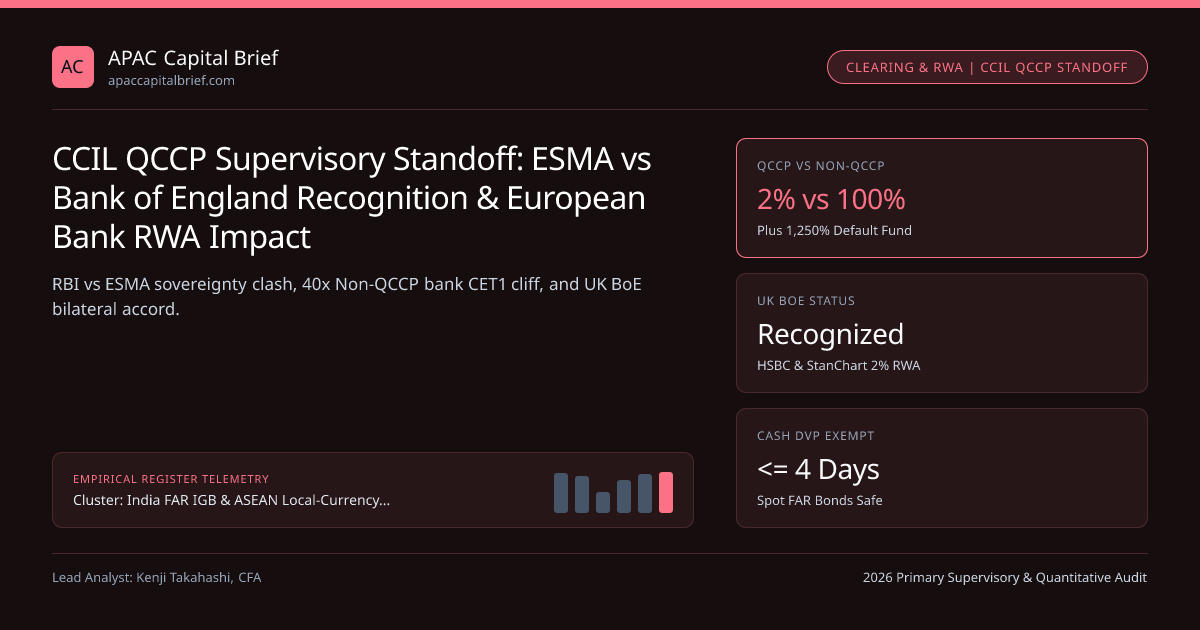
Right as global fixed-income funds prepared to funnel US$40+ billion into India's Fully Accessible Route (FAR) sovereign bonds, a high-stakes extraterritorial battle over sovereign regulatory sovereignty erupted between Brussels/Paris and Mumbai: the European Securities and Markets Authority (ESMA) withdrew "Third-Country Qualifying Central Counterparty (QCCP)" status from Clearing Corporation of India Ltd (CCIL) (alongside NSE Clearing and Indian Clearing Corp) after the Reserve Bank of India (RBI) and SEBI refused to sign an MoU granting European regulators unilateral on-site audit and sanction powers over India's core sovereign clearinghouse! For European dealer/custodian giants (BNP Paribas, Deutsche Bank, Société Générale—as well as UK banks until the Bank of England struck a pragmatic bilateral breakthrough!), losing QCCP status threatened a 50x explosion in Basel III Capital Requirements Regulation (CRR) risk-weighted assets (RWA)!
Basel III CRR Math: Why Losing "QCCP" Status Multiplies Bank Capital 50x!#
Under Basel III / EU CRR Article 306 & 310, when an international bank clears sovereign bonds, FX forwards, or interest-rate swaps in Mumbai through CCIL:
- Recognized QCCP (
Qualifying CCP): Trade exposures incur a tiny 2.0% risk weight (or 4% on omnibus client legs), and Default Fund contributions carry minimal standardized charges! - Derecognized Non-QCCP: On the exact day ESMA's withdrawal took effect (following delayed forbearance deadlines issued by Germany's BaFin and France's ACPR through October 2024+), trade exposures jump from a 2% risk weight to bilateral corporate/unrated risk weights (
50% to 100%!), while CCIL Default Fund contributions suffer a punitive1,250% risk weight(meaning 1-for-1 full CET1 capital deduction!)!
Competitive Market Shift: Why UK, US & Domestic Indian Custodians Won Market Share!#
Watch how divergent post-Brexit regulatory philosophies directly reshaped who captures FPI custody and primary-dealer wallet share on India's US$45B+ FAR bond inflows:
- UK Bank of England Pragmatism (HSBC & Standard Chartered Protected!): Freed from EU EMIR 2.2 rigidity post-Brexit, the Bank of England and RBI signed a bespoke Cooperation & Information-Sharing Memorandum of Understanding respecting RBI's primary supervisory authority—preserving full 2% QCCP treatment for UK-headquartered HSBC and Standard Chartered (the two largest foreign FPI custodians in India, holding >55% combined foreign custody share!)!
- US Federal Reserve / CFTC Stance (Citi & JPMorgan): US agencies applied pragmatic no-action/equivalence deference for local FPI cash bond settlement, avoiding capital cliffs on Citibank India and JPMorgan Mumbai.
- EU Banks (Deutsche Bank, BNP Paribas, Crédit Agricole): Forced after BaFin/ACPR transitional forbearance expired to restructure their Indian clearing membership—shifting away from Direct Clearing Member Default Fund exposure into indirect client clearing via domestic Indian Clearing Banks (State Bank of India, Kotak, ICICI, HDFC), shrinking proprietary rupee IRS market-making books, or migrating offshore INR NDF/OIS trading to GIFT City IFSC and Singapore!
| Bank Headquarter Jurisdiction | Regulatory Stance on India CCIL | CRR / Basel Trade & Default-Fund Weight | Operational Custody & Trading Response |
|---|---|---|---|
| United Kingdom (HSBC, Standard Chartered) | Bank of England – RBI MoU Signed (CCIL recognized under UK CCP regime) | 2.0% QCCP Trade Weight preserved | Major Market-Share Winner: seamlessly onboarded bulk of European UCITS GBI-EM mandates! |
| United States (Citi, JPMorgan, BofA) | US prudential/CFTC equivalence accommodations | Low QCCP / DVP sovereign settlement treatment | Uninterrupted Primary Dealer RFQ liquidity on Bloomberg E-Bond & Tradeweb |
| European Union (Deutsche Bank, BNP Paribas, SocGen) | ESMA Derecognized CCIL (BaFin/ACPR temporary extensions sunsetting; EMIR 3.0 negotiations) | 50%–100% Trade RWA + 1,250% Default Fund RWA if direct member! | Stepped down from high-Default-Fund segments; use indirect Indian GCM clearing & DvP T+1/T+2 exemptions |
| Domestic Indian Banks (SBI, Kotak, ICICI, Axis) & Brokers (Bonanza) | Supervised directly by RBI & SEBI (100% QCCP onshore!) | 2.0% QCCP Weight under RBI Basel III norms | Expanded institutional FPI sub-clearing & local Primary Dealer market share |
European Bank Regulatory Capital Surge Upon CCIL Loss of QCCP Status#
- CET1RequiredQCCP = 0.105 * [ 0.02 * EADTrades + KCCPMultiplier * DFContribution ]
- CET1RequiredNonQCCP = 0.105 * [ 1.00 * EADTrades + 12.50 * DF_Contribution ]
- Worked Mumbai Branch Balance-Sheet Impact (EUR-Headquartered Dealer With EUR 1.80B Exposure-at-Default in INR IRS/FX Forwards + EUR 65M CCIL Default Fund):
- 1. As Recognized QCCP:
- RWA = (0.02 * 1,800M) + (~0.45 * 65M) = EUR 36.0M + EUR 29.25M = EUR 65.25M RWA -> CET1 Capital = EUR 6.85 Million!
- 2. As Derecognized Non-QCCP (Without Restructuring Into Indirect Clearing):
- RWA = (1.00 * 1,800M) + (12.50 * 65M) = EUR 1,800M + EUR 812.5M = EUR 2,612.5M RWA -> CET1 Capital = EUR 274.31 Million!
- > A staggering 40.0x increase in trapped CET1 capital (+EUR 267.5M), crushing Mumbai branch ROE from 16% down to <1.5%!
India FPI Custody & Clearing Competitive Landscape (2026)#
Crucial Relief Detail for European UCITS Fund Investors!#
Does ESMA's derecognition of CCIL stop a Dublin or Luxembourg UCITS bond fund from buying 10% GBI-EM Indian FAR bonds? NO! Why? Two reasons: (1) EU CRR capital charges apply to *EU-regulated banks*, NOT directly to UCITS asset-management portfolios (which can freely appoint HSBC, Standard Chartered, or Citibank as their Indian FPI custodian!), and (2) even where Deutsche Bank or BNP Paribas acts as custodian on standard T+1/T+2 Delivery-versus-Payment (DvP) cash sovereign bond settlements, CRR exempts standard <=4-day cash DvP settlement from counterparty credit RWA—meaning the 40x RWA cliff hit margined derivatives (INR OIS swaps & FX forwards)** rather than spot cash FAR bond custody! Pair this with CCIL TREPS repo & MIBOR plumbing, GIFT City IFSC offshore clearing, and our India FAR & ASEAN bond inclusion hub, or explore all APAC bond dispatches.
Frequently asked questions
Why did the Reserve Bank of India refuse ESMA request for audit access to CCIL?
CCIL clears India sovereign debt (IGBs), RBI TREPS money-market liquidity, and onshore USD/INR interbank FX; RBI viewed granting a foreign agency direct on-site inspection and fining powers over domestic sovereign infrastructure without reciprocity as an unacceptable breach of sovereignty.
Did ESMA derecognition of CCIL block European UCITS funds from tracking JPMorgan GBI-EM India?
No. EU CRR QCCP penalties apply to EU commercial/investment bank balance sheets, not UCITS fund portfolios; European funds either clear via UK/US/Indian custodians (HSBC, StanChart, Citi) or utilize standard cash T+1/T+2 DvP settlement.
How did Deutsche Bank and BNP Paribas continue servicing clients in India after BaFin/ACPR forbearance ended?
EU banks restructured margined derivative/FX clearing into indirect client-clearing arrangements through domestic RBI-supervised Indian General Clearing Members (such as SBI or ICICI) while keeping spot DvP securities custody active.
Why did the UK Bank of England reach an agreement with RBI when ESMA did not?
Under the UK post-Brexit overseas CCP regime, the Bank of England prioritizes outcomes-based deference to home-country supervisors adhering to IOSCO PFMI principles rather than demanding direct extraterritorial inspection rights inside Mumbai.
Publication record
- Published
- 13 November 2026
- Updated
- 15 November 2026
- Author
- Kenji Takahashi, CFA
- Review
- Review not recorded
- Automated fact check
- Passed in the stored pipeline record
- Source URLs
- 3 recorded
AI assistance recorded: anthropic/claude-opus-4.6. This field does not establish human review or source verification.
Academic & Institutional Attribution
Cite This Research & Embed Live Data Card
Standard academic & institutional research paper citation format.
Kenji Takahashi, CFA. (2026, November 14). CCIL QCCP Supervisory Standoff: ESMA vs Bank of England Recognition & European Bank RWA Impact. APAC Capital Brief. https://apaccapitalbrief.com/dispatches/ccil-qccp-esma-boe-derecognition-european-bank-custody-rwaRegulatory Directory Cross-Reference
Referenced Institutions & Regulatory Registries
Mentioned Regulated Institutions
Referenced Supervisory Authorities
Related Asean India Sovereign Bond Inclusion & Institutional Briefings
Explore Asean India Sovereign Bond Inclusion Hub (20) →Asean India Sovereign Bond Inclusion
India FAR IGB Index Inclusion, RBI/SEBI Plumbing & ASEAN Local-Currency Bond Guide (2026)Asean India Sovereign Bond Inclusion
RBI Two-Front Rupee Defense: US$700B FX Reserves, Forward Swap Books & Offshore INR NDF InterventionAsean India Sovereign Bond Inclusion
India FAR Sovereign Bond Taxation: 20% Section 196D FPI Withholding, DTAA Treaties & Capital GainsAsean India Sovereign Bond Inclusion
GIFT City IFSC Institutional Architecture: IFSCA Fund Regimes, GIFT Nifty (NSE IX) & IBU BankingAsean India Sovereign Bond Inclusion
Bank Indonesia SRBI Bills, "Operation Twist" & Foreign Flows Into IndoGB Sovereign Bonds (SBN)Asean India Sovereign Bond Inclusion
Indonesia 100% DHE SDA Export FX Retention Mandate (PP 8/2025): Onshore USD Liquidity & Exporter SwapsAsean India Sovereign Bond Inclusion
Malaysia BNM Onshore FX Rules, Dynamic Hedging, AOOs & 0%-WHT MGS / FTSE WGBI FlowsAsean India Sovereign Bond Inclusion
SEBI FPI Granular Beneficial-Ownership Rules (INR 50,000 Cr Update) & Offshore ODI / P-Note BanCorporate Governance
Jensen Huang resigns as Nvidia chief - Nikkei AsiaMonetary Policy
AI slump not seen affecting Bank of Japan’s rate-rise plan - The Japan TimesMarket Insights
Nikkei 225 bear market deepens as volatility surges - StoneXMarket Insights
Nikkei 225 Rises to 61,248.59 for a Third Straight Gain as Chip Stocks Rally - BBN Times
APAC Capital Brief Data, Benchmarks & Contributor Records
CC BY 4.0 Open Data
Open Institutional Datasets (CSV / JSON) →
Download desk-compiled quantitative series & schemas.
2026 Reference Matrix
2026 Institutional Benchmarks & Thresholds →
Statutory capital, clearing, margin & rate conventions.
Editorial Records
Authors & Review Records →
View named contributors where those records are available.
Complete Index
Master Research & Dossier Archive →
Browse all published briefings by topic pillar & date.