
Asean India Sovereign Bond Inclusion
JPMorgan GBI-EM 10% India FAR Cap, FTSE EMGBI Entry & Onshore NDS-OM / CCIL Settlement
Completing its 1% monthly climb to the 10% JPMorgan GBI-EM ceiling and entering FTSE EMGBI, India FAR sovereign bond market clears 100% onshore via SEBI FPIs and CCIL.
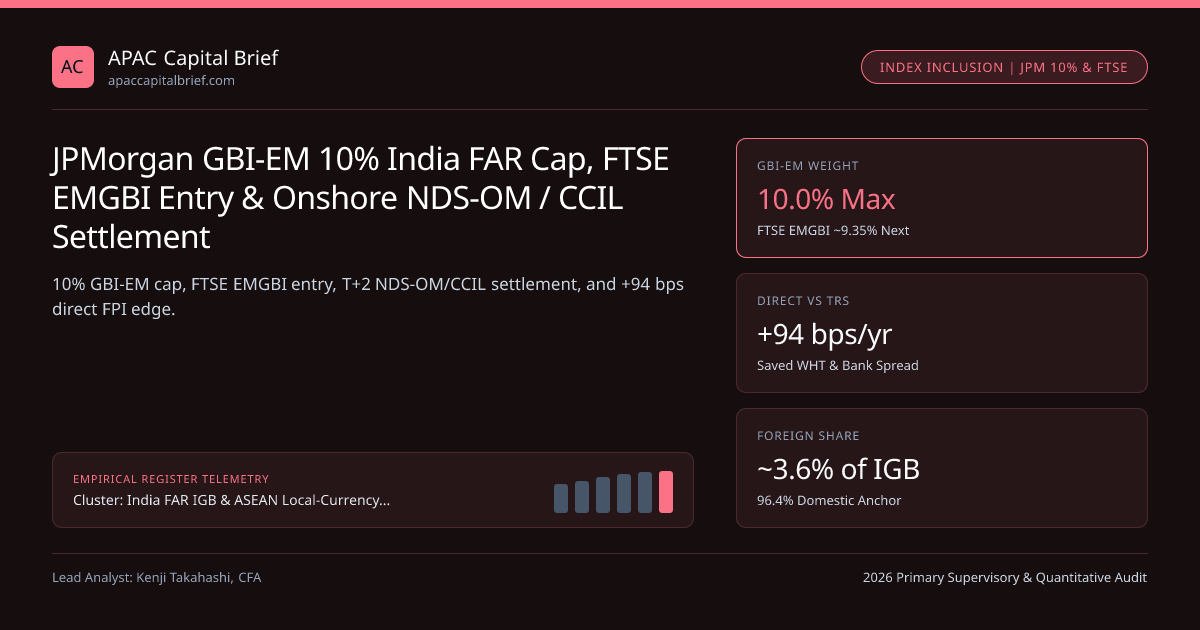
Between June 28, 2024 and March 31, 2025, India's Fully Accessible Route (FAR) Government Bonds added 1.0% index weight per month until hitting the hard 10.0% country ceiling inside JPMorgan's flagship ~US$235 billion GBI-EM Global Diversified Index (joining China, Indonesia, Mexico, and Malaysia at the 10% maximum cap!), followed immediately by Bloomberg EM Local Currency Index scaling and FTSE Russell Emerging Markets Government Bond Index (EMGBI) inclusion commencing September 2025 (~9.35% target weight over 6 months)! Yet unlike China (which built offshore Bond Connect via Hong Kong CMU) or South Korea (which connected KSD directly to Euroclear), 100% of direct cash Indian FAR bond trading settles onshore in Mumbai through Designated Depository Participants (DDPs) regulated by SEBI and the Negotiated Dealing System – Order Matching (NDS-OM) / CCIL regulated by the Reserve Bank of India (RBI)!
Step-by-Step Onshore Onboarding & Execution Plumbing for Global Bond Funds#
How does a US$20 billion Dublin UCITS or Boston 40-Act EM bond fund buy the 7.10% GS 2034 or 6.79% GS 2034 benchmark IGB without Euroclear?
- Common Application Form (CAF) Single-Window FPI Onboarding: Through SEBI's digital portal (
NSDL / CDSL FPI Monitor), a Category I FPI (pension fund, sovereign wealth fund, regulated mutual fund/UCITS) obtains its SEBI FPI registration, Income Tax Permanent Account Number (PAN), Constituents' Subsidiary General Ledger (CSGL) gilt account at an onshore custodian bank (HSBC India, Standard Chartered India, Citi India, Kotak, SBI, Deutsche Bank), and rupee Special Non-Resident Rupee (SNRR / FPI Rupee) account in 10 to 18 business days. - Electronic Execution (
Bloomberg E-Bond / Tradeweb / Refinitiv -> NDS-OM): In crucial operational relief granted ahead of inclusion, RBI allowed FPIs to match bilaterally or via Request-for-Quote (RFQ) on Bloomberg E-Bond and Tradeweb, flowing straight-through into CCIL for guaranteed novation on a T+1 OR FPI-elected T+2 settlement cycle (accommodating cross-time-zone FX funding!). - Extended Cutoffs & Margin Netting: RBI and CCIL extended FPI trade-matching windows on T+1 morning (
up to 09:00–10:00 IST) so New York and London portfolio managers executing late afternoon trades can affirm custodian allocations seamlessly without pre-funding INR cash on Trade Date!
RBI's Macroprudential Masterstroke: Excluding New 14-Year & 30-Year IGBs From FAR!#
Only four weeks after JPMorgan inclusion went live in July 2024, the RBI (in consultation with the Government of India) made a surgical macroprudential tweak that reshaped the Indian yield curve: *all newly issued* 14-year and 30-year Indian Government Securities were REMOVED from future FAR eligibility (while keeping existing FAR bonds grandfathered and keeping all new 5-year, 7-year, and 10-year benchmark IGBs 100% inside FAR**)!
| Maturity Segment / Access Route | Post-July 2024 RBI Rule | Primary Investor Base | Curve Slope & Basis Consequence |
|---|---|---|---|
| 5Y, 7Y & 10Y Benchmark IGBs | 100% FAR Eligible (Zero foreign cap; automatic JPM/FTSE index entry if >=US$1B face) | Global passive/active FPIs, Indian banks (SLR statutory 18% liquidity!) & mutual funds | Compresses 5Y–10Y belly yields by -15 to -25 bps relative to non-FAR off-the-runs! |
| New 14Y, 30Y, 40Y & 50Y IGBs | Excluded From FAR (Subject to tight ~6% General FPI Corporate/VRR/MTF caps) | Domestic Indian Life Insurers (LIC, HDFC Life, SBI Life) & EPFO provident pensions! | Steepened 10s30s IGB curve (+22 to +32 bps), shielding ultra-long bonds from global risk-off outflows! |
| Sovereign Green Bonds (SGrBs) | Select 5Y/10Y tranches retained in FAR | Dedicated ESG EM sovereign funds + domestic banks | Trades at a modest 2–5 bps "greenium" inside nominal IGBs |
| Total Return Swaps (TRS) / ODIs | Offshore synthetic FAR exposure issued by global investment banks (with SEBI ODI debt carve-outs) | Funds still awaiting PAN/FPI onboarding (~12%–18% of early flow -> shrinking to <6%) | Costs 45 to 85 bps/yr in bank balance-sheet financing & tax pass-through spread! |
Index-Inclusion Scarcity Richness ("FAR Specialness Spread") & Synthetic TRS vs Direct Onshore Break-Even#
- DirectFPINetYield = Y10YFAR * (1 - tauDTAAWHT) - cCustody_8bps
- SyntheticTRSNetYield = Y10YFAR * (1 - tauBank20%WHT) - sDealerTRSFee65bps
- Worked Cost Comparison (US$250M Ticket in 10Y FAR IGB @ 6.82%; Singapore/UAE Fund Using 10%–15% Treaty WHT vs Offshore TRS):
- 1. Offshore Total Return Swap (Bank hedges onshore paying 20% + surcharge = 21.84% WHT + charges 65 bps TRS spread):
- Net Yield = 6.82% * (1 - 0.2184) - 0.65% = 5.33% - 0.65% = 4.68%
- 2. Direct Onshore SEBI Cat-I FPI (Singapore 15% treaty + cess = 16.38% WHT, 8 bps local custody):
- Net Yield = 6.82% * (1 - 0.1638) - 0.08% = 5.70% - 0.08% = 5.62% (+94 bps/yr permanent outperformance = +US$2.35M/yr saved!)
Who Owns Indian Government Bonds (IGBs)? Structural Buyer Base#
Macro Takeaway: Even at US$45B+, Foreigners Own <4% of Total IGBs!#
Look at Bar #4 above—that single statistic explains why 10-year Indian IGBs consistently exhibit half the beta to US 10-year Treasury selloffs of Mexican MBonos, Brazilian NTN-Fs, or Indonesian IndoGBs: even after absorbing US$45B of passive inclusion inflows, foreigners still own less than 3.8% of India's sovereign debt stock, anchored by an 18% Statutory Liquidity Ratio (SLR) on Indian banks and captive LIC/EPFO buyers! Next, examine the European custody twist on CCIL clearing in CCIL ESMA/BoE QCCP derecognition workarounds, audit tax math in India 20% WHT & DTAA treaties, and return to our India FAR & ASEAN bond inclusion hub or APAC bond dispatches.
Frequently asked questions
Can Foreign Portfolio Investors (FPIs) settle Indian FAR Government Bonds on T+2 instead of T+1?
Yes. While domestic Indian interbank IGB trades settle on T+1 via CCIL, the RBI explicitly permits FPIs to settle secondary-market OTC sovereign bond trades on either T+1 or T+2 to accommodate global custodian affirmation and onshore USD/INR FX conversion.
Why did global funds switch rapidly from offshore Total Return Swaps (TRS) to direct onshore FPI accounts?
Offshore TRS dealers hedge onshore at India full ~21.84% corporate/FPI withholding tax rate and charge 50–85 bps in balance-sheet financing fees, costing investors ~94 bps/year compared to holding bonds directly inside a treaty-eligible onshore FPI account.
What is NDS-OM in India sovereign bond market?
Negotiated Dealing System – Order Matching (NDS-OM), owned by the RBI and operated by CCIL, is India anonymous electronic sovereign bond order book and OTC reporting engine handling >85% of secondary Indian Government Bond turnover.
Why do Indian Government Bonds show such low correlation with US Treasury yield spikes?
Over 96% of Indian sovereign debt is held domestically by commercial banks (bound by an 18% Statutory Liquidity Ratio), Life Insurance Corporation of India (LIC), and the Employees Provident Fund Organisation (EPFO).
Publication record
- Published
- 13 November 2026
- Updated
- 15 November 2026
- Author
- Kenji Takahashi, CFA
- Review
- Review not recorded
- Automated fact check
- Passed in the stored pipeline record
- Source URLs
- 3 recorded
AI assistance recorded: anthropic/claude-opus-4.6. This field does not establish human review or source verification.
Academic & Institutional Attribution
Cite This Research & Embed Live Data Card
Standard academic & institutional research paper citation format.
Kenji Takahashi, CFA. (2026, November 14). JPMorgan GBI-EM 10% India FAR Cap, FTSE EMGBI Entry & Onshore NDS-OM / CCIL Settlement. APAC Capital Brief. https://apaccapitalbrief.com/dispatches/jpmorgan-gbi-em-india-far-igb-10pct-cap-ccil-fpi-settlementRegulatory Directory Cross-Reference
Referenced Institutions & Regulatory Registries
Top Regulated Institutions in This Coverage Slice
Referenced Supervisory Authorities
Related Asean India Sovereign Bond Inclusion & Institutional Briefings
Explore Asean India Sovereign Bond Inclusion Hub (20) →Asean India Sovereign Bond Inclusion
India FAR IGB Index Inclusion, RBI/SEBI Plumbing & ASEAN Local-Currency Bond Guide (2026)Asean India Sovereign Bond Inclusion
CCIL QCCP Supervisory Standoff: ESMA vs Bank of England Recognition & European Bank RWA ImpactAsean India Sovereign Bond Inclusion
RBI Two-Front Rupee Defense: US$700B FX Reserves, Forward Swap Books & Offshore INR NDF InterventionAsean India Sovereign Bond Inclusion
India FAR Sovereign Bond Taxation: 20% Section 196D FPI Withholding, DTAA Treaties & Capital GainsAsean India Sovereign Bond Inclusion
GIFT City IFSC Institutional Architecture: IFSCA Fund Regimes, GIFT Nifty (NSE IX) & IBU BankingAsean India Sovereign Bond Inclusion
Bank Indonesia SRBI Bills, "Operation Twist" & Foreign Flows Into IndoGB Sovereign Bonds (SBN)Asean India Sovereign Bond Inclusion
Indonesia 100% DHE SDA Export FX Retention Mandate (PP 8/2025): Onshore USD Liquidity & Exporter SwapsAsean India Sovereign Bond Inclusion
Malaysia BNM Onshore FX Rules, Dynamic Hedging, AOOs & 0%-WHT MGS / FTSE WGBI FlowsMarket Insights
Japan stocks lower at close of trade; Nikkei 225 down 0.71% - Investing.comCorporate Governance
Jensen Huang resigns as Nvidia chief - Nikkei AsiaMonetary Policy
AI slump not seen affecting Bank of Japan’s rate-rise plan - The Japan TimesMarket Insights
Nikkei 225 bear market deepens as volatility surges - StoneX
APAC Capital Brief Data, Benchmarks & Contributor Records
CC BY 4.0 Open Data
Open Institutional Datasets (CSV / JSON) →
Download desk-compiled quantitative series & schemas.
2026 Reference Matrix
2026 Institutional Benchmarks & Thresholds →
Statutory capital, clearing, margin & rate conventions.
Editorial Records
Authors & Review Records →
View named contributors where those records are available.
Complete Index
Master Research & Dossier Archive →
Browse all published briefings by topic pillar & date.