
Asean India Sovereign Bond Inclusion
RBI Two-Front Rupee Defense: US$700B FX Reserves, Forward Swap Books & Offshore INR NDF Intervention
Deploying US$680B–705B in FX reserves simultaneously across Mumbai spot, onshore forward swaps, and Singapore/Dubai/GIFT City NDFs, the RBI engineered EM lowest FX volatility.
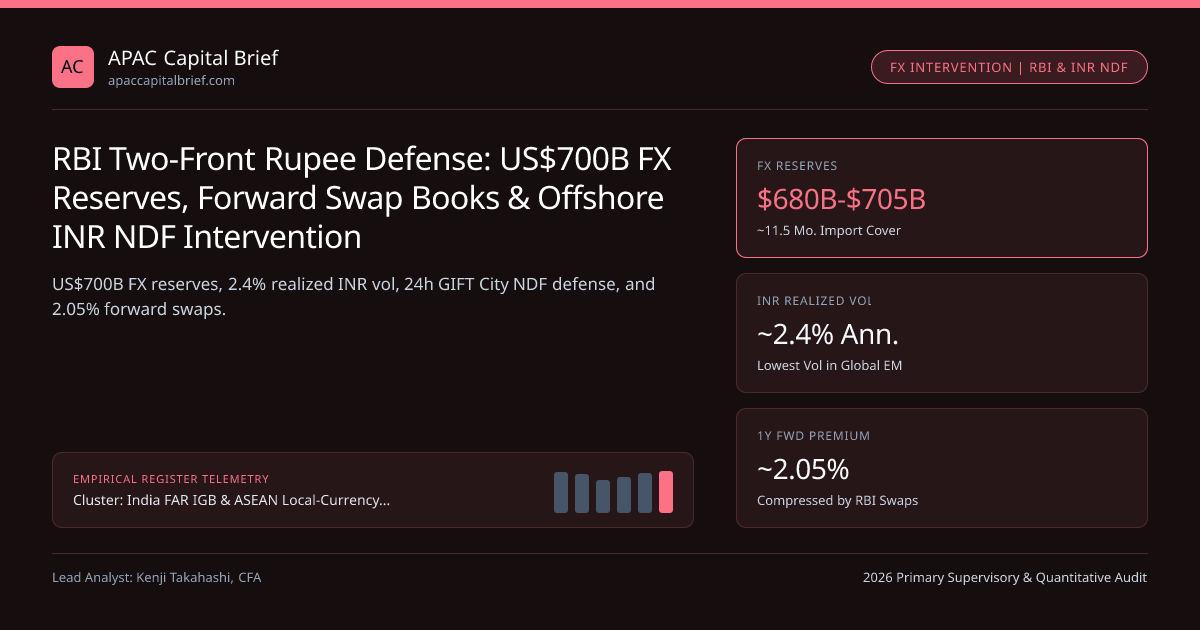
Between 2023 and 2026, while the Japanese yen swung in 2,500-pip annual arcs and Latin American EM currencies posted 11% to 16% annualized realized volatility, USD/INR realized volatility collapsed to an astonishing 1.8% to 3.2%—lower than EUR/USD, GBP/USD, or AUD/USD! How did the Reserve Bank of India (RBI) transform a classic twin-deficit Emerging Market currency into a low-volatility quasi-crawling anchor (making unhedged 6.82% Indian FAR sovereign bonds the highest carry-to-vol trade in global fixed income!)? By backing a US$680B–US$705B sovereign FX reserve war chest with a sophisticated three-dimensional intervention playbook spanning onshore Mumbai spot, onshore Buy/Sell FX swaps, AND direct participation via domestic banks in the offshore Singapore/London/Dubai/GIFT City Non-Deliverable Forward (NDF) market!
Why RBI Entered the Offshore USD/INR NDF Market Directly in 2020–2026#
Historically, RBI refused to acknowledge the massive offshore cash-settled USD/INR NDF market (whose daily turnover across Singapore MAS, London, New York, and Dubai exceeds US$45B–US$60B/day—more than 2.5x onshore Mumbai spot turnover!). During the 2013 Taper Tantrum, offshore macro funds hammered INR NDFs during New York afternoon hours when Mumbai was asleep, creating a +150 pip morning gap-up panic when onshore spot opened at 09:00 IST!
- The June 2020 Structural Pivot: RBI authorized Indian Category-I Authorized Dealer (AD-I) banks managing GIFT City IFSC Banking Units (IBUs) to transact directly in offshore INR NDFs 24 hours a day!
- Two-Front Synchronization: Today, whenever strong-USD shocks hit London or New York at 21:00 IST, RBI instructs major public/private Indian banks to sell USD/INR 1M–3M NDFs directly into Singapore/London electronic books—capping the NDF-to-onshore-forward basis wedge before Mumbai opens at 09:00 IST—while rolling maturing short-USD positions via onshore Buy/Sell USD/INR FX swaps so domestic rupee banking liquidity isn't accidentally starved!
Sterilization Mechanics: Why Spot USD Selling Drains Rupee Liquidity Unless Swapped!#
Fixed-income and money-market desks watch RBI's monthly Bulletin disclosure of its Net Forward Foreign Currency Assets / Liabilities like hawks because FX intervention directly moves overnight MIBOR and TREPS repo rates:
- Suppose FPI equity outflows (policed under SEBI rules) prompt RBI to sell US$15 billion in spot Mumbai FX at 84.40–85.80 to cap depreciation. Selling US$15B spot sucks INR 1.28 trillion (~US$15B) out of Indian commercial banks' cash reserves overnight, pushing interbank call rates 25 bps above the RBI Repo Rate!
- The RBI Swap Solution: RBI immediately executes a USD/INR Sell/Buy Swap (buying spot USD back from banks today to inject INR 1.28 trillion right back into Mumbai money markets, while selling USD 6-months or 12-months forward!). Notice the forward-point consequence: RBI selling 6M/12M USD forwards compresses annualized USD/INR onshore forward premia down to
1.75% – 2.25%—even narrower than theoreticalRBI Repo (6.25%–6.50%) minus US SOFR (4.65%)interest parity!
| RBI Intervention Channel | Market Venue & Hours | Impact on Domestic INR Banking Liquidity | Impact on USD/INR Forward Premia & NDF Basis |
|---|---|---|---|
| Onshore Spot USD Sales / Purchases | CCIL FX-Clear (09:00–15:30 IST core) | Drains INR when selling USD; Floods INR when buying USD inflows | Neutral on swap points unless unsterilized |
| Onshore USD/INR Sell/Buy FX Swaps | Bilateral & RBI FX Swap Auctions (6M to 3Y tenors) | Re-injects INR liquidity drained by spot USD defense! | Compresses 1Y onshore MIFOR/forward premia by -25 to -55 bps (making exporter hedging tight & importer hedging cheap!) |
| Offshore 1M–3M INR NDF Sales | Singapore (MAS), London, NY & GIFT City IBUs (24h) | Zero Day-1 INR liquidity drain (cash-settled in USD at RBI Reference Rate fixing!) | Crushes offshore NDF-minus-onshore-DF basis spikes from +80 pips down to +-8 pips! |
| Cross-Border Payment Corridors (Cashfree Payments PA-CB tier) | RBI Payment Aggregator – Cross Border & UPI LCT | Channels US$125B+/yr world-#1 Indian diaspora remittances cleanly onshore | Structural US$10B+/month current-account cushion offsetting crude oil imports |
Carry-to-Volatility (Sharpe) Advantage of RBI Volatility Suppression vs Covered Interest Parity Forward Compression#
- Annualized1YForwardPremiumpct = [ ( 1 + rINR1Y ) / ( 1 + rUSDSOFR1Y ) - 1 ] + CIPRBISwapSupply_Wedge
- UnhedgedEMCarryToVolRatio = ( Y10YBondNet - rUSDSOFR - E[dSFXcrawl] ) / sigmaRealizedFX_1Y
- Empirical 2026 Cross-EM Carry-to-Vol Comparison:
- 1. India FAR IGB (Net Post-DTAA Yield = 5.70%, Expected RBI Managed Crawl = -1.2%/yr, Realized Vol sigma_INR = 2.5%):
- Expected Excess Return Over 4.65% Cash (incl. +65 bps roll/duration) = +0.50% to +1.15% at 2.5% FX vol -> Vol-Adjusted Stability #1 in EM!
- Meanwhile, Importers / Corporate ECB Hedgers lock 1Y USD/INR forward at JUST 2.05% annualized (thanks to -35 bps RBI forward selling wedge)!
- 2. Brazil / Mexico High-Yield Local Bond (9.8%–11.5% yield, BUT 13.8%–15.5% realized FX vol):
- A single 2-week -8% FX air-pocket wipes out an entire year of coupon carry!
USD/INR Realized Volatility vs Global G10 & EM Peers (2026)#
Macro Risk Monitor: The IMF "Stabilized Arrangement" Debate & Net Short Forward Unwinds#
When the IMF reclassified India's de facto exchange-rate regime as a "stabilized arrangement" (which RBI vigorously contested, emphasizing it targets disorderly volatility rather than any fixed USD/INR level!), smart macro desks focused on one concrete balance-sheet gauge: whenever global dollar surges push RBI's Net Short Forward / NDF book past -US$55B to -US$65B (as occurred briefly in late 2024–early 2025 under Governor Sanjay Malhotra's transition!), RBI eventually allows a controlled 1.5%–2.5% step-crawl adjustment in spot USD/INR so maturing forward shorts roll off cleanly without depleting headline spot reserves! Compare this NDF architecture with Asian NDF vs onshore DF CIP wedges, GIFT City IFSC NDF onshore migration, and our India FAR & ASEAN bond inclusion hub, or explore all APAC FX dispatches.
Frequently asked questions
How does the Reserve Bank of India intervene in the offshore USD/INR NDF market without an offshore trading desk?
Since June 2020, RBI permits Indian Category-I Authorized Dealer banks operating International Financial Services Centre Banking Units (IBUs) in GIFT City to transact freely in offshore NDFs with Singapore, London, and NY dealers, routing RBI smoothing flows 24/5.
Why does RBI selling USD in the forward/swap market make hedging USD debt cheaper for Indian companies?
When RBI executes a Sell/Buy swap (buying spot USD to restore rupee liquidity while selling 6M–12M forward USD), the extra forward USD supply pushes 1-year onshore USD/INR forward premia down toward ~2.0%, cutting corporate External Commercial Borrowing (ECB) hedge costs.
What fixes the daily cash settlement price of an offshore USD/INR NDF contract?
Standard offshore USD/INR NDF contracts cash-settle in USD two business days after fixing against the official FBIL (Financial Benchmarks India Pvt Ltd) USD/INR Reference Rate computed from randomly sampled 11:30–12:30 IST onshore spot trades.
When does RBI allow USD/INR to adjust higher instead of holding a tight range?
Whenever broad DXY dollar strength or yuan/ASEAN FX depreciation pushes India 40-currency Real Effective Exchange Rate (REER) past ~106–108 overvaluation and swells RBI net short forward book past -$55B–65B, RBI permits an orderly crawl to protect export competitiveness.
Publication record
- Published
- 13 November 2026
- Updated
- 15 November 2026
- Author
- Kenji Takahashi, CFA
- Review
- Review not recorded
- Automated fact check
- Passed in the stored pipeline record
- Source URLs
- 3 recorded
AI assistance recorded: anthropic/claude-opus-4.6. This field does not establish human review or source verification.
Academic & Institutional Attribution
Cite This Research & Embed Live Data Card
Standard academic & institutional research paper citation format.
Kenji Takahashi, CFA. (2026, November 14). RBI Two-Front Rupee Defense: US$700B FX Reserves, Forward Swap Books & Offshore INR NDF Intervention. APAC Capital Brief. https://apaccapitalbrief.com/dispatches/rbi-onshore-spot-forward-book-vs-offshore-inr-ndf-defenseRegulatory Directory Cross-Reference
Referenced Institutions & Regulatory Registries
Top Regulated Institutions in This Coverage Slice
Referenced Supervisory Authorities
Related Asean India Sovereign Bond Inclusion & Institutional Briefings
Explore Asean India Sovereign Bond Inclusion Hub (20) →Asean India Sovereign Bond Inclusion
India FAR IGB Index Inclusion, RBI/SEBI Plumbing & ASEAN Local-Currency Bond Guide (2026)Asean India Sovereign Bond Inclusion
India FAR Sovereign Bond Taxation: 20% Section 196D FPI Withholding, DTAA Treaties & Capital GainsAsean India Sovereign Bond Inclusion
GIFT City IFSC Institutional Architecture: IFSCA Fund Regimes, GIFT Nifty (NSE IX) & IBU BankingAsean India Sovereign Bond Inclusion
Bank Indonesia SRBI Bills, "Operation Twist" & Foreign Flows Into IndoGB Sovereign Bonds (SBN)Asean India Sovereign Bond Inclusion
Indonesia 100% DHE SDA Export FX Retention Mandate (PP 8/2025): Onshore USD Liquidity & Exporter SwapsAsean India Sovereign Bond Inclusion
Malaysia BNM Onshore FX Rules, Dynamic Hedging, AOOs & 0%-WHT MGS / FTSE WGBI FlowsAsean India Sovereign Bond Inclusion
SEBI FPI Granular Beneficial-Ownership Rules (INR 50,000 Cr Update) & Offshore ODI / P-Note BanAsean India Sovereign Bond Inclusion
SEBI NSE/BSE Index Options Overhaul: INR 15 Lakh Lot Sizes, Weekly Expiry Cap & 2% Expiry ELMMonetary Policy
AI slump not seen affecting Bank of Japan’s rate-rise plan - The Japan TimesMarket Insights
Nikkei 225 bear market deepens as volatility surges - StoneXMarket Insights
Nikkei 225 Rises to 61,248.59 for a Third Straight Gain as Chip Stocks Rally - BBN TimesMonetary Policy
Japan advisers urge focus on sustaining growth after inflation hits BOJ goal - Reuters
APAC Capital Brief Data, Benchmarks & Contributor Records
CC BY 4.0 Open Data
Open Institutional Datasets (CSV / JSON) →
Download desk-compiled quantitative series & schemas.
2026 Reference Matrix
2026 Institutional Benchmarks & Thresholds →
Statutory capital, clearing, margin & rate conventions.
Editorial Records
Authors & Review Records →
View named contributors where those records are available.
Complete Index
Master Research & Dossier Archive →
Browse all published briefings by topic pillar & date.