
APAC Semiconductor AI Capex Equities
TOPIX JPY 18.4 Trillion Share Buybacks & Mochiai Cross-Shareholding Unwind Mechanics
JFSA enforcement against P&C insurer strategic cross-shareholdings has catalyzed JPY 18.4 trillion in annual TOPIX corporate share buybacks and ToSTNeT-3 block retirements.
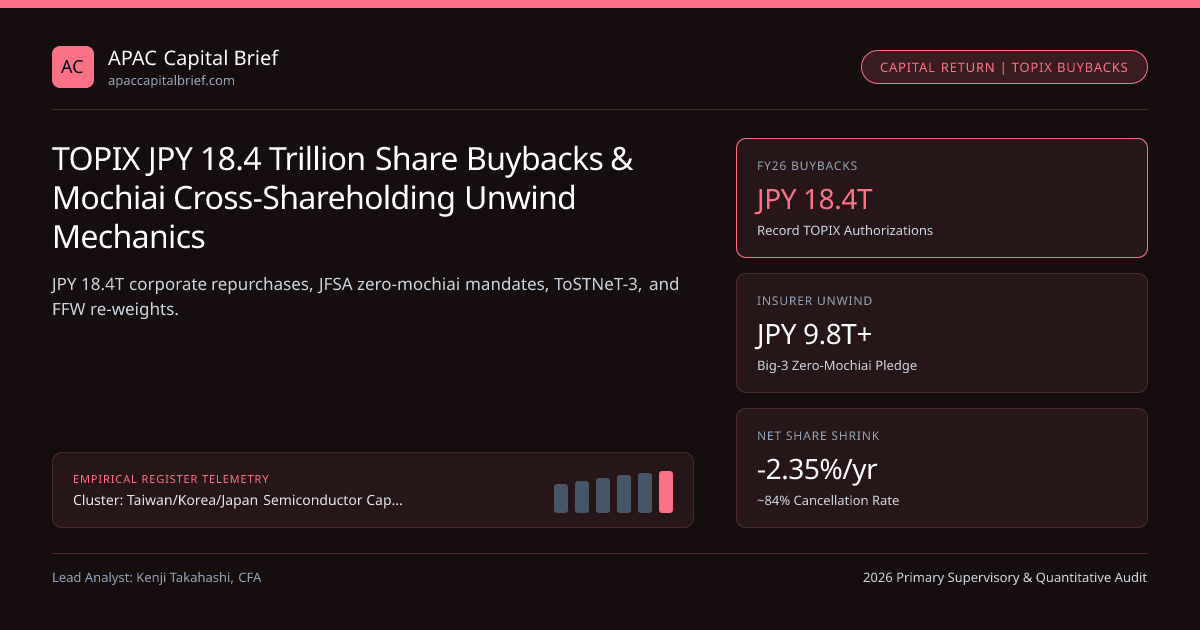
Corporate Japan authorized an unprecedented JPY 18.4 trillion in TOPIX share buybacks across FY2026—nearly double the JPY 9.6 trillion pace set just two years earlier, and surpassing total US S&P 500 net share-count reduction on a float-adjusted yield basis! Behind this buyback wave lies a profound regulatory catalyst triggered by the Financial Services Agency (JFSA): following price-fixing investigations in commercial corporate insurance, the JFSA ordered Japan's three mega non-life insurers (Tokio Marine, MS&AD, and Sompo) to *liquidate 100% of their JPY 9.8+ trillion strategic policy-shareholding (seisaku hoyu kabushiki* / mochiai) portfolios within five to six years*, triggering reciprocal unwind cascades across Toyota Group, megabanks, trading houses (sogo shosha*), and industrial suppliers.
How Reciprocal Mochiai Unwinds Execute Without Crushing Market Prices#
If megabanks and P&C insurers dumped JPY 6–8 trillion of cross-held blue-chip equities directly onto Tokyo Stock Exchange continuous lit order books each year, secondary supply overhang would cap equity multiples. Instead, investment bankers at Daiwa Securities, Nomura, and SMBC Nikko choreograph a matched three-mechanism execution playbook:
- Off-Floor ToSTNeT-3 Buyback Crosses: At 08:45 JST before continuous trading opens, the issuing corporation announces a fixed-price off-auction repurchase at yesterday's closing price via ToSTNeT-3; cross-holding banks and insurers tender into the facility, allowing the issuer to absorb the block directly into treasury for cancellation with zero intraday price impact.
- Accelerated Global Secondary Offerings + Simultaneous Open-Market Buybacks: For multi-billion-dollar unwinds (such as Toyota Motor, Honda, Denso, or Mitsubishi Corp), underwriters syndicate an international secondary block to global long-only institutions (expanding true free float!) while the issuer simultaneously executes an open-market buyback for 50%–100% of the offering size.
- Accelerated Share Repurchases (ASRs) & Collar Structures: Structured equity desks advance immediate share delivery to corporate treasuries while hedging via VWAP execution windows.
Free-Float Weight (FFW) Nuance: ToSTNeT-3 vs Secondary Public Placement#
Quantitative index-rebalance desks track a critical microstructure distinction under the 2026 TOPIX Buyback Benchmark Standard:
- When Bank A sells 3% of Industrial Firm B back to Firm B via ToSTNeT-3 and Firm B cancels the shares, Firm B's EPS jumps +3.1%, but Firm B's public Free-Float Market Cap stays roughly unchanged (because policy holdings were already excluded from JPX's Free-Float Weight calculation!).
- Conversely, when Bank A sells that 3% stake into a global public secondary offering (placed with foreign pensions and domestic funds) AND Firm B executes an open-market VWAP buyback, JPX raises Firm B's Free-Float Weight (FFW) at the next periodic review—triggering mechanical passive buying from TOPIX ETFs and GPIF's JPY 64.5T domestic equity sleeve!
| Corporate Cohort / Venue | Cross-Holding Sale Target | Buyback & Capital Return Policy | Index & Liquidity Impact |
|---|---|---|---|
| Big-3 P&C Insurers (Supervised by JFSA) | 100% Reduction (~JPY 9.8T total book) by FY2030 | Deploy 50%–70% of after-tax sale gains into own buybacks & M&A | Self-reinforcing buyback loop across both seller & target stocks |
| Megabanks (MUFG, SMFG, Mizuho) | Cut policy stocks below 10%–15% of Consolidated Net Assets | JPY 300B–JPY 1.0T annual buyback programs per megabank | Boosts CET1 velocity & ROE above 9.5% alongside BoJ 1.25% NIM |
| Daiwa Securities ECM & Block Desk | Primary bookrunner on mega secondary unwinds & ASRs | Captures underwriting fees + corporate derivatives execution | Smooths multi-trillion-yen supply without widening bid-ask spreads |
| Cash-Rich SMIDs (Aizawa coverage) | Unwind reciprocal regional bank & supplier stakes | Combine TSE 1.0x PBR plans with 5%–8% float buybacks | Eliminates poison-pill entrenchment, opening door to strategic M&A |
EPS Accretion & TOPIX Free-Float Weight (FFW) Passive Inflow Multiplier#
- DeltaEPSpct = [ Byen / ( Pavg * N0 ) - ( Byen * raftertaxcash ) / NetIncome0 ] / [ 1 - Byen / ( Pavg * N0 ) ]
- PassiveTOPIXFlow = ( AUMTOPIXPassive / MCapTOPIXFloat ) * ( Nremaining * Pmkt * Delta_FFW )
- Worked Calculation (JPY 5.0T Market-Cap Issuer Executing JPY 250B Open-Market Buyback Alongside 5% Mochiai Public Sale):
- 1. Share Shrink = JPY 250B / JPY 5,000B = 5.0% of total shares | Foregone cash yield raftertax_cash = 0.70%, Earnings Yield (E/P) = 7.20%
- DeltaEPSpct = (0.050 - 0.050 * (0.0070 / 0.0720)) / 0.950 = (0.050 - 0.00486) / 0.950 = +4.75% pure EPS accretion!
- 2. Public Secondary Sale lifts JPX Free-Float Weight from 0.65 to 0.70 (Delta_FFW = +0.05 on JPY 4,750B post-buyback cap = +JPY 237.5B float cap)
- With ~JPY 115T tracking TOPIX out of JPY 680T float (~16.9% passive ownership):
- PassiveTOPIXFlow = 0.169 * JPY 237.5B = +JPY 40.1 Billion in forced passive index buying!
Corporate Japan Total Shareholder Cash Return (JPY Trillions)#
Contrast With Korea: Why Cancellation Rate (~84%) Matters#
Crucially, Japanese corporations cancel roughly 84% of repurchased shares under Article 178 of Japan's Companies Act (and Japanese corporate law strips voting rights from any residual treasury stock), preventing boards from parking treasury shares with "white knights" during takeover battles—the exact governance loophole plaguing Seoul's KOSPI that we examine next in KRX Corporate Value-Up and treasury-share cancellation and Nikkei 225 vs TOPIX float mechanics. Return to our Northeast Asia semiconductor & governance hub or view all APAC equity dispatches.
Frequently asked questions
What is ToSTNeT-3 on the Tokyo Stock Exchange and why do cross-holding sellers use it?
ToSTNeT-3 (Tokyo Stock Exchange Trading Network System-3) is an off-auction pre-market crossing facility solely for issuer share repurchases at the prior day closing price, allowing banks and insurers to tender large blocks directly to the issuer with zero intraday price slippage.
Why did the JFSA force Japanese non-life insurers to sell 100% of their strategic cross-shareholdings?
JFSA investigations revealed that large strategic equity stakes in corporate clients distorted commercial insurance underwriting competition and enabled premium price-fixing, leading regulators to mandate complete divestment of policy shareholdings.
Why do global equity investors prefer secondary offerings + open-market buybacks over ToSTNeT-3 crosses?
ToSTNeT-3 retires dormant non-float shares directly without increasing public float, whereas placing cross-held shares with institutional investors via a secondary offering increases JPX Free-Float Weight (FFW) and secondary trading liquidity.
Can Japanese boards vote treasury shares to block hostile takeovers?
No. Under Article 308(2) of Japan Companies Act, treasury shares carry zero voting rights, and ~84% of TOPIX buybacks are permanently retired via Article 178 board resolutions.
Publication record
- Published
- 14 November 2026
- Updated
- 15 November 2026
- Author
- Kenji Takahashi, CFA
- Review
- Review not recorded
- Automated fact check
- Passed in the stored pipeline record
- Source URLs
- 3 recorded
AI assistance recorded: anthropic/claude-opus-4.6. This field does not establish human review or source verification.
Academic & Institutional Attribution
Cite This Research & Embed Live Data Card
Standard academic & institutional research paper citation format.
Kenji Takahashi, CFA. (2026, November 14). TOPIX JPY 18.4 Trillion Share Buybacks & Mochiai Cross-Shareholding Unwind Mechanics. APAC Capital Brief. https://apaccapitalbrief.com/dispatches/topix-18-4t-yen-share-buybacks-mochiai-cross-shareholdingsRegulatory Directory Cross-Reference
Referenced Institutions & Regulatory Registries
Mentioned Regulated Institutions
Referenced Supervisory Authorities
Related APAC Semiconductor AI Capex Equities & Institutional Briefings
Explore APAC Semiconductor AI Capex Equities Hub (20) →APAC Semiconductor AI Capex Equities
Northeast Asia Semiconductor AI Capex, HBM4 Supply Chains & Corporate Governance: 2026 APAC GuideAPAC Semiconductor AI Capex Equities
KRX Corporate Value-Up Index, Dividend Tax Separation & Treasury-Share Cancellation RulesAPAC Semiconductor AI Capex Equities
Korea 60% Chaebol Inheritance Tax, Split-Listings & Commercial Act Article 382-3 ReformAPAC Semiconductor AI Capex Equities
Taiwan Life Insurer US$760B FX Hedging: TWD Offshore NDF Spikes, CS Swaps & Proxy ShortsAPAC Semiconductor AI Capex Equities
Japan Semiconductor WFE Monopolies: Tokyo Electron, Advantest, Lasertec & Disco AI Margin PowerAPAC Semiconductor AI Capex Equities
TSMC Kumamoto JASM & Rapidus Hokkaido: METI Semiconductor Subsidies & Megabank Project FinanceAPAC Semiconductor AI Capex Equities
TAIEX Single-Stock AI Concentration, UCITS 10/20 Caps & Taiwan FSC FINI Custody RulesAPAC Semiconductor AI Capex Equities
Korea FSS NSDS Electronic Short-Selling System, Penalty Laws & KOSPI 200 Futures BasisASIC Afsl Australian Superannuation
ASIC RG 166 AFSL Financial Requirements: NTA Buffers, 12-Month Cash-Flow & OTC Derivative IssuersASIC Afsl Australian Superannuation
ASIC CFD Product Intervention Order (Extended to 2027) & Section 761G Wholesale Investor ReformASIC Afsl Australian Superannuation
APRA CPS 230 Operational Risk Management: 72-Hour Breach Clocks & Super Administration OutagesASIC Afsl Australian Superannuation
APRA Abolition of Bank AT1 Hybrids (2027–2032): Tier 2 Subordinated Debt & CET1 Repricing
APAC Capital Brief Data, Benchmarks & Contributor Records
CC BY 4.0 Open Data
Open Institutional Datasets (CSV / JSON) →
Download desk-compiled quantitative series & schemas.
2026 Reference Matrix
2026 Institutional Benchmarks & Thresholds →
Statutory capital, clearing, margin & rate conventions.
Editorial Records
Authors & Review Records →
View named contributors where those records are available.
Complete Index
Master Research & Dossier Archive →
Browse all published briefings by topic pillar & date.