
APAC Semiconductor AI Capex Equities
Korea 60% Chaebol Inheritance Tax, Split-Listings & Commercial Act Article 382-3 Reform
Amending Article 382-3 of Korea Commercial Act to establish director fiduciary duty directly to shareholders targets unfair chaebol mergers, split-listings, and KOSPI discounts.
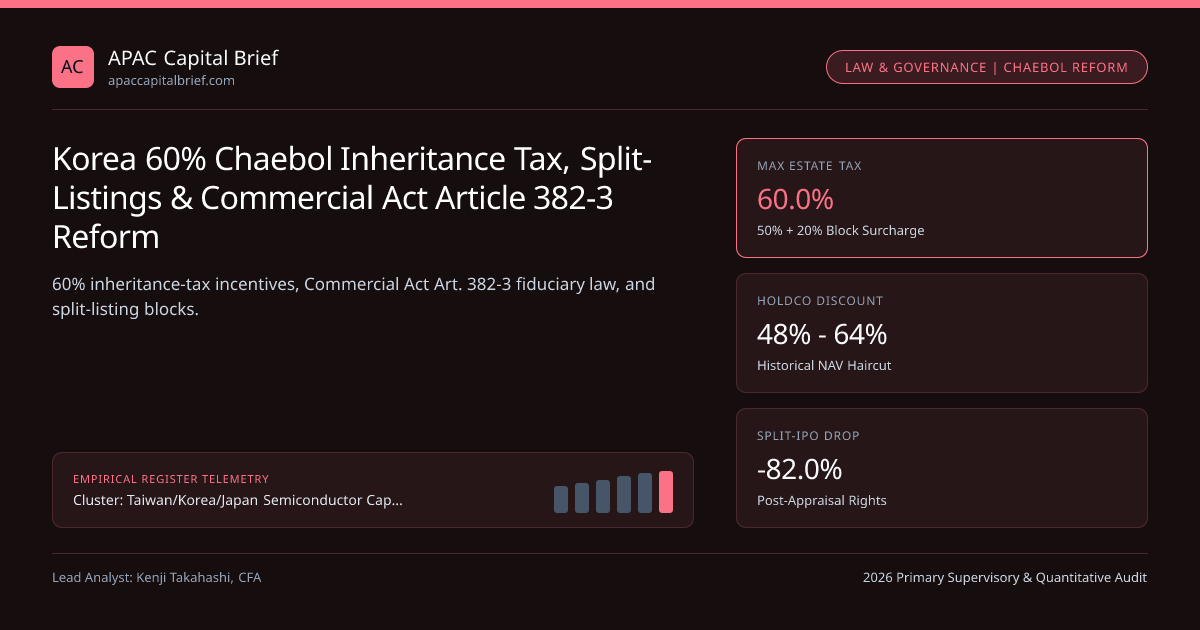
Why did founding families across South Korea's industrial conglomerates spend two decades tolerating—or actively engineering—0.35x to 0.65x price-to-book multiples on listed holding companies while global private-equity funds offered 2.5x book? The structural answer lies at the intersection of the OECD's highest statutory inheritance tax (up to 60% with the 20% controlling-shareholder surcharge) and a *statutory void in Article 382-3 of South Korea's Commercial Act (Sangbeop), which historically defined corporate directors' duty of loyalty strictly toward "the company"* as an abstract legal entity rather than toward all shareholders proportionally.
The Perverse Math of a 60% Listed-Equity Inheritance Tax#
Under South Korea's Inheritance and Gift Tax Act, transferring a controlling block (>50% or largest-shareholder stake) of a listed corporation triggers a 50% top marginal tax bracket multiplied by a 1.20x controlling-block valuation premium = 60.0% effective tax rate, valued using the 4-month average market stock price (2 months prior and 2 months after the succession event!):
- If a chaebol patriarch's listed holdco stake rises from 0.45x P/B (KRW 4.0T) to 1.35x P/B (KRW 12.0T) via KRX Value-Up reforms, the family's cash inheritance-tax bill explodes from KRW 2.4T to KRW 7.2T—forcing heirs to forfeit voting control to the National Tax Service or private equity!
- Consequently, multi-generational succession planning historically incentivized depressed parent-holdco share prices, *carve-out IPOs ("split-listings" / Muljeok Bunhal)* of crown-jewel growth divisions (such as battery or biopharma units), and stock-for-stock mergers executed at market-price exchange ratios that favored unlisted or affiliate entities heavily owned by third-generation heirs!
Commercial Act Article 382-3: Why Adding "And Shareholders" Changes Everything#
Historically, Korean courts invoked the literal text of Commercial Act Article 382-3 ("Directors shall perform their duties faithfully for the good of the company...") to dismiss minority-shareholder lawsuits over dilutive third-party convertible bonds or skewed affiliate mergers—ruling that shifting wealth from Group Company A's minority shareholders to Group Company B's controlling family did not harm "Company A's corporate balance sheet itself", only the interpersonal wealth split among shareholders!
- Statutory Fiduciary Reform: Expanding Article 382-3's duty of loyalty to encompass shareholders' proportional economic interests, reinforced by FSC and FSS Capital Markets Act amendments (abolishing rigid market-price merger formulas in affiliate restructuring, requiring independent external fairness opinions, and granting dissenters appraisal rights on split-listings), exposes rubber-stamp outside directors to *direct civil liability and breach-of-trust (baeim) scrutiny* if they approve value-destructive intra-group mergers (as seen when institutional revolt forced Doosan Group to scrap its skewed Bobcat-Robotics merger!).
| Governance / Legal Mechanism | Legacy South Korean Regime | Reformed 2025–2026 Framework | Impact on Foreign & Domestic Funds |
|---|---|---|---|
| Commercial Act Art. 382-3 | Duty owed solely to "the company"; shareholder dilution deemed non-actionable | Duty extended to proportional shareholder interests + electronic AGM voting | Empowers derivative lawsuits & blocks dilutive CBs / skewed affiliate mergers |
| Intra-Group Merger Ratios (FSC) | Mandatory arithmetic average of 1-month, 1-week, and prior-day share prices | Abolished rigid market-price lock for non-affiliated & reformed affiliate fairness audits | Stops merging a 0.4x P/B holdco into a 4.5x P/B heir-owned growth stock! |
| Crown-Jewel Split-Listings (Muljeok Bunhal) | Unrestricted IPO of carved-out 100% subsidiary with zero parent compensation | Dissenting shareholder appraisal rights + KRX 5-year listing scrutiny | Collapsed dual-listing parent holdco carve-outs by >80% |
| Mandatory Tender Offers in M&A | Buyer could acquire 25%–35% control block at 80% premium while paying 0% to minorities | Capital Markets Act push requiring 50% + 1 share tender at identical control price | Eliminates private control-premium extraction on management buyouts |
Sum-of-the-Parts (SOTP) Holdco Discount Compression Under Merger & Fiduciary Protection#
- PHoldco = NAVHoldco * ( 1 - ddoubletax - dopex - ptunneling * LossGivenTunneling )
- Empirical Calibration on a KOSPI Conglomerate Holding Company (NAV = KRW 15.0 Trillion):
- 1. Legacy Regime (Structural Tax/Opex Discount = 18%, Perceived Probability of Dilutive Merger/Split p_tunnel = 0.70, Loss = 55%):
- Total Holdco Discount = 0.18 + (0.70 * 0.55) = 0.18 + 0.385 = 56.5% Discount -> Market Cap = KRW 6.53 Trillion (0.44x NAV)
- 2. Post-Art. 382-3 & FSC Merger Fairness Regime (p_tunnel drops from 0.70 to 0.15):
- Total Holdco Discount = 0.18 + (0.15 * 0.55) = 0.18 + 0.0825 = 26.25% Discount -> Market Cap = KRW 11.06 Trillion (+69.4% Upside!)
Global Inheritance Tax & Control-Transfer Governance Benchmarks#
Tactical Playbook for Institutional KOSPI Allocators#
Rather than buying a broad passive KOSPI wrapper indiscriminately, institutional desks screen specifically for succession-complete conglomerates (where third-generation inheritance taxes are already settled in multi-year installments—requiring high cash dividends to fund annual tax installments!) paired with 3-for-1 cumulative voting and KRX Value-Up treasury cancellation commitments. Cross-reference Korean short-selling and FX market reforms in FSS NSDS short-selling rules, MSCI Korea RFI FX reform, and our Northeast Asia semiconductor & governance hub, or view all APAC equity dispatches.
Frequently asked questions
Why did Korean law previously mandate market stock prices for affiliate mergers even when one stock was at 0.4x book?
To prevent arbitrary asset appraisals, Korea Capital Markets Act historically forced listed mergers to use an arithmetic average of 1-month, 1-week, and closing share prices—inadvertently rewarding controlling families who merged a depressed 0.4x P/B holdco into a richly valued affiliate.
How does inheritance-tax installment payment flip a chaebol family dividend incentive?
Once succession occurs and heirs pledge shares under Korea 5-to-10-year tax installment facility (yeonbu yeonnap), heirs need massive recurring cash income to service annual principal and interest payments to the National Tax Service, turning them into aggressive dividend advocates.
What is "split-listing" (Muljeok Bunhal) on the Korea Exchange?
A listed parent spins off its fastest-growing division as a 100%-owned subsidiary and shortly thereafter conducts a separate IPO of that subsidiary, leaving parent shareholders holding a hollowed-out conglomerate stub trading at a 55%+ NAV discount.
Why do Korean business lobbies worry about breach-of-trust (baeim) alongside Article 382-3?
Korea Criminal Act carries strict criminal breach-of-trust penalties; reformers pair expanding Article 382-3 civil shareholder fiduciary duties with codifying US-style Business Judgment Rule safe harbors for good-faith commercial investment risk.
Publication record
- Published
- 14 November 2026
- Updated
- 15 November 2026
- Author
- Kenji Takahashi, CFA
- Review
- Review not recorded
- Automated fact check
- Passed in the stored pipeline record
- Source URLs
- 3 recorded
AI assistance recorded: anthropic/claude-opus-4.6. This field does not establish human review or source verification.
Academic & Institutional Attribution
Cite This Research & Embed Live Data Card
Standard academic & institutional research paper citation format.
Kenji Takahashi, CFA. (2026, November 14). Korea 60% Chaebol Inheritance Tax, Split-Listings & Commercial Act Article 382-3 Reform. APAC Capital Brief. https://apaccapitalbrief.com/dispatches/korea-chaebol-inheritance-tax-commercial-act-fiduciary-lawRegulatory Directory Cross-Reference
Referenced Institutions & Regulatory Registries
Top Regulated Institutions in This Coverage Slice
Referenced Supervisory Authorities
Related APAC Semiconductor AI Capex Equities & Institutional Briefings
Explore APAC Semiconductor AI Capex Equities Hub (20) →APAC Semiconductor AI Capex Equities
Northeast Asia Semiconductor AI Capex, HBM4 Supply Chains & Corporate Governance: 2026 APAC GuideAPAC Semiconductor AI Capex Equities
Taiwan Life Insurer US$760B FX Hedging: TWD Offshore NDF Spikes, CS Swaps & Proxy ShortsAPAC Semiconductor AI Capex Equities
Japan Semiconductor WFE Monopolies: Tokyo Electron, Advantest, Lasertec & Disco AI Margin PowerAPAC Semiconductor AI Capex Equities
TSMC Kumamoto JASM & Rapidus Hokkaido: METI Semiconductor Subsidies & Megabank Project FinanceAPAC Semiconductor AI Capex Equities
TAIEX Single-Stock AI Concentration, UCITS 10/20 Caps & Taiwan FSC FINI Custody RulesAPAC Semiconductor AI Capex Equities
Korea FSS NSDS Electronic Short-Selling System, Penalty Laws & KOSPI 200 Futures BasisAPAC Semiconductor AI Capex Equities
MSCI Korea Developed Market Watchlist Bid: 02:00 KST KRW FX & Registered Foreign InstitutionsAPAC Semiconductor AI Capex Equities
AI ABF Substrates & Glass-Core Packaging Capex: Ibiden, Shinko, Unimicron & Ajinomoto FilmASIC Afsl Australian Superannuation
APRA CPS 230 Operational Risk Management: 72-Hour Breach Clocks & Super Administration OutagesASIC Afsl Australian Superannuation
APRA Abolition of Bank AT1 Hybrids (2027–2032): Tier 2 Subordinated Debt & CET1 RepricingASIC Afsl Australian Superannuation
AOFM ACGB Syndications, ASX Cash-Settled 3Y/10Y Bond Futures & EFP Swap-Spread MechanicsASIC Afsl Australian Superannuation
ASIC Private Credit & CRE Loan Surveillance: Fee Skimming, PIK Valuations & Redemption Gates
APAC Capital Brief Data, Benchmarks & Contributor Records
CC BY 4.0 Open Data
Open Institutional Datasets (CSV / JSON) →
Download desk-compiled quantitative series & schemas.
2026 Reference Matrix
2026 Institutional Benchmarks & Thresholds →
Statutory capital, clearing, margin & rate conventions.
Editorial Records
Authors & Review Records →
View named contributors where those records are available.
Complete Index
Master Research & Dossier Archive →
Browse all published briefings by topic pillar & date.