
APAC Semiconductor AI Capex Equities
TAIEX Single-Stock AI Concentration, UCITS 10/20 Caps & Taiwan FSC FINI Custody Rules
When a single foundry exceeds 36% of Taiwan TAIEX, foreign institutional investors face CFTC narrow-based futures bans, UCITS active-fund caps, and FSC Taiwan FINI custody rules.
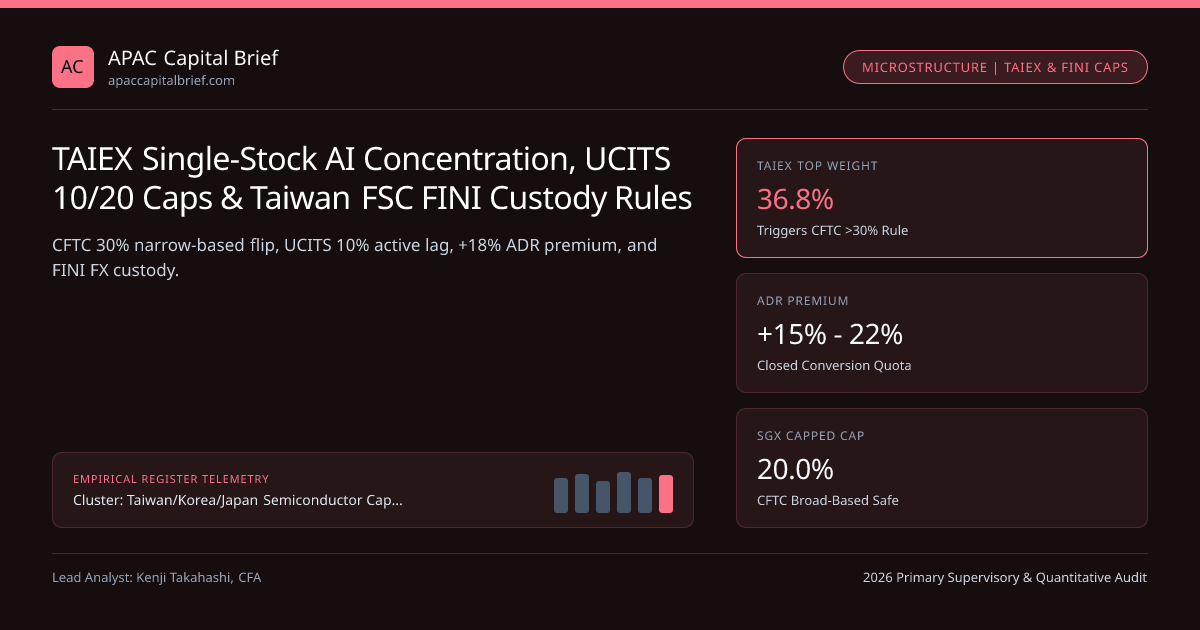
Explosive earnings compounding across TSMC's US$62B CoWoS-L AI ramp pushed a single issuer past 36%–38% of the capitalization-weighted Taiwan Stock Exchange Capitalization Weighted Stock Index (TAIEX)—and above 52% of MSCI Taiwan's uncapped free-float market cap! For Foreign Institutional Investors (FINIs) routing orders through cross-border houses like KGI Asia Limited under the joint supervision of the Financial Supervisory Commission (FSC Taiwan) and the Central Bank (CBC), extreme single-stock concentration creates three simultaneous regulatory and derivatives plumbing traps rarely understood outside Taipei execution desks.
Trap 1: CFTC "Narrow-Based Security Index" Ban on US Persons Trading TAIEX Futures#
Under the US Commodity Exchange Act and SEC/CFTC joint definitions, any foreign equity index in which a single constituent exceeds 30% of index weight for more than 45 out of 90 consecutive trading days flips automatically from a "Broad-Based Security Index" into a "Narrow-Based Security Index":
- Once TSMC crossed 30% of TAIEX and stayed there, US-domiciled institutional investors (40-Act mutual funds, US CTAs, US hedge funds) became legally prohibited from trading TAIFEX TAIEX Futures (TX) and Mini-TAIEX Futures (MTX)!
- How do US desks hedge Taiwan beta instead? They migrate into FTSE Taiwan RIC Capped Index Futures on SGX (where single-stock weight is hard-capped at 20% quarterly), MSCI Taiwan 25/50 Capped swaps, or pair TSMC NYSE ADRs (which trade at a persistent +14% to +22% fungibility premium over Taipei 2330 TT ordinary shares because FINI ADR creation quotas are closed!) against AI server ODMs (Hon Hai, Quanta, Wiwynn) and Taipei Exchange (TPEx) cooling/CCL suppliers.
Trap 2: Forced Active Underweights Under UCITS 5/10/40 & Taiwan SITCA Rules#
Why do active Emerging Markets and Asia ex-Japan mutual funds systematically trail passive benchmarks whenever Hsinchu rallies? Because European UCITS Article 52 ("5/10/40 Rule") caps any single equity issuer in an active fund at 10% of NAV (only index-tracking passive UCITS ETFs may invoke Article 53 to hold up to 20%, or 35% for a single market-dominant issuer!). Similarly, domestic Taiwanese active equity mutual funds historically faced a 10% single-stock cap until FSC Taiwan relaxed thresholds for specialized tech mandates and launched active ETFs.
| Investor / Venue Segment | Single-Stock Statutory Cap | Resulting Benchmark Distortion | Institutional Workaround |
|---|---|---|---|
| US Hedge Funds & CTAs | 30% CFTC Broad-Based Ceiling | Barred from TAIFEX TX/MTX futures once TSMC >30% | Trade SGX FTSE Taiwan RIC Capped (20% cap) or ISDA total-return swaps |
| European Active UCITS Funds | 10% Hard Single-Issuer Cap | Forced -500 to -2,600 bps structural underweight vs Asia/TW indices | Overweight correlated high-beta AI proxy suppliers (ASE, MediaTek, Advantest) |
| NYSE TSM ADR Arbitrageurs | FSC/CBC ADR Conversion Freeze | Cannot convert cheap Taipei 2330 TT shares into expensive US TSM ADRs | Mean-reversion pairs trading when ADR premium stretches outside +12% to +24% band |
| FINI Cash & Futures Accounts (KGI Asia) | No Speculative TWD Holding | CBC requires unused TWD sales proceeds repatriated or deployed rapidly | Post USD/EUR/JPY or offshore G7 bonds directly as TAIFEX initial margin |
Active Fund Benchmark Tracking Drag From Statutory Single-Stock Caps#
- AlphaDragStructural = - ( wBenchmarkTSMC - wCapUCITS ) * ( RTSMC - RRestofTAIEX )
- Worked 2026 Performance Attribution Example:
- wBenchmarkTSMC = 36.8% | wCapUCITS = 10.0% -> Forced Underweight = -26.8% (-2,680 bps!)
- Suppose TSMC returns +38.0% over 12 months while the remaining 63.2% of TAIEX returns +11.5%:
- Benchmark Return = (0.368 * 38.0%) + (0.632 * 11.5%) = 13.98% + 7.27% = +21.25%
- Max-Capped Active Portfolio Return (zero stock-picking error elsewhere) = (0.100 * 38.0%) + (0.900 * 11.5%) = 3.80% + 10.35% = +14.15%
- Pure Regulatory Cap Drag = 14.15% - 21.25% = -7.10% (-710 bps of unavoidable active lag!)
Trap 3: FINI Registration, Pre-Delivery Overrides & Foreign-Currency Margin#
Unlike Hong Kong or Singapore omnibus settlement, trading onshore Taipei cash equities requires an ID-level FINI registration via TWSE and strict adherence to CBC's prohibition against holding idle onshore TWD deposits for currency speculation. Crucially, FSC Taiwan modernized FINI capital efficiency by allowing foreign funds to pledge offshore USD/EUR/JPY cash and foreign sovereign securities as collateral for TAIFEX derivatives and SBL (Securities Borrowing & Lending) stock borrow, sparing FINIs from converting USD into TWD purely to post margin!
Pairing FINI Flows With Domestic NT$5.8T Retail ETF Rebalances#
Foreign desks also track domestic counter-flows across Taiwan's booming retail ETF ecosystem—analyzed in Taiwan's NT$5.8T high-dividend ETF weight-cap reforms—alongside Taiwan lifer TWD NDF hedging and our Northeast Asia semiconductor & governance hub, or explore all APAC silicon dispatches.
Frequently asked questions
Why does TSM ADR on the NYSE trade at a 15%–22% premium to TSMC shares in Taipei?
Converting Taipei-listed 2330 TT ordinary shares into new NYSE TSM ADRs requires specific FSC/CBC regulatory approval, which has not been granted for decades (whereas converting ADRs back to local shares is free), creating a one-way arbitrage wall whenever global AI funds buy US-listed ADRs.
Why were US institutional investors restricted from trading TAIFEX TAIEX Futures?
Under US CFTC and SEC joint rules, when a single stock exceeds 30% of a foreign index for >45 of 90 trading days, futures on that index become "Narrow-Based Security Index" futures ineligible for US persons unless dual-registered with the SEC.
What happens if a Foreign Institutional Investor (FINI) fails T+2 equity settlement in Taiwan?
Taiwan enforces one of the strictest zero-tolerance T+2 settlement regimes in Asia: an unexcused settlement default triggers immediate public broker reporting, FINI ID suspension, and forced close-out, requiring pre-matched custodian funding.
How do active UCITS managers mitigate the 10% single-stock cap on TSMC?
Managers maximize their 10% TSMC cash allocation and build high-beta "synthetic foundry" overweights across direct CoWoS/N2 supply-chain beneficiaries such as ASE Technology, MediaTek, Tokyo Electron, and Advantest.
Publication record
- Published
- 14 November 2026
- Updated
- 15 November 2026
- Author
- Kenji Takahashi, CFA
- Review
- Review not recorded
- Automated fact check
- Passed in the stored pipeline record
- Source URLs
- 3 recorded
AI assistance recorded: anthropic/claude-opus-4.6. This field does not establish human review or source verification.
Academic & Institutional Attribution
Cite This Research & Embed Live Data Card
Standard academic & institutional research paper citation format.
Kenji Takahashi, CFA. (2026, November 14). TAIEX Single-Stock AI Concentration, UCITS 10/20 Caps & Taiwan FSC FINI Custody Rules. APAC Capital Brief. https://apaccapitalbrief.com/dispatches/taiex-ai-concentration-taiwan-fsc-fini-custody-fx-rulesRegulatory Directory Cross-Reference
Referenced Institutions & Regulatory Registries
Mentioned Regulated Institutions
Referenced Supervisory Authorities
Related APAC Semiconductor AI Capex Equities & Institutional Briefings
Explore APAC Semiconductor AI Capex Equities Hub (20) →APAC Semiconductor AI Capex Equities
Northeast Asia Semiconductor AI Capex, HBM4 Supply Chains & Corporate Governance: 2026 APAC GuideAPAC Semiconductor AI Capex Equities
Korea FSS NSDS Electronic Short-Selling System, Penalty Laws & KOSPI 200 Futures BasisAPAC Semiconductor AI Capex Equities
MSCI Korea Developed Market Watchlist Bid: 02:00 KST KRW FX & Registered Foreign InstitutionsAPAC Semiconductor AI Capex Equities
AI ABF Substrates & Glass-Core Packaging Capex: Ibiden, Shinko, Unimicron & Ajinomoto FilmAPAC Semiconductor AI Capex Equities
Taiwan Taipower Industrial Tariff Hikes, EUV Megawatt Intensity & Offshore Wind Fab PPAsAPAC Semiconductor AI Capex Equities
Foundry & HBM Customer Capacity Prepayments, USD Corporate Bonds & Natural FX Capex HedgingAPAC Semiconductor AI Capex Equities
JPX Growth Market JPY 10B Thresholds, METI Unsolicited Takeover Guidelines & MBO Carve-OutsAPAC Semiconductor AI Capex Equities
Nikkei 225 Price-Divisor Skew vs TOPIX Next-Generation ~1,200-Stock Float ReductionASIC Afsl Australian Superannuation
ASX CHESS Replacement via TCS BaNCS (2026–2029) & Australia T+1 Equity Settlement RoadmapASIC Afsl Australian Superannuation
APRA SPS 530 Unlisted Asset Governance: Out-of-Cycle Revaluations & Member Switching ArbitrageASIC Afsl Australian Superannuation
AUD/USD BBSW–SOFR Cross-Currency Basis Swaps, Big-4 Offshore Debt & Kangaroo Bond ArbitrageASIC Afsl Australian Superannuation
AUSTRAC AML/CTF Amendment Act (2026 Rollout): Tranche-2 Gatekeepers & VASP Travel Rule
APAC Capital Brief Data, Benchmarks & Contributor Records
CC BY 4.0 Open Data
Open Institutional Datasets (CSV / JSON) →
Download desk-compiled quantitative series & schemas.
2026 Reference Matrix
2026 Institutional Benchmarks & Thresholds →
Statutory capital, clearing, margin & rate conventions.
Editorial Records
Authors & Review Records →
View named contributors where those records are available.
Complete Index
Master Research & Dossier Archive →
Browse all published briefings by topic pillar & date.