
Boj Jgb Curve Yen Repatriation
MoF Japan JGB Issuance Mix: Shortening Weighted-Average Maturity & Debt Service
To cushion Bank of Japan Rinban tapering across APAC markets, Japan Ministry of Finance trimmed 20Y–40Y super-long supply while expanding 2Y, 5Y, and 6M T-Bill auctions, shortening issuance WAM to 8.1 years.
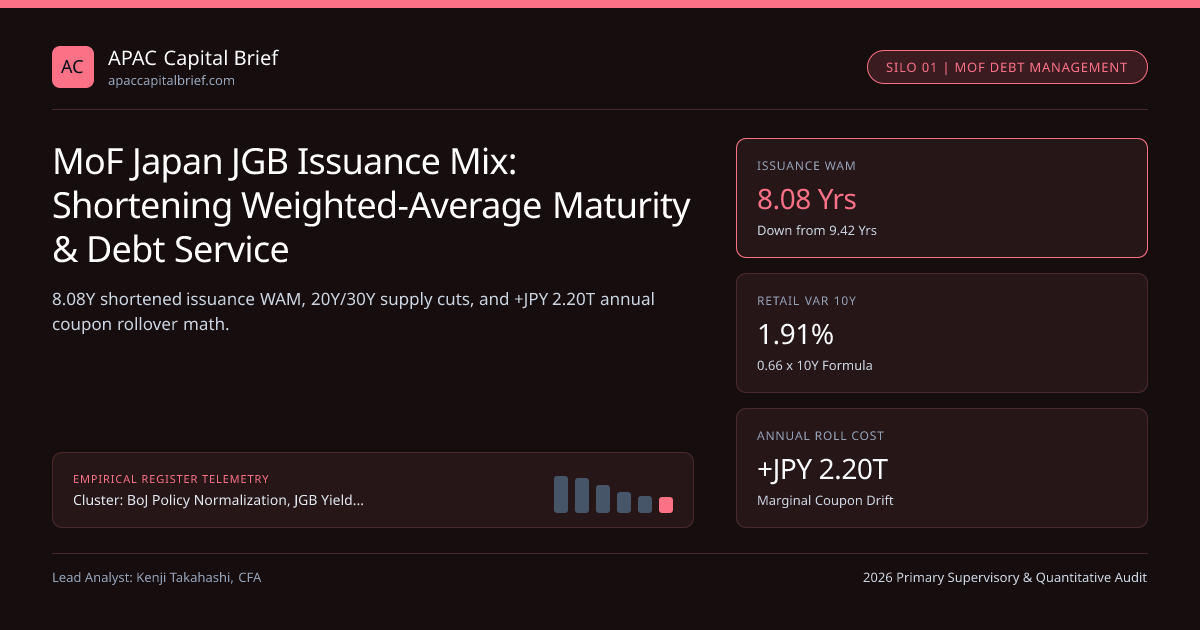
Confronted with monthly Rinban tapering down to JPY 2.9 trillion and a +100 bps steepening slope between 10-year (2.89%) and 30-year (3.89%) yields, the Ministry of Finance (MoF) Financial Bureau executed its sharpest sovereign maturity pivot in two decades. In formulating the FY2026 JGB Issuance Plan after Primary Dealer Advisory Meetings, Kasumigaseki shaved JPY 1.2 trillion each off annual 20-year and 30-year reopenings while boosting 6-month Treasury Discount Bills (T-DBs), 2-year JGBs, and 5-year JGBs—compressing the Weighted-Average Issuance Maturity (WAM) from 9.4 years in FY2022 down to 8.08 years.
Balancing Market Absorption Against Refinancing Rollover Risk#
Debt-management officials at Kasumigaseki walk a delicate fiscal tightrope across Japan's ~JPY 172 trillion annual gross calendar-base market issuance (dominated by ~JPY 136 trillion of refunding bonds rolling maturing debt):
- Shortening WAM Stabilizes Long-End Auctions Today: Cutting monthly 20-year auctions from JPY 1.2T to JPY 0.9T–1.0T prevents orphan-belly indigestion at primary dealers like Daiwa Securities and channels supply into 2-year (2.05%) and 5-year (2.41%) tenors eagerly absorbed by commercial bank liquidity buffers and USD-swapped foreign reserve managers.
- Faster Refinancing Pass-Through Into Kokusaihi Tomorrow: Because Japan's outstanding JGB stock (~JPY 1,105 trillion ordinary JGBs, ~240% gross debt-to-GDP) carries a legacy weighted-average coupon near 0.92%, shifting marginal issuance into 6-month T-DBs and 2-year notes accelerates the speed at which 1.25%+ short rates reprice national debt-service appropriations (Kokusaihi).
Tenor-by-Tenor FY2026 Calendar-Base Issuance Breakdown#
Comparing the 2026 JGB curve benchmark standard across individual auction lines reveals how MoF aligns supply with natural institutional habitat—from Central Tanshi repo pools at the front end to Japanese lifers at 30–40 years and household retail buyers via Aizawa Securities:
| JGB Tenor / Instrument | Annual Auction Cadence | FY2026 Per-Auction Size | Annualized Supply Share | Core Natural Buyer Cohort |
|---|---|---|---|---|
| 6M & 1Y Treasury Discount Bills | Monthly / Weekly T-DBs | JPY 3.5T – 4.2T | ~24.8% | Foreign central banks (USD-swapped +22bp) & Central Tanshi |
| 2-Year & 5-Year Notes | 12x Monthly Each | JPY 2.7T (2Y) / JPY 2.5T (5Y) | ~36.3% | Megabanks, regional banks & domestic corporate cash pools |
| 10-Year Benchmark JGB | 12x Monthly | JPY 2.6T | ~18.2% | Primary dealers (Daiwa), GPIF & global macro funds |
| 20-Year JGB | 12x Monthly (Trimmed) | JPY 0.9T – 1.0T | ~6.6% | Trust banks, relative-value ASW desks (+31 bps over OIS) |
| 30-Year & 40-Year JGBs | 12x (30Y) / 6x Bi-Monthly (40Y) | JPY 0.75T (30Y) / JPY 0.35T (40Y) | ~6.5% | Nippon Life, Dai-ichi, Meiji Yasuda & Kampo ESR accounts |
| Retail JGBs & GX Climate Transition | Monthly Window / Syndicated | Household & ESG Dedicated | ~7.6% | Japanese households (floating 10Y retail JGB @ 0.66 * 10Y) |
Sovereign Average Coupon Repricing & General-Account Kokusaihi Trajectory#
- AvgCoupont = (1 - theta) * AvgCoupon{t-1} + theta * YmarginalWAM
- NetInterestOutlayt = DebtStockt * AvgCoupon_t
- Where:
- DebtStockt = JPY 1,105 Trillion (ordinary JGB stock)
- AvgCoupon{t-1} = 0.92% (legacy QE-era blended coupon)
- theta = 1 / WAM_stock = 1 / 8.85 = 11.30% annual rollover fraction (accelerated by WAM shortening)
- YmarginalWAM = 2.68% (issuance-weighted yield across T-DBs through 40Y JGBs)
- Worked Calculation (1-Year Rollover Increment):
- AvgCoupont = (0.8870 * 0.92%) + (0.1130 * 2.68%) = 0.8160% + 0.3028% = 1.1188% (+19.9 bps jump/yr!)
- Incremental Annual Interest Bill = JPY 1,105T * 0.001988 = +JPY 2.20 Trillion per fiscal year added to Kokusaihi
Japan's Unique "60-Year Redemption Rule" and Floating 10Y Retail JGBs#
Two uniquely Japanese fiscal mechanisms cushion debt sustainability despite +JPY 2.20 trillion annual interest creep:
- The 60-Year Redemption Rule (Genzeikin Seido): Every new deficit/construction JGB is budgeted for complete principal amortization over 60 years (
1/60 = 1.67%transferred annually into the Government Debt Consolidation Fund), meaning headline Kokusaihi (~JPY 31.8T) already embeds ~JPY 17.9T of principal amortization alongside ~JPY 13.9T of pure coupon interest. - Floating-Rate 10-Year Retail JGBs (Kojin-muke Kokusai — Variable 10Y): Resetting semi-annually at
0.66 × 10-Year Benchmark Yield(currently 1.91%, zero principal market loss risk), household retail JGB sales surged past JPY 5.4 trillion annually—recycling bank deposits directly into Kasumigaseki at 98 bps below institutional 10Y market yields!
Curve Trading Implications: 5s30s Flattening Bias Around MoF Reviews#
Semi-annual MoF JGB Market Special Participant meetings (held every June and December prior to Supplementary and Initial Budget drafts) have become premier curve-trading catalysts across APAC fixed-income markets. As synthesized in our BoJ policy normalization master guide and 30Y/40Y lifer convexity dispatch, whenever 30-year yields push toward 4.00% ahead of December budget compilation, Kasumigaseki's bias to trim 30Y/40Y auction sizes in favor of 2Y/5Y notes consistently rewards tactical 5s30s JGB flatteners.
Frequently asked questions
Why did the Ministry of Finance Japan cut 20-year and 30-year JGB issuance in FY2026?
As Bank of Japan Rinban tapering reduced central-bank absorption, Primary Dealer Advisory surveys warned of weak 20-year belly demand; trimming super-long supply capped 30-year yields near 3.89% and shifted issuance to liquid 2Y/5Y tenors.
How fast do higher Bank of Japan interest rates increase Japan national debt-service budget?
Because Japan existing JPY 1,105T JGB stock has an average remaining maturity near 8.85 years (~11.3% annual rollover), blended coupon costs rise gradually by ~20 bps (+JPY 2.20T) per year rather than repricing overnight.
How is the interest rate on Japan Variable 10-Year Retail JGB (Kojin-muke Kokusai) calculated?
The Variable 10-Year Retail JGB coupon resets every six months at exactly 0.66 times the reference 10-year fixed JGB auction yield (with a 0.05% statutory floor) and allows par redemption after 12 months.
What is Japan 60-Year Redemption Rule in sovereign budget accounting?
Under Japan Public Finance Act practice, 1/60th (1.67%) of outstanding deficit and construction bond principal is appropriated every year into the Debt Consolidation Fund, amortizing each bond cohort fully over 60 years.
Publication record
- Published
- 14 November 2026
- Updated
- 15 November 2026
- Author
- Kenji Takahashi, CFA
- Review
- Review not recorded
- Automated fact check
- Passed in the stored pipeline record
- Source URLs
- 3 recorded
AI assistance recorded: anthropic/claude-opus-4.6. This field does not establish human review or source verification.
Academic & Institutional Attribution
Cite This Research & Embed Live Data Card
Standard academic & institutional research paper citation format.
Kenji Takahashi, CFA. (2026, November 14). MoF Japan JGB Issuance Mix: Shortening Weighted-Average Maturity & Debt Service. APAC Capital Brief. https://apaccapitalbrief.com/dispatches/mof-japan-jgb-weighted-average-maturity-tbill-issuance-mixRegulatory Directory Cross-Reference
Referenced Institutions & Regulatory Registries
Mentioned Regulated Institutions
Primary Tier-1 Supervisory Registries
Related Boj Jgb Curve Yen Repatriation & Institutional Briefings
Explore Boj Jgb Curve Yen Repatriation Hub (20) →Boj Jgb Curve Yen Repatriation
Bank of Japan Policy Normalization, JGB Curve Steepening & Lifer Repatriation: 2026 APAC GuideBoj Jgb Curve Yen Repatriation
Retail FX Margin (Mrs. Watanabe), FFAJ Open Interest & Tokyo 09:55 Nakane FixingBoj Jgb Curve Yen Repatriation
Japan New NISA Household Outflows: Toshin Foreign Equity Trusts & Yen LeakageBoj Jgb Curve Yen Repatriation
MoF & BoJ FX Intervention Forensics: FEFSA Reserves, Fed Repo Pool & Table 1 MathBoj Jgb Curve Yen Repatriation
Japanese Megabank NIM Expansion: TIBOR/TONA Loan Repricing vs 0.24 Deposit BetaBoj Jgb Curve Yen Repatriation
Kampo & Norinchukin AAA CLO Tranches vs 3.89% Super-Long Cash JGBsBoj Jgb Curve Yen Repatriation
Japan 10-Year JGBi Breakeven Inflation (BEI), Deflation Floors & MoF BuybacksBoj Jgb Curve Yen Repatriation
JSCC JGB & TONA IRS Clearing: VaR Initial Margin, Cross-Margining & Repo HaircutsHkma Sfc Mas Wealth Hub Regimes
HK SFC VATP & Type 1 Omnibus Uplift vs Singapore MAS PSA DPT Statutory Trust RulesHkma Sfc Mas Wealth Hub Regimes
Offshore CNH HIBOR Squeezes, PBoC Central Bank Bills & HKMA RMB Liquidity FacilityHkma Sfc Mas Wealth Hub Regimes
HK SFC Manager-In-Charge (MIC) & RO Rules vs Singapore MAS IAC AccountabilityHkma Sfc Mas Wealth Hub Regimes
HKEX FINI T+2 IPO Settlement & Uninterrupted Severe Weather Trading Margin Rules
APAC Capital Brief Data, Benchmarks & Contributor Records
CC BY 4.0 Open Data
Open Institutional Datasets (CSV / JSON) →
Download desk-compiled quantitative series & schemas.
2026 Reference Matrix
2026 Institutional Benchmarks & Thresholds →
Statutory capital, clearing, margin & rate conventions.
Editorial Records
Authors & Review Records →
View named contributors where those records are available.
Complete Index
Master Research & Dossier Archive →
Browse all published briefings by topic pillar & date.