
Boj Jgb Curve Yen Repatriation
Japanese Megabank NIM Expansion: TIBOR/TONA Loan Repricing vs 0.24 Deposit Beta
With 62% of domestic corporate loans floating off TIBOR, TONA, or short-prime resets against a 0.24 ordinary-deposit beta, Japan three megabanks capture massive net interest income leverage across APAC markets.
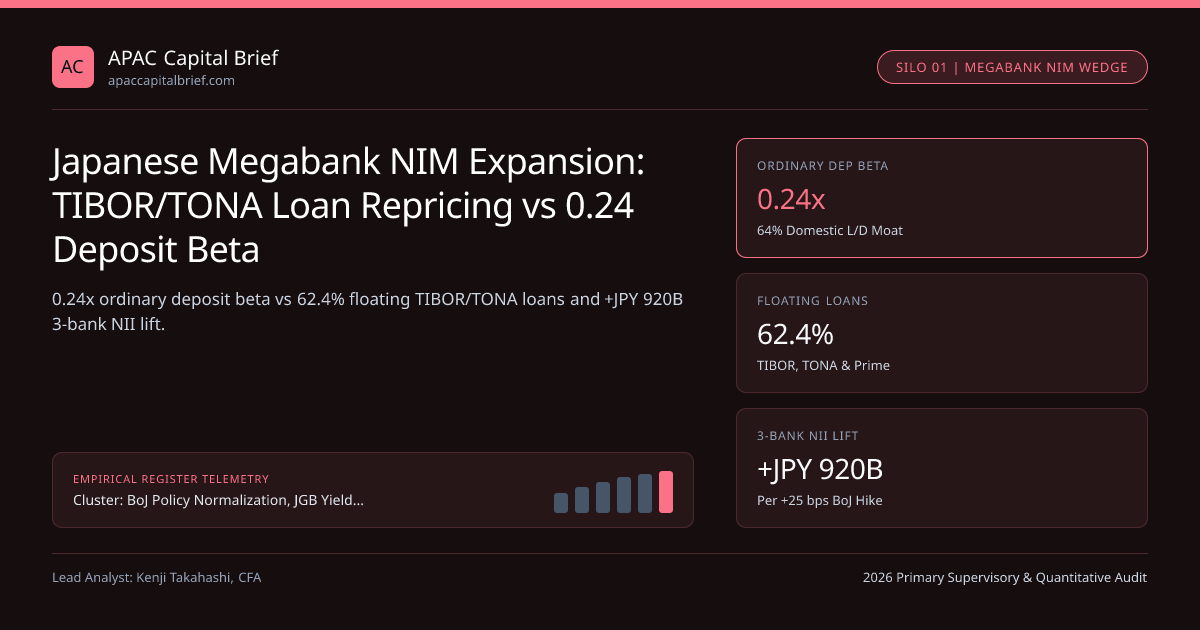
No large-cap global banking cohort exhibits cleaner positive asset sensitivity to central bank rate hikes than Japan's three G-SIB megabanks—Mitsubishi UFJ Financial Group (MUFG), Sumitomo Mitsui Financial Group (SMFG), and Mizuho Financial Group. Across an aggregate JPY 520+ trillion domestic yen deposit base, ordinary retail and corporate operational accounts reprice with an empirical deposit pass-through beta of just 0.22 to 0.28, whereas roughly 62% of domestic corporate loans float directly off 3-month/6-month JBA TIBOR, compounded TONA, or the Short-Term Prime Lending Rate (Tanki Puraimu Reto)—generating JPY 280–340 billion of incremental pre-tax net interest income per megabank for every +25 bps Bank of Japan call rate hike.
Asset-Side Repricing Channels: TIBOR, TONA, Short Prime, and BoJ Reserves#
When Nihonbashi steps the uncollateralized call target up by +25 bps (e.g., from 1.00% to 1.25%), four distinct yen asset buckets across megabank balance sheets reprice upward on predictable schedules supervised by the JFSA:
- Immediate T+0 Repricing — BoJ Current Account Reserves (~100% Beta): Combined megabank excess balances of ~JPY 165 trillion parked at the Complementary Deposit Facility immediately earn +25 bps (
+JPY 412.5 billion annualized gross interest day one). - 1-to-6-Month Repricing — Large Corporate Market-Linked Loans (~100% Beta): Syndicated and bilateral loans to TSE Prime corporations indexed to 3M/6M Japanese Yen TIBOR (noting Euroyen TIBOR cessation completed end-2024, consolidating onto Domestic Yen TIBOR and TONA OIS/Term Reference Rates) reset automatically on roll dates.
- 1-to-2-Month Lag — SME & Variable Residential Mortgages (Short-Term Prime): Linked to the bank-announced Short-Term Prime Rate (lifted +15 to +25 bps per BoJ step), repricing SME working-capital lines immediately and variable-rate home mortgages semi-annually (under Japan's 5-year payment / 125% cap rule).
- 2-to-5-Year Rollover — Fixed JGB ALM Bond Ladders: Maturing 0.15%–0.50% sovereign notes reinvest into 2.05%–2.89% 2Y–10Y JGBs.
Quantifying the Deposit-Loan Spread Wedge Across G-SIBs vs Brokers#
Compare domestic interest-rate gearing across Japan's three G-SIBs alongside capital-markets wealth intermediaries (Daiwa Securities and Aizawa Securities) that monetize higher yen rates through MRF/wrap cash sweeps and secondary bond turnover:
| Institution / Group | Domestic Yen Deposit L/D Ratio | Estimated Annual NII Uplift per +25 bps | Capital Return & Strategic Deployment |
|---|---|---|---|
| MUFG (8306.T) | ~61.2% (Largest Surplus Deposit Base) | +JPY 350B – 385B Full-Year Run-Rate | Industry-leading TOPIX buybacks + Asian commercial bank stakes |
| SMFG (8316.T) | ~66.8% (Olive Retail Ecosystem) | +JPY 290B – 320B Full-Year Run-Rate | Progressive 40%+ dividend payout policy + Olive digital deposit lock-in |
| Mizuho Financial (8411.T) | ~68.4% (70%+ TSE Prime Coverage) | +JPY 245B – 270B Full-Year Run-Rate | Corporate investment-banking fee synergy + US M&A advisory |
| Daiwa Securities | Daiwa Next Bank Sweep Twin-Account | Net Interest + Fixed-Income Dealing Lift | Captures household cash migration from 0.30% bank deposits into 2.4%+ bonds |
| Central Tanshi | Interbank Money-Market Dealer | Volume-Driven Call/Repo Spread Expansion | Clears resurrected interbank unsecured & GC repo volume (see Spoke 1) |
Incremental Net Interest Income (DeltaNII) for a Megabank per +Deltar Policy Hike#
- DeltaNII = ( RCAB * 1.00 + Lfloat * betaloan + Broll * thetabond - Dord * betadep - Dtime * betatime ) * Delta_r
- Where (Representative Megabank Yen Book, Delta_r = +0.0025 [+25 bps]):
- R_CAB = JPY 62.0T (BoJ excess reserves, beta = 1.00)
- Lfloat = JPY 78.0T (TIBOR/TONA/Short-Prime loans, betaloan = 0.92)
- Broll = JPY 34.0T (JGB portfolio with 1-year rollover fraction thetabond = 0.25)
- Dord = JPY 138.0T (liquid ordinary deposits, betadep = 0.24)
- Dtime = JPY 36.0T (time & corporate negotiable CDs, betatime = 0.68)
- Worked Calculation:
- Asset Repricing Base = 62.0T + (78.0T * 0.92) + (34.0T * 0.25) = 62.0 + 71.76 + 8.50 = JPY 142.26T
- Deposit Cost Base = (138.0T * 0.24) + (36.0T * 0.68) = 33.12 + 24.48 = JPY 57.60T
- Net Positive Rate Gap = 142.26T - 57.60T = +JPY 84.66 Trillion
- Delta_NII (+25 bps) = JPY 84.66T * 0.0025 = +JPY 211.65B Yr-1 (+JPY 345B+ by Yr-3 as JGBs & fixed loans roll!)
Credit-Cost Normalization and the "5-Year / 125% Rule" on Japanese Mortgages#
Bears argue that higher yen rates will trigger residential mortgage defaults or zombie SME insolvencies. Two institutional features insulate megabank credit costs (which remain benign near 12–18 bps of total loans):
- Japan's 5-Year / 125% Variable Mortgage Rule: Over 74% of Japanese homebuyers select floating-rate mortgages, but monthly cash installment amounts stay frozen for 5 years, and at the 5-year reset cannot increase by more than 25% (only the interest-vs-principal split inside the payment adjusts initially), preventing immediate household cash-flow shocks.
- SME Pandemic Zero-Zero Loan Runoff Completed: Government-guaranteed COVID-era Zero-Zero loans have already peaked in restructuring, while megabank loan books skew overwhelmingly toward investment-grade corporate borrowers holding record cash piles.
Valuation Re-Rating Above 1.0x PBR#
Expanding domestic NIMs combined with aggressive liquidation of strategic Mochiai cross-shareholdings lifted MUFG and SMFG sustainably above the 1.0x–1.25x Price-to-Book threshold, contrasting sharply with duration-constrained smaller lenders examined in Japanese regional bank JGB unrealized loss supervision. Review the full macro rate-hike path in our BoJ policy normalization master guide and APAC financials hub.
Frequently asked questions
Why is the deposit beta at Japanese megabanks so much lower than at US commercial banks?
Japanese megabanks enjoy ~64% domestic loan-to-deposit ratios and Japan lacks a high-yielding retail money-market fund (MMF) culture comparable to US Treasury MMFs, leaving banks with surplus deposits and minimal pressure to hike ordinary savings rates.
How fast do Japanese corporate loans reprice after a 25 bps Bank of Japan rate hike?
Excess BoJ reserves reprice on Day 1, TIBOR/TONA-indexed large-corporate loans reset across 1–6 months, and Short-Term Prime SME loans typically adjust 4–8 weeks after the Monetary Policy Meeting.
Why haven higher Bank of Japan rates caused a spike in Japanese variable-rate mortgage defaults?
Most Japanese floating mortgages include a 5-year fixed-installment rule and a 125% reset ceiling: when mortgage rates rise, only the interest share inside the monthly payment increases initially while total monthly cash outlay stays unchanged for up to five years.
What happened to Euroyen TIBOR in Japanese corporate loan contracts?
JBA TIBOR Administration permanently ceased publishing Euroyen TIBOR at the end of December 2024, transitioning legacy corporate loan contracts to Domestic Yen TIBOR or compounded/term TONA fallback rates.
Publication record
- Published
- 14 November 2026
- Updated
- 15 November 2026
- Author
- Kenji Takahashi, CFA
- Review
- Review not recorded
- Automated fact check
- Passed in the stored pipeline record
- Source URLs
- 3 recorded
AI assistance recorded: anthropic/claude-opus-4.6. This field does not establish human review or source verification.
Academic & Institutional Attribution
Cite This Research & Embed Live Data Card
Standard academic & institutional research paper citation format.
Kenji Takahashi, CFA. (2026, November 15). Japanese Megabank NIM Expansion: TIBOR/TONA Loan Repricing vs 0.24 Deposit Beta. APAC Capital Brief. https://apaccapitalbrief.com/dispatches/japanese-megabank-nim-expansion-tibor-loan-deposit-betaRegulatory Directory Cross-Reference
Referenced Institutions & Regulatory Registries
Mentioned Regulated Institutions
Primary Tier-1 Supervisory Registries
Related Boj Jgb Curve Yen Repatriation & Institutional Briefings
Explore Boj Jgb Curve Yen Repatriation Hub (20) →Boj Jgb Curve Yen Repatriation
Bank of Japan Policy Normalization, JGB Curve Steepening & Lifer Repatriation: 2026 APAC GuideBoj Jgb Curve Yen Repatriation
Kampo & Norinchukin AAA CLO Tranches vs 3.89% Super-Long Cash JGBsBoj Jgb Curve Yen Repatriation
Japan 10-Year JGBi Breakeven Inflation (BEI), Deflation Floors & MoF BuybacksBoj Jgb Curve Yen Repatriation
JSCC JGB & TONA IRS Clearing: VaR Initial Margin, Cross-Margining & Repo HaircutsBoj Jgb Curve Yen Repatriation
BoJ Uncollateralized Overnight Call Rate & Reserve Tiering Mechanics at 1.25%Boj Jgb Curve Yen Repatriation
BoJ Rinban JGB Tapering to JPY 2.9T/Month & Primary Dealer DV01 AbsorptionBoj Jgb Curve Yen Repatriation
30Y & 40Y Super-Long JGB Convexity: Japanese Lifer ESR Solvency & ALM MatchingBoj Jgb Curve Yen Repatriation
FX-Hedged UST & OAT Carry Erosion: Quantifying Japanese Lifer Bond RepatriationHkma Sfc Mas Wealth Hub Regimes
HKEX HKD-RMB Dual Counter Model: Market-Maker Stamp Duty Exemption & Southbound RMBHkma Sfc Mas Wealth Hub Regimes
MAS Notice 637 vs HKMA Banking (Capital) Rules: Basel III Final 72.5% Output Floor & Wealth RWAHkma Sfc Mas Wealth Hub Regimes
Client Money Segregation: HK SFC Cap. 571I Rules vs Singapore MAS CMS Trust AccountsAPAC Semiconductor AI Capex Equities
TSMC US$62B FY2026 Capex & 125,000 wpm CoWoS-L Ramp: Packaged Wafer Margin Mechanics
APAC Capital Brief Data, Benchmarks & Contributor Records
CC BY 4.0 Open Data
Open Institutional Datasets (CSV / JSON) →
Download desk-compiled quantitative series & schemas.
2026 Reference Matrix
2026 Institutional Benchmarks & Thresholds →
Statutory capital, clearing, margin & rate conventions.
Editorial Records
Authors & Review Records →
View named contributors where those records are available.
Complete Index
Master Research & Dossier Archive →
Browse all published briefings by topic pillar & date.