
Boj Jgb Curve Yen Repatriation
Japan New NISA Household Outflows: Toshin Foreign Equity Trusts & Yen Leakage
Japan permanent tax-exempt New NISA channels JPY 1.1 to 1.4 trillion monthly of household savings into unhedged global and US equity trusts, creating persistent spot yen selling across APAC markets.
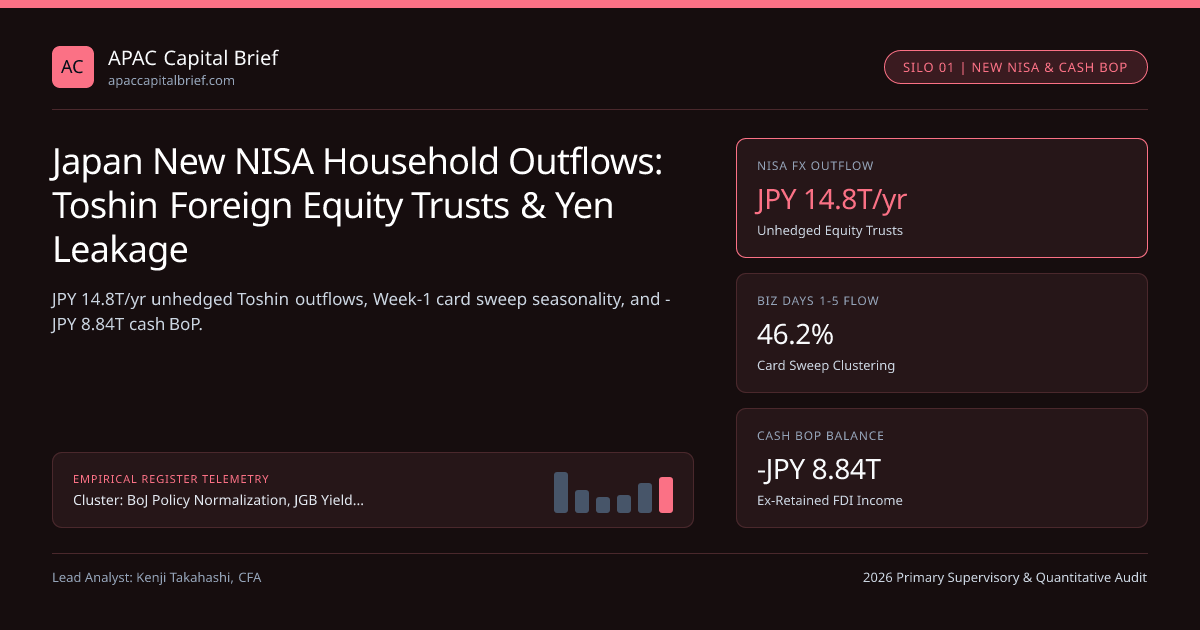
While global bond traders fixate on Bank of Japan rate hikes to 1.25%, Japan's balance of payments experiences a relentless, price-insensitive yen outflow every single business morning: JPY 13.5 to JPY 16.2 trillion per annum of household cash converting into unhedged foreign equities via the revamped Nippon Individual Savings Account (New NISA) and domestic investment trusts (Toshin). Designed by the JFSA to mobilize Japan's JPY 1,120 trillion household cash pile ("Doubling Asset-Based Income Plan"), New NISA inadvertently engineered a structural USD/JPY floor by routing roughly *78%–83% of monthly Tsumitate (installment) and Growth quota inflows into unhedged MSCI ACWI ("All-Country" / Orukan) and S&P 500 funds*.
Statutory Architecture of Permanent Tax-Exempt New NISA#
Launched in January 2024 as a permanent exemption from Japan's 20.315% capital-gains and dividend tax, New NISA expanded household limits threefold compared with its predecessor:
- Tsumitate Investment Quota: Up to JPY 1.2 million/year in JFSA-screened low-fee index and diversified accumulation trusts.
- Growth Investment Quota: Up to JPY 2.4 million/year across individual equities (including TSE Prime high-dividend names), ETFs, and active/index mutual funds.
- Combined Annual Cap of JPY 3.6 Million & Lifetime Book-Cost Cap of JPY 18.0 Million: Crucially, selling an asset frees up its original book-cost quota for reuse in the following calendar year, incentivizing permanent long-term compounding.
Because index funds such as Mitsubishi UFJ AM's eMAXIS Slim All Country (~63% US weight) and eMAXIS Slim US Equity (S&P 500) charge ultra-low management fees (0.05775%–0.09372%) and never hedge currency exposure (saving retail investors the ~380 bps USD/JPY forward drag), 100% of net subscriptions translate into outright spot FX conversion!
Japan's "Phantom Current Account Surplus" vs Cash-Flow Balance of Payments#
Macro textbooks wonder how Japan can run a JPY 25+ trillion headline Current Account Surplus while the yen stays structurally soft. Decomposing Ministry of Finance Balance of Payments (BoP) accounting on a cash-settlement basis resolves the paradox immediately:
| Balance of Payments / NISA Channel | Headline Accounting Print | Actual Spot JPY Conversion Reality | Intermediary / Regulatory Anchor |
|---|---|---|---|
| Primary Income Surplus (~JPY 37T/yr) | Massive accounting surplus | ~55%–62% retained & reinvested offshore as FDI earnings; zero spot JPY bought | Overseas subsidiaries of Toyota, trading houses & megabanks |
| Digital Deficit ("Web3/Cloud/Ad Deficit") | Services balance drag (-JPY 6.4T/yr) | 100% hard cash USD outflow paid monthly to US cloud, SaaS, streaming & AI APIs | Corporate FX desks at MUFG / SMFG / Mizuho |
| New NISA Toshin Net Subscriptions | Financial Account Portfolio Outflow | 100% hard cash spot FX selling (~JPY 15T/yr annualized) at 09:55 Nakane fix | Online brokers + mid-tier wealth desks (Aizawa Securities, Daiwa) |
| Domestic High-Dividend Growth NISA | Domestic Equity Allocation (~19%) | Zero FX impact; supports TOPIX value & buyback names | JFSA / ichiyoshi.co.jp wealth channels |
Cash-Flow Adjusted Structural Yen Balance (BoPCashJPY)#
- BoPCashJPY = GoodsTrade + ServicesDigital + ( (1 - rhoreinvest) * PrimaryIncome ) - NISAToshinOutflow
- Where (Annualized FY2026 Run-Rate, JPY Trillions):
- Goods_Trade = -JPY 3.2T (energy/LNG & AI chip imports minus auto/WFE exports)
- Services_Digital = -JPY 5.8T (digital cloud/licensing deficit partially offset by inbound tourism +JPY 6.8T)
- PrimaryIncome = +JPY 37.4T, with offshore reinvestment ratio rhoreinvest = 0.60
- NISAToshinOutflow = JPY 14.8T (unhedged household foreign equity accumulation)
- Worked Calculation:
- Cash Primary Income Repatriated = (1 - 0.60) * 37.4T = +JPY 14.96T
- BoPCashJPY = -3.2T - 5.8T + 14.96T - 14.80T = -JPY 8.84 Trillion net structural cash yen selling per year!
Calendar-Month Seasonality: Business Days 1 Through 5 Toshin Surge#
Because SBI Securities, Rakuten Securities, Monex, and bricks-and-mortar wealth houses (Daiwa Securities and Aizawa Securities) process automated credit-card reward NISA sweeps (up to JPY 100,000/month per cardholder under revised JFSA Cabinet Office rules) predominantly on the 1st through 5th business days of every calendar month—plus bonus months in January, July, and December—nearly 46% of the entire month's Toshin spot FX outflow concentrates into the first week of each month.
What Could Reverse NISA Yen Leakage Toward Domestic TOPIX?#
Importantly, Japanese households are not allergic to domestic stocks inside the JPY 2.4M Growth Quota when governance reforms deliver visible dividend growth: high-yield TSE Prime banks, trading houses (sogo shosha), and semiconductor leaders capture ~19%–24% of Growth Quota flows. As modeled in our BoJ policy normalization master guide and TSE Prime 1.0x PBR reform study, sustained TOPIX dividend-yield expansion above 2.6% paired with 1.91% Retail JGBs gradually tempers marginal foreign leakage—though early-month USD/JPY Toshin bids remain a cornerstone calendar anomaly across APAC FX markets.
Frequently asked questions
Why do New NISA investment trusts create direct spot USD/JPY buying pressure?
Over 80% of New NISA mutual fund inflows target unhedged global ("Orukan") and S&P 500 equity funds; because these funds do not use FX forwards, domestic trust-bank custodians must sell JPY and buy USD in the spot market to acquire underlying shares.
Why does Japan headline current account surplus fail to strengthen the yen against NISA outflows?
Roughly 60% of Japan JPY 37T Primary Income surplus consists of accounting profits retained and reinvested abroad by foreign subsidiaries rather than wired back into yen, whereas NISA outflows and US cloud/digital fees are 100% cash yen sales.
Which days of the month experience the heaviest New NISA USD/JPY buying?
Business Days 1 through 5 of each calendar month absorb ~46% of monthly NISA Toshin FX demand due to monthly credit-card Tsumitate settlement schedules (capped at JPY 100,000/month per investor), with a secondary wave after the 25th payday.
Do Japanese retail investors panic-sell New NISA foreign funds during Nikkei or USD/JPY drops?
JFSA and Investment Trusts Association Japan data during sharp market drawdowns show net NISA subscriptions remain resiliently positive because automated monthly Tsumitate orders treat lower USD/JPY and S&P 500 levels as dollar-cost averaging.
Publication record
- Published
- 14 November 2026
- Updated
- 15 November 2026
- Author
- Kenji Takahashi, CFA
- Review
- Review not recorded
- Automated fact check
- Passed in the stored pipeline record
- Source URLs
- 3 recorded
AI assistance recorded: anthropic/claude-opus-4.6. This field does not establish human review or source verification.
Academic & Institutional Attribution
Cite This Research & Embed Live Data Card
Standard academic & institutional research paper citation format.
Kenji Takahashi, CFA. (2026, November 14). Japan New NISA Household Outflows: Toshin Foreign Equity Trusts & Yen Leakage. APAC Capital Brief. https://apaccapitalbrief.com/dispatches/japan-new-nisa-toshin-foreign-equity-outflows-yen-leakageRegulatory Directory Cross-Reference
Referenced Institutions & Regulatory Registries
Mentioned Regulated Institutions
Referenced Supervisory Authorities
Related Boj Jgb Curve Yen Repatriation & Institutional Briefings
Explore Boj Jgb Curve Yen Repatriation Hub (20) →Boj Jgb Curve Yen Repatriation
Bank of Japan Policy Normalization, JGB Curve Steepening & Lifer Repatriation: 2026 APAC GuideBoj Jgb Curve Yen Repatriation
MoF & BoJ FX Intervention Forensics: FEFSA Reserves, Fed Repo Pool & Table 1 MathBoj Jgb Curve Yen Repatriation
Japanese Megabank NIM Expansion: TIBOR/TONA Loan Repricing vs 0.24 Deposit BetaBoj Jgb Curve Yen Repatriation
Kampo & Norinchukin AAA CLO Tranches vs 3.89% Super-Long Cash JGBsBoj Jgb Curve Yen Repatriation
Japan 10-Year JGBi Breakeven Inflation (BEI), Deflation Floors & MoF BuybacksBoj Jgb Curve Yen Repatriation
JSCC JGB & TONA IRS Clearing: VaR Initial Margin, Cross-Margining & Repo HaircutsBoj Jgb Curve Yen Repatriation
BoJ Uncollateralized Overnight Call Rate & Reserve Tiering Mechanics at 1.25%Boj Jgb Curve Yen Repatriation
BoJ Rinban JGB Tapering to JPY 2.9T/Month & Primary Dealer DV01 AbsorptionHkma Sfc Mas Wealth Hub Regimes
HK SFC Manager-In-Charge (MIC) & RO Rules vs Singapore MAS IAC AccountabilityHkma Sfc Mas Wealth Hub Regimes
HKEX FINI T+2 IPO Settlement & Uninterrupted Severe Weather Trading Margin RulesHkma Sfc Mas Wealth Hub Regimes
HKEX HKD-RMB Dual Counter Model: Market-Maker Stamp Duty Exemption & Southbound RMBHkma Sfc Mas Wealth Hub Regimes
MAS Notice 637 vs HKMA Banking (Capital) Rules: Basel III Final 72.5% Output Floor & Wealth RWA
APAC Capital Brief Data, Benchmarks & Contributor Records
CC BY 4.0 Open Data
Open Institutional Datasets (CSV / JSON) →
Download desk-compiled quantitative series & schemas.
2026 Reference Matrix
2026 Institutional Benchmarks & Thresholds →
Statutory capital, clearing, margin & rate conventions.
Editorial Records
Authors & Review Records →
View named contributors where those records are available.
Complete Index
Master Research & Dossier Archive →
Browse all published briefings by topic pillar & date.