
Boj Jgb Curve Yen Repatriation
Kampo & Norinchukin AAA CLO Tranches vs 3.89% Super-Long Cash JGBs
After purging fixed-rate foreign sovereigns, Norinchukin Bank and Japan Post Insurance weigh floating-rate USD AAA CLO tranches (2.01% FX-hedged) against 3.89% cash 30-year JGBs in APAC markets.
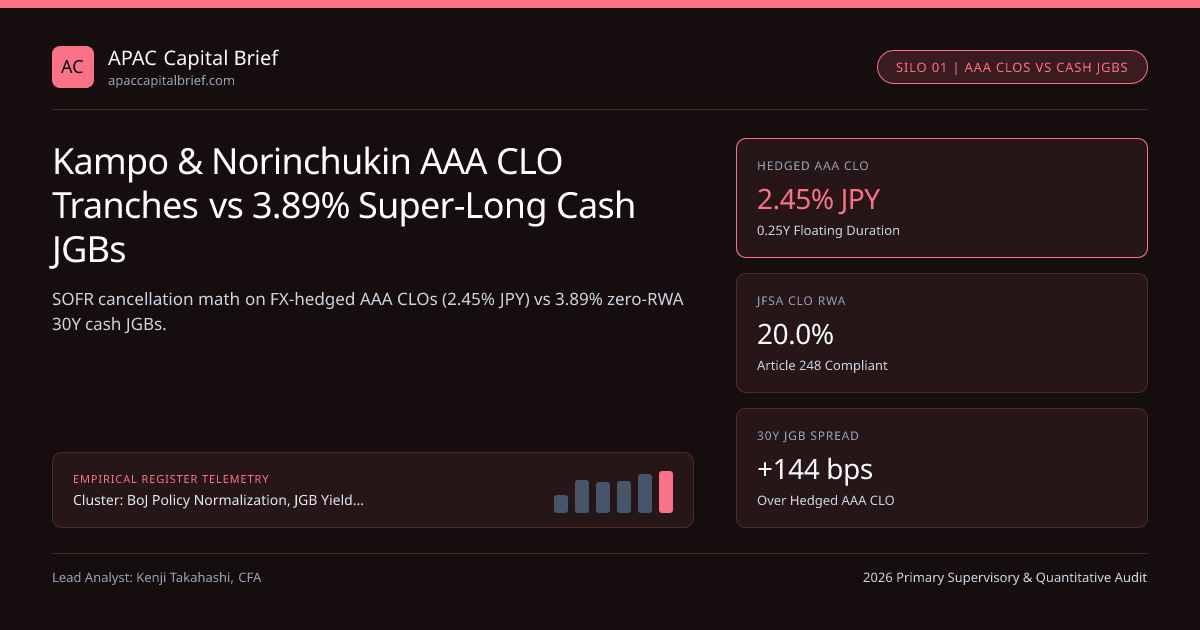
Norinchukin Bank's landmark JPY 1.5+ trillion realized loss-cut on fixed-rate US and European sovereign bonds in FY2024—followed by its pivot back into floating-rate USD/EUR AAA Collateralized Loan Obligation (CLO) senior tranches alongside Japan Post Insurance (Kampo)—illustrates the sharpest credit-versus-duration arbitrage calculation in Tokyo institutional asset management. Unlike fixed-rate 10-year US Treasuries crushed by inverted yield curves, quarterly-resetting AAA CLOs (3M SOFR + 135–142 bps) automatically neutralize short-term FX forward hedging costs! Yet in 2026, even AAA CLOs face formidable domestic competition from 3.89% unhedged 30-year JGBs.
Why Floating-Rate AAA CLOs Survive FX Hedging When Fixed USTs Fail#
Recall from our FX-hedged UST and OAT carry erosion analysis that rolling a 3-month USD/JPY forward costs 3M SOFR - 3M TONA + |Basis|. Watch what happens algebraically when a Tokyo bank or insurer buys a floating-rate dollar asset paying 3M SOFR + S_CLO and hedges 100% of currency risk via rolling 3-month FX forwards or cross-currency swaps:
3M SOFR cancels out completely on both sides of the equation! Regardless of whether the Federal Reserve sets SOFR at 5.25%, 4.25%, or 3.00%, the hedged JPY return on a senior AAA CLO equals 3M TONA + CLO Credit Spread - Cross-Currency Basis—delivering pure, zero-duration floating yen spread above 1.25% TONA with zero historical AAA principal defaults since inception of the 1990s BSL CLO market!
JFSA Risk-Retention Verification Rules & Basel III SEC-ERBA Capital Weights#
Under Article 248 of the JFSA Capital Adequacy Notification (implementing Basel III securitization rules), a Japanese depository or insurer purchasing overseas CLO tranches would face a punitive 3x Risk-Weight Multiplier (up to 60%–1,250% RWA) if the CLO manager violates 5% "skin-in-the-game" risk retention—unless the Japanese buyer completes rigorous independent due diligence proving underlying broadly syndicated loans (BSLs) were originated under sound underwriting standards!
Both Norinchukin and Kampo operate dedicated credit-underwriting teams in New York and London (frequently anchoring entire entire $250M–$300M AAA tranches as "anchor investors" via primary structuring desks alongside global banks and Daiwa Securities) to preserve the 20% floor risk weight under the Securitization External Ratings-Based Approach (SEC-ERBA).
| Asset Class for Tokyo Whales | Gross JPY-Equivalent Yield | Modified Duration | Basel III / ESR Capital Weight | Optimal Institutional Mandate |
|---|---|---|---|---|
| US BSL AAA CLO (3M FX-Hedged) | 2.45% (TONA + 120bp net) | 0.25 Yrs (Quarterly Float) | 20% Bank RWA / Low ESR Spread | Norinchukin & bank treasuries avoiding IRRBB duration |
| Euro AAA CLO (3M EUR/JPY Hedged) | 2.38% (TONA + 113bp net) | 0.25 Yrs (Euribor Float) | 20% Bank RWA (5% EU Retention) | Diversifies US BSL leveraged-loan obligor overlap |
| 5-Year Cash JGB (Domestic) | 2.41% | 4.68 Yrs | 0% Sovereign Risk Weight | Regional banks & megabank core liquidity sleeves |
| 10-Year Cash JGB (Domestic) | 2.89% | 8.64 Yrs | 0% Sovereign Risk Weight | GPIF, city banks & Aizawa domestic wealth |
| 30-Year Cash JGB (Domestic) | 3.89% | 19.40 Yrs | 0% Credit / Cuts ESR Duration | Kampo, Nippon Life & Dai-ichi long-liability matching |
Return on Risk-Weighted Assets (RoRWA) & Net Hedged Spread Comparison#
- YCLOJPYgross = rTONA3m + sAAACLO + alphabasis_3m
- NetSpreadAfterCapitalCost = YCLOJPYgross - ( RWSECERBA * CET1min * CoE_bank )
- Where:
- rTONA3m = 1.25%
- sAAACLO = +1.38% (138 bps primary anchor print on Tier-1 US CLO manager)
- alphabasis3m = -0.18% (-18 bps annualized 3M FX swap basis & roll execution)
- RWSECERBA = 0.20 (20% Basel III risk weight for senior STS/compliant AAA tranche)
- CET1_min * CoE = 10.0% * 8.8% = 0.88% -> Capital charge = 0.20 * 0.88% = 0.176% (17.6 bps)
- Worked Calculation:
- YCLOJPY_gross = 1.25% + 1.38% - 0.18% = 2.45% (zero duration risk!)
- Capital-Adjusted Net Yield = 2.45% - 0.18% = 2.27% (beats 1.25% BoJ CDF by +102 bps without taking JGB duration!)
Why Norinchukin Buys AAA CLOs While Kampo Splits Between CLOs and 30Y JGBs#
Look closely at the liability duration difference between Norinchukin Bank and Japan Post Insurance (Kampo):
- Norinchukin Bank is funded by short-to-medium-term JA Bank agricultural cooperative deposits (
~1–4 year behavioral duration). Buying 30-year JGBs would recreate the exact long-duration mismatch that caused its FY2024 sovereign bond losses! Hence, floating-rate 2.45% FX-hedged AAA CLOs (0.25Y duration) give Norinchukin +120 bps gross over BoJ call deposits with near-zero interest-rate VaR. - Kampo, conversely, owes multi-decade postal life-insurance benefits (
16+ year liability duration). Once 30-year JGBs reached 3.89%, cash 30Y JGBs beat FX-hedged AAA CLOs by +144 bps gross while carrying 0% credit risk weight—prompting Kampo and peer lifers to cap CLO reinvestment and redirect marginal yen into domestic super-longs!
Spillover to US Leveraged Loan Creation and CLO Liability Arbitrage#
Because Japanese banks ("the Tokyo AAA whale bid") historically anchored 20%–30% of primary US BSL CLO AAA tranches, tighter AAA CLO spreads (SOFR + 138 bps) sustained by Norinchukin and trust-bank demand keep the equity arbitrage open for US private-credit and BSL managers—even as lifer demand rotates homeward as documented in our BoJ policy normalization master guide and APAC credit dispatches.
Frequently asked questions
Why did FX hedging crush US Treasury returns for Japanese banks but leave AAA CLO returns intact?
Fixed-rate US Treasuries suffered when 3M SOFR rose above 10Y yields, whereas AAA CLOs pay a floating coupon of 3M SOFR + ~138 bps—meaning every rise in SOFR hedging cost was matched one-for-one by higher quarterly CLO coupon income.
How did JFSA implement risk-retention rules for Japanese banks buying US CLOs?
Rather than banning US open-market CLOs lacking 5% manager retention, JFSA Article 248 exempts Japanese banks from punitive 3x risk weights if the bank independently verifies sound underlying loan underwriting and credit monitoring.
Why did Norinchukin Bank suffer JPY 1.5T+ losses in FY2024 if it held safe AAA CLOs?
Norinchukin losses came from fixed-rate US and European government bonds—not from AAA CLOs, which suffered zero credit losses and traded near par; after cutting sovereign bond losses, Norinchukin resumed selective AAA CLO allocations.
When does a 5-year cash JGB beat an FX-hedged USD AAA CLO for a Japanese bank?
At 2.41% yield and 0% sovereign risk weight, a 5-year cash JGB slightly edges out an FX-hedged AAA CLO after deducting the 18 bps capital cost of the CLO 20% RWA—provided the bank has spare IRRBB 5-year duration capacity.
Publication record
- Published
- 14 November 2026
- Updated
- 15 November 2026
- Author
- Kenji Takahashi, CFA
- Review
- Review not recorded
- Automated fact check
- Passed in the stored pipeline record
- Source URLs
- 3 recorded
AI assistance recorded: anthropic/claude-opus-4.6. This field does not establish human review or source verification.
Academic & Institutional Attribution
Cite This Research & Embed Live Data Card
Standard academic & institutional research paper citation format.
Kenji Takahashi, CFA. (2026, November 14). Kampo & Norinchukin AAA CLO Tranches vs 3.89% Super-Long Cash JGBs. APAC Capital Brief. https://apaccapitalbrief.com/dispatches/kampo-norinchukin-aaa-clo-tranches-vs-super-long-jgb-yieldRelated Boj Jgb Curve Yen Repatriation & Institutional Briefings
Explore Boj Jgb Curve Yen Repatriation Hub (20) →Boj Jgb Curve Yen Repatriation
Bank of Japan Policy Normalization, JGB Curve Steepening & Lifer Repatriation: 2026 APAC GuideBoj Jgb Curve Yen Repatriation
Japan 10-Year JGBi Breakeven Inflation (BEI), Deflation Floors & MoF BuybacksBoj Jgb Curve Yen Repatriation
JSCC JGB & TONA IRS Clearing: VaR Initial Margin, Cross-Margining & Repo HaircutsBoj Jgb Curve Yen Repatriation
BoJ Uncollateralized Overnight Call Rate & Reserve Tiering Mechanics at 1.25%Boj Jgb Curve Yen Repatriation
BoJ Rinban JGB Tapering to JPY 2.9T/Month & Primary Dealer DV01 AbsorptionBoj Jgb Curve Yen Repatriation
30Y & 40Y Super-Long JGB Convexity: Japanese Lifer ESR Solvency & ALM MatchingBoj Jgb Curve Yen Repatriation
FX-Hedged UST & OAT Carry Erosion: Quantifying Japanese Lifer Bond RepatriationBoj Jgb Curve Yen Repatriation
Rengo Shunto Base-Pay Hikes, Services PPI & BoJ Taylor-Rule Rate TransmissionHkma Sfc Mas Wealth Hub Regimes
MAS Notice 637 vs HKMA Banking (Capital) Rules: Basel III Final 72.5% Output Floor & Wealth RWAHkma Sfc Mas Wealth Hub Regimes
Client Money Segregation: HK SFC Cap. 571I Rules vs Singapore MAS CMS Trust AccountsAPAC Semiconductor AI Capex Equities
TSMC US$62B FY2026 Capex & 125,000 wpm CoWoS-L Ramp: Packaged Wafer Margin MechanicsAPAC Semiconductor AI Capex Equities
SK Hynix KRW 48T HBM4 Capex & MR-MUF Yield Lead vs Samsung TC-NCF Hybrid Bonding
APAC Capital Brief Data, Benchmarks & Contributor Records
CC BY 4.0 Open Data
Open Institutional Datasets (CSV / JSON) →
Download desk-compiled quantitative series & schemas.
2026 Reference Matrix
2026 Institutional Benchmarks & Thresholds →
Statutory capital, clearing, margin & rate conventions.
Editorial Records
Authors & Review Records →
View named contributors where those records are available.
Complete Index
Master Research & Dossier Archive →
Browse all published briefings by topic pillar & date.