
APAC Semiconductor AI Capex Equities
Taiwan Life Insurer US$760B FX Hedging: TWD Offshore NDF Spikes, CS Swaps & Proxy Shorts
Holding over US$760 billion in foreign assets against New Taiwan Dollar liabilities, Taiwan life insurers transmit massive volatility into TWD NDFs, KRW, and APAC capital markets.
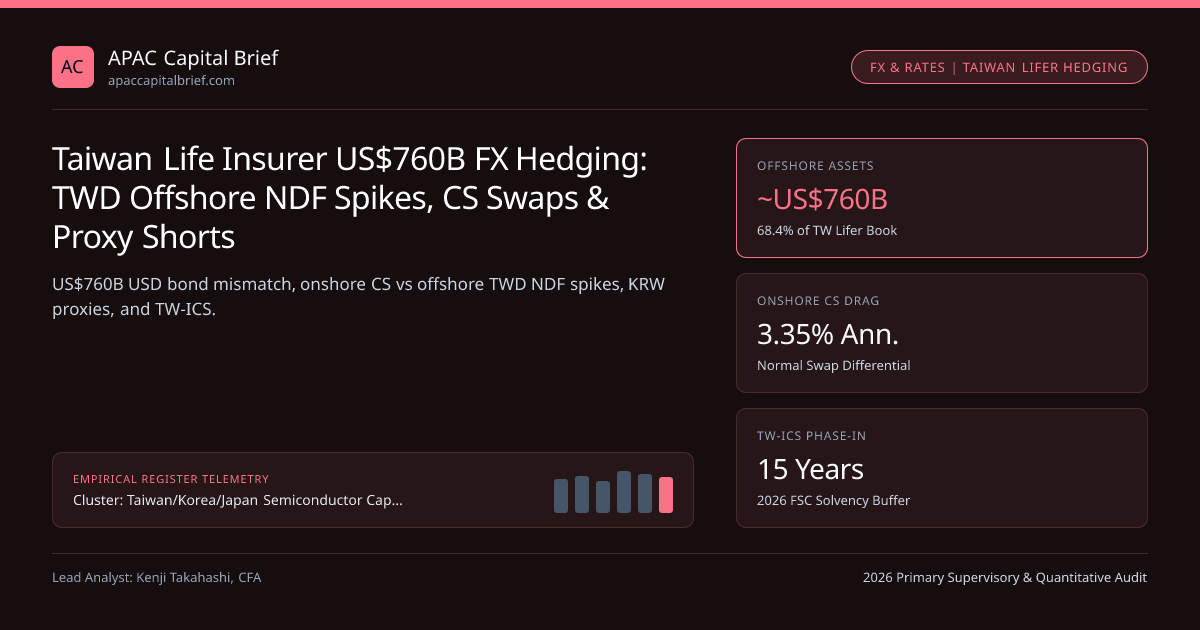
Taiwan's life insurance industry (Cathay Life, Fubon Life, Nan Shan Life, Shin Kong Life, Taiwan Life, KGI Life) represents the most structurally unbalanced currency mismatch in global institutional finance: roughly NT$36 trillion (~US$1.12 trillion) in total assets funded 85%+ by domestic New Taiwan Dollar (TWD) policies, yet invested >68% (~US$760 billion) in USD-denominated US Treasuries, investment-grade corporate bonds, and agency MBS! Supervised closely by the Financial Supervisory Commission (FSC Taiwan) and the Central Bank of the Republic of China (Taiwan) — CBC — how Taipei's lifers dynamically adjust their 60%–72% composite FX hedge ratio dictates swap points across onshore USD/TWD Cross-Currency Swaps (CS), offshore Non-Deliverable Forwards (NDFs), and correlated Asian proxy currencies (KRW, CNH, SGD, JPY).
Onshore CS vs Offshore NDF Segmentation & CBC Real-Demand Rules#
Why can't Cathay Life or Fubon Life simply hedge 100% of their US$760B foreign bond book onshore at stable Covered Interest Parity rates? Because Taiwan's domestic USD deposit base and exporter USD supply cannot come close to absorbing US$760B of structural institutional USD selling! Furthermore, the CBC strictly segments onshore deliverable forwards (DF / CS) from offshore cash-settled USD/TWD NDFs:
- Domestic Banks Restricted in NDFs: CBC restricts onshore Taiwanese banking units' offshore NDF books to tight caps (~20% of total FX positions), forcing foreign hedge funds, FinTechs, and Taiwanese insurers' offshore vehicles to crowd into a one-sided Singapore/Hong Kong USD/TWD NDF market.
- Normal Regime vs USD-Selloff Shock: In calm regimes, onshore 3M/12M CS swap cost tracks the
SOFR - TAIBIRrate differential (~310–355 bps annualized). However, whenever US Treasury yields plunge or AI-driven TAIEX inflows (anchored by TSMC's surge) strengthen spot TWD by >2.5% in a week, under-hedged lifers panic-sell USD/TWD 1M–3M NDFs offshore—blowing annualized NDF implied hedging costs out to 650–1,100+ bps in 48 hours!
Proxy Hedging Contagion Into KRW, CNH & SGD#
To avoid paying 340+ bps on onshore CS swaps or 700+ bps on stressed TWD NDFs, FSC Taiwan permits life insurers (under Insurance Bureau FX Valuation Reserve regulations) to count proxy-currency hedges toward risk mitigation—specifically shorting USD against high-correlation East Asian exporter currencies (KRW, CNH, SGD, JPY) whose interest rates sit closer to USD SOFR or whose forward curves are far deeper:
| Hedging Instrument / Regulator | Annualized Carry Cost (Calm / Stress) | Liquidity Capacity & Counterparties | Cross-Market Contagion Mechanism |
|---|---|---|---|
| Onshore USD/TWD CS Swap | 3.35% Calm / 4.15% Stress | Capped by Taipei bank USD balance sheets & exporter hedging | Drains onshore USD liquidity; monitored daily by CBC |
| Offshore USD/TWD 3M NDF (SG/HK) | 3.60% Calm / 8.50%–11.50% Panic | Cleared via global FX banks & NDF desks in Singapore/HK | Violent negative NDF points crush macro long-TWD carry trades |
| KRW / CNH / SGD Proxy Basket | 1.65% – 2.25% Annualized Drag | Deep offshore KRW NDF & deliverable CNH/SGD swap markets | Correlation breakdown risk: if TWD jumps +4% while KRW stalls, lifer suffers double mark-to-market bleed! |
| FSC Taiwan New FX Reserve Option | 0 bps Cash Outflow (Internal Reserve Provision) | Lifers redirect former CS hedging fees into permanent FX Valuation Reserves | Structural reduction in lifer NDF panic-buying lowers long-term hedging bleed |
| Formosa USD Callable Bonds (TPEx) | Zero TWD FX Hedge if held in USD / Accounting match | US$190B+ outstanding global bank/tech bonds listed on Taipei Exchange | Rate drops trigger massive issuer calls -> reinvestment cliff! |
Net Investment Yield & Proxy-Hedge Basis Tracking Error for a Taiwanese Life Insurer#
- RNetTWD = YUSDPortfolio - hCS * CostCS - hNDF * CostNDF - hProxy * CostProxy + (1 - hCS - hNDF) * dSUSDTWD - hProxy * betaadj * dSUSDProxy
- Worked Stress Scenario (US$100B Foreign Portfolio; 42% CS @ 3.40%, 13% NDF @ 3.70%, 10% KRW Proxy @ 1.85%, 35% Unhedged):
- 1. Calm Annualized Hedging Cost = (0.42 * 3.40%) + (0.13 * 3.70%) + (0.10 * 1.85%) = 1.428% + 0.481% + 0.185% = 2.094% drag
- Against a 5.15% USD A-rated Corporate Bond book -> Net Yield = 5.15% - 2.09% = 3.06% (clears 2.85% average policy liability cost).
- 2. Correlation Shock (TWD appreciates -5.0% vs USD on TAIEX AI inflows, while KRW only appreciates -1.8% vs USD):
- Unhedged + Imperfect Proxy FX Loss = (0.45 * -5.0%) - (0.10 * -1.8%) = -2.25% + 0.18% = -2.07% (-US$2.07 Billion hit absorbed by FSC FX Valuation Reserve!)
Taiwan Lifers vs Japanese Lifers: Structural FX Mismatch (2026)#
2026 TW-ICS Solvency Transition & FSC FX Valuation Reserve Reform#
Unlike Japanese lifers repatriating into 3.89% 30-year JGBs (see our Silo 1 analysis), Taiwanese lifers cannot repatriate at scale because Taiwan's entire domestic sovereign bond market (~NT$6.3T / US$198B) is less than one-quarter the size of lifers' offshore bond holdings, and 10Y Taiwan Government Bonds yield just ~1.68%! Consequently, as Taiwan inaugurated its localized TW-ICS (Insurance Capital Standard) in 2026, FSC Taiwan granted a 15-year phase-in transition alongside an expanded FX Valuation Reserve mechanism allowing insurers to convert unproductive annual NDF/CS swap fee outlays into permanent balance-sheet FX loss-absorption buffers, monitored alongside KGI Asia Limited cross-border credit flows. Pair this with TAIEX AI concentration and FINI FX custody rules, foundry USD bond hedging, and our Northeast Asia semiconductor & governance hub, or explore APAC capital dispatches.
Frequently asked questions
Why cannot Taiwanese life insurers repatriate USD bond holdings home like Japanese life insurers?
Japan has a JPY 1,100+ trillion (~US$7.3T) JGB market offering 3.89% 30-year yields, whereas Taiwan conservative fiscal debt leaves total outstanding Taiwan Government Bonds near just US$198B yielding ~1.68%—far too small and low-yielding for US$1.12T in lifer assets.
Why does the offshore USD/TWD NDF basis blow out much wider than onshore CS swaps during USD drops?
Taiwan central bank (CBC) requires real trade/investment documentation for onshore deliverable forwards and caps domestic banks offshore NDF participation at 20%, leaving offshore NDF dealers chronically one-sided whenever lifers and macro funds sell USD/TWD simultaneously.
What are Formosa Bonds on the Taipei Exchange (TPEx) and why do Taiwan lifers buy them?
Formosa Bonds are foreign-currency (primarily USD) corporate/bank bonds issued in Taiwan and listed on TPEx; historically they allowed Taiwanese lifers to buy long-dated USD callable paper outside standard overseas investment quotas until FSC tightened combined ceilings.
How does FSC expanded FX Valuation Reserve change TWD NDF volatility in 2026?
By letting lifers allocate pre-tax profits and saved hedging outlays into a larger statutory FX Valuation Reserve to offset unrealized currency swings, FSC reduces forced pro-cyclical NDF panic-buying when TWD appreciates.
Publication record
- Published
- 14 November 2026
- Updated
- 15 November 2026
- Author
- Kenji Takahashi, CFA
- Review
- Review not recorded
- Automated fact check
- Passed in the stored pipeline record
- Source URLs
- 3 recorded
AI assistance recorded: anthropic/claude-opus-4.6. This field does not establish human review or source verification.
Academic & Institutional Attribution
Cite This Research & Embed Live Data Card
Standard academic & institutional research paper citation format.
Kenji Takahashi, CFA. (2026, November 14). Taiwan Life Insurer US$760B FX Hedging: TWD Offshore NDF Spikes, CS Swaps & Proxy Shorts. APAC Capital Brief. https://apaccapitalbrief.com/dispatches/taiwan-lifer-twd-proxy-fx-hedging-ndf-cs-basis-volatilityRelated APAC Semiconductor AI Capex Equities & Institutional Briefings
Explore APAC Semiconductor AI Capex Equities Hub (20) →APAC Semiconductor AI Capex Equities
Northeast Asia Semiconductor AI Capex, HBM4 Supply Chains & Corporate Governance: 2026 APAC GuideAPAC Semiconductor AI Capex Equities
Japan Semiconductor WFE Monopolies: Tokyo Electron, Advantest, Lasertec & Disco AI Margin PowerAPAC Semiconductor AI Capex Equities
TSMC Kumamoto JASM & Rapidus Hokkaido: METI Semiconductor Subsidies & Megabank Project FinanceAPAC Semiconductor AI Capex Equities
TAIEX Single-Stock AI Concentration, UCITS 10/20 Caps & Taiwan FSC FINI Custody RulesAPAC Semiconductor AI Capex Equities
Korea FSS NSDS Electronic Short-Selling System, Penalty Laws & KOSPI 200 Futures BasisAPAC Semiconductor AI Capex Equities
MSCI Korea Developed Market Watchlist Bid: 02:00 KST KRW FX & Registered Foreign InstitutionsAPAC Semiconductor AI Capex Equities
AI ABF Substrates & Glass-Core Packaging Capex: Ibiden, Shinko, Unimicron & Ajinomoto FilmAPAC Semiconductor AI Capex Equities
Taiwan Taipower Industrial Tariff Hikes, EUV Megawatt Intensity & Offshore Wind Fab PPAsASIC Afsl Australian Superannuation
APRA Abolition of Bank AT1 Hybrids (2027–2032): Tier 2 Subordinated Debt & CET1 RepricingASIC Afsl Australian Superannuation
AOFM ACGB Syndications, ASX Cash-Settled 3Y/10Y Bond Futures & EFP Swap-Spread MechanicsASIC Afsl Australian Superannuation
ASIC Private Credit & CRE Loan Surveillance: Fee Skimming, PIK Valuations & Redemption GatesASIC Afsl Australian Superannuation
ASX CHESS Replacement via TCS BaNCS (2026–2029) & Australia T+1 Equity Settlement Roadmap
APAC Capital Brief Data, Benchmarks & Contributor Records
CC BY 4.0 Open Data
Open Institutional Datasets (CSV / JSON) →
Download desk-compiled quantitative series & schemas.
2026 Reference Matrix
2026 Institutional Benchmarks & Thresholds →
Statutory capital, clearing, margin & rate conventions.
Editorial Records
Authors & Review Records →
View named contributors where those records are available.
Complete Index
Master Research & Dossier Archive →
Browse all published briefings by topic pillar & date.