
Boj Jgb Curve Yen Repatriation
Japanese Regional Bank JGB Unrealized Losses & JFSA IRRBB Capital Supervision
Rising 10-year JGB yields to 2.89% have deepened unrealized available-for-sale bond losses across Japan regional banks, triggering intensive JFSA IRRBB outlier supervision across APAC markets.
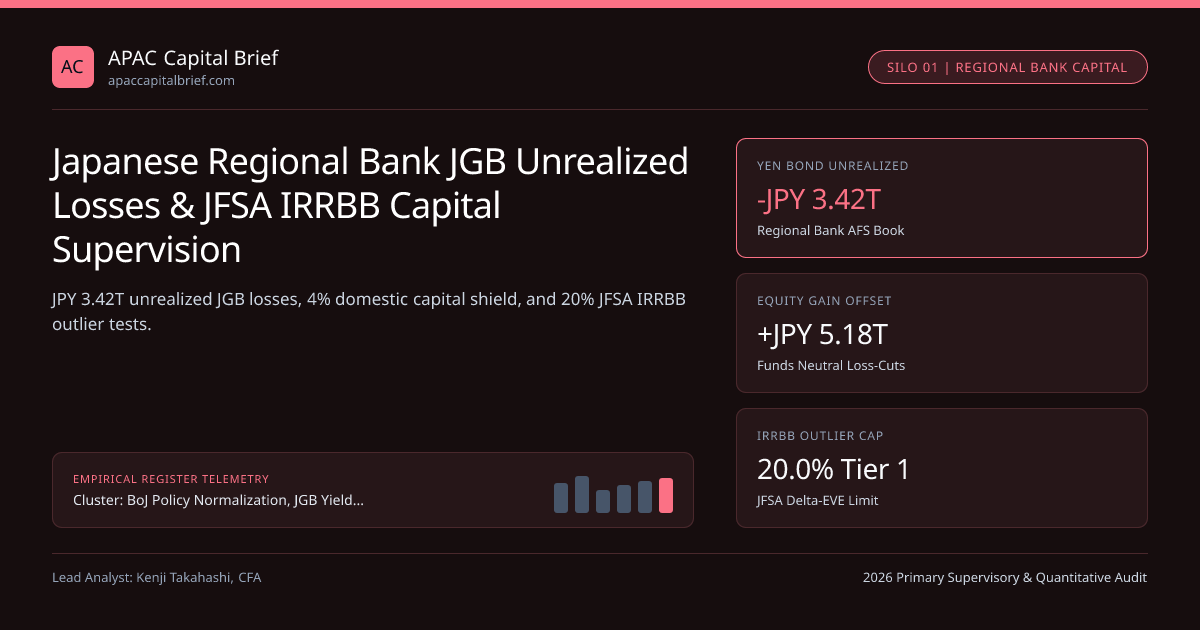
Across Japan's 97 first-tier and second-tier regional banks (chiho ginko and daini-chiho ginko), aggregate net unrealized losses on domestic yen bond portfolios swelled past JPY 3.4 trillion as the 10-year JGB benchmark climbed to 2.89%. Yet zero SVB-style depositor runs have materialized in prefectural Japan. Understanding why requires examining a crucial prudential bifurcation administered by the Financial Services Agency (JFSA): the accounting shield granted to Domestic-Standard Banks (4.0% minimum capital ratio) versus Basel III International-Standard Banks (8.0% + buffers), paired with strict JFSA IRRBB (Interest Rate Risk in the Banking Book) 20% outlier enforcement.
Domestic-Standard (4% Floor) vs International-Standard Capital Accounting#
Roughly 85 of Japan's regional banks operate solely domestically without overseas branches and therefore report regulatory capital under Japan's Domestic Standard rather than full Basel III international rules:
- Exclusion of Unrealized AFS Losses from Regulatory Capital: Under Domestic Standard rules, net unrealized losses on "Other Securities" (sonota yukashoken, equivalent to Available-for-Sale / AFS) are deducted on the GAAP balance sheet via Accumulated Other Comprehensive Income (AOCI) but are added back (excluded) when computing the statutory 4.0% Core Capital Ratio! Losses only hit regulatory capital if the bank actually sells the bond or executes a bear-steepener loss-cut (losu-katto).
- International-Standard Regional Banks (~12 Larger Groups): Groups with overseas offices (such as Chiba Bank, Concordia/Bank of Yokohama, Shizuoka Financial, Fukuoka Financial) must include AOCI mark-to-market bond swings directly in Common Equity Tier 1 (CET1)—forcing them to hedge duration proactively via TONA OIS payer swaps or hold higher equity buffers.
The Real Binding Constraint: JFSA's 20% IRRBB Delta-EVE Outlier Test#
If Domestic-Standard banks can ignore unrealized AFS losses in their 4% capital ratio, what stops them from doubling down on unhedged 20-year JGBs? JFSA Comprehensive Guidelines for Supervision — IRRBB Materiality Test (Delta EVE / Tier 1 <= 20%). Every quarter, banks must compute the economic value drop (Delta EVE) of their entire banking book (loans + bonds minus sticky core deposits modeled with 5-year behavioral decay) across upward parallel, steepener, and flattener rate shocks. Breaching 20% of Core Capital brands a lender an "IRRBB Outlier Bank," triggering intrusive on-site JFSA inspections and board remediation orders.
| Bank Classification / Counterparty | Regulatory Capital Standard | Avg Core / CET1 Ratio (2026) | Bond Portfolio Restructuring Strategy |
|---|---|---|---|
| Top International Regionals (Chiba, Shizuoka, Concordia) | Basel III International (AOCI Included) | 11.4% – 13.8% CET1 | Heavy TONA OIS payer hedges + floating loan growth; TSE PBR > 0.85x |
| Mid-Tier Prefectural Domestic Banks | JFSA Domestic Standard (4% Floor) | 8.6% – 10.4% Core Cap | Offset JGB loss-cuts by harvesting unrealized gains on TOPIX equity ETFs/shares |
| Second-Tier Regional & Shinkin Cooperatives | Domestic / Cooperative Standard | 7.2% – 9.1% Core Cap | High IRRBB sensitivity (14%–19% Delta-EVE); shift cash to 1.25% BoJ CDF |
| Daiwa Securities | Regional Bank ALM Structurer | Primary Repack Counterparty | Executes simultaneous equity cross-shareholding unwind + JGB ladder replacement |
| Aizawa Securities | Regional Financial Distribution | Secondary Bond / Trust Desk | Distributes shorter 2Y–5Y municipal & corporate floaters to regional treasuries |
JFSA IRRBB Outlier Ratio & Gain-Offsetting Bond Loss-Cut Capacity#
- IRRBBRatio = maxs ( DeltaEVEs ) / CoreCapitalTier1 <= 20.0%
- TaxNeutralJGBLossCut = RealizedEquityCrossHoldingGains / ( AvgJGBPrice_Discount )
- Where (Representative JPY 6.5T Asset Prefectural Bank):
- CoreCapitalTier1 = JPY 290 Billion (Core Capital Ratio = 9.1%)
- 20% IRRBB Outlier Ceiling = JPY 58.0 Billion maximum permissible Delta-EVE
- Realized Gain on Mochiai Stocks = JPY 18.5 Billion (from selling appreciated TOPIX stakes)
- Avg Seasoned 10Y JGB Discount = 11.8% below par (88.20 clean price)
- Worked Calculation:
- Par JGBs Liquidated Without Net Income Hit = JPY 18.5B / 0.118 = JPY 156.78 Billion par value purged!
- Reinvesting JPY 138.3B proceeds into 5Y JGBs at 2.41% adds +JPY 2.84B/yr recurring net interest income.
Why SVB Did Not Happen in Japan: 73.8% Loan-to-Deposit Ratios & Core Deposit Modeling#
Unlike Silicon Valley Bank—where uninsured venture-capital corporate deposits fled within 36 hours—Japanese regional bank funding consists over 78% of granular household pension and salary accounts protected up to JPY 10 million per depositor under the Deposit Insurance Corporation of Japan (DICJ). With an average regional loan-to-deposit ratio near 73.8% and trillions parked overnight at the 1.25% Bank of Japan CDF floor, prefectural banks face zero liquidity forced-selling pressure.
Investment Differentiation Within TOPIX Regional Bank Equities#
Equity investors comparing regional lenders against MUFG/SMFG/Mizuho megabank NIM expansion screen specifically for Net Unrealized Equity Gains minus Net Bond Losses > +15% of Tier 1 Capital. Banks possessing rich Mochiai equity cushions (see TOPIX buybacks and cross-shareholding unwinds) simultaneously satisfy TSE governance mandates AND purge deadweight 0.20%-coupon JGBs in a single FY2026 income-neutral swap. Read our BoJ policy normalization master guide and APAC banking dispatches for prefectural bank consolidation updates.
Frequently asked questions
Why did unrealized JGB losses not trigger regulatory capital breaches at Japanese regional banks?
Domestic-standard Japanese banks (without overseas branches) follow JFSA capital rules that exclude unrealized available-for-sale securities losses from their 4.0% Core Capital Ratio unless those losses are crystallized through actual sales.
What is the JFSA 20% IRRBB outlier rule for Japanese regional banks?
Under JFSA Interest Rate Risk in the Banking Book (IRRBB) supervision, if a standardized upward or curve-twist interest rate shock reduces a bank economic value of equity (Delta-EVE) by more than 20% of Tier 1 capital, JFSA mandates remedial action.
How are regional banks cleaning up old 0.2% coupon JGBs without reporting net losses?
Regional banks pair-trade bond loss-cuts with sales of appreciated corporate cross-shareholdings (Mochiai stocks), using realized equity gains (+JPY 5.18T sector pool) to offset realized JGB losses dollar-for-dollar in net income.
Which Japanese regional banks must include unrealized JGB losses in CET1 capital?
Roughly a dozen large regional banking groups operating international branches—such as Chiba Bank, Concordia Financial, Shizuoka Financial, and Fukuoka Financial—follow Basel III International Standards where AOCI bond marks flow directly into CET1.
Publication record
- Published
- 14 November 2026
- Updated
- 15 November 2026
- Author
- Kenji Takahashi, CFA
- Review
- Review not recorded
- Automated fact check
- Passed in the stored pipeline record
- Source URLs
- 3 recorded
AI assistance recorded: anthropic/claude-opus-4.6. This field does not establish human review or source verification.
Academic & Institutional Attribution
Cite This Research & Embed Live Data Card
Standard academic & institutional research paper citation format.
Kenji Takahashi, CFA. (2026, November 14). Japanese Regional Bank JGB Unrealized Losses & JFSA IRRBB Capital Supervision. APAC Capital Brief. https://apaccapitalbrief.com/dispatches/japan-regional-bank-jgb-htm-unrealized-loss-jfsa-capitalRegulatory Directory Cross-Reference
Referenced Institutions & Regulatory Registries
Mentioned Regulated Institutions
Referenced Supervisory Authorities
Related Boj Jgb Curve Yen Repatriation & Institutional Briefings
Explore Boj Jgb Curve Yen Repatriation Hub (20) →Boj Jgb Curve Yen Repatriation
Bank of Japan Policy Normalization, JGB Curve Steepening & Lifer Repatriation: 2026 APAC GuideBoj Jgb Curve Yen Repatriation
MoF Japan JGB Issuance Mix: Shortening Weighted-Average Maturity & Debt ServiceBoj Jgb Curve Yen Repatriation
Retail FX Margin (Mrs. Watanabe), FFAJ Open Interest & Tokyo 09:55 Nakane FixingBoj Jgb Curve Yen Repatriation
Japan New NISA Household Outflows: Toshin Foreign Equity Trusts & Yen LeakageBoj Jgb Curve Yen Repatriation
MoF & BoJ FX Intervention Forensics: FEFSA Reserves, Fed Repo Pool & Table 1 MathBoj Jgb Curve Yen Repatriation
Japanese Megabank NIM Expansion: TIBOR/TONA Loan Repricing vs 0.24 Deposit BetaBoj Jgb Curve Yen Repatriation
Kampo & Norinchukin AAA CLO Tranches vs 3.89% Super-Long Cash JGBsBoj Jgb Curve Yen Repatriation
Japan 10-Year JGBi Breakeven Inflation (BEI), Deflation Floors & MoF BuybacksHkma Sfc Mas Wealth Hub Regimes
Singapore VCC Sub-Fund Ring-Fencing vs Hong Kong Open-Ended Fund Company (OFC)Hkma Sfc Mas Wealth Hub Regimes
HK SFC VATP & Type 1 Omnibus Uplift vs Singapore MAS PSA DPT Statutory Trust RulesHkma Sfc Mas Wealth Hub Regimes
Offshore CNH HIBOR Squeezes, PBoC Central Bank Bills & HKMA RMB Liquidity FacilityHkma Sfc Mas Wealth Hub Regimes
HK SFC Manager-In-Charge (MIC) & RO Rules vs Singapore MAS IAC Accountability
APAC Capital Brief Data, Benchmarks & Contributor Records
CC BY 4.0 Open Data
Open Institutional Datasets (CSV / JSON) →
Download desk-compiled quantitative series & schemas.
2026 Reference Matrix
2026 Institutional Benchmarks & Thresholds →
Statutory capital, clearing, margin & rate conventions.
Editorial Records
Authors & Review Records →
View named contributors where those records are available.
Complete Index
Master Research & Dossier Archive →
Browse all published briefings by topic pillar & date.