
Boj Jgb Curve Yen Repatriation
Japan GPIF JPY 258 Trillion Symmetric 25/25/25/25 Portfolio Rebalancing Bands
Managing JPY 258 trillion around a symmetric 25/25/25/25 benchmark, Japan GPIF executes multi-trillion-yen contrarian rebalancing across JGBs, TOPIX, and unhedged foreign assets in APAC markets.
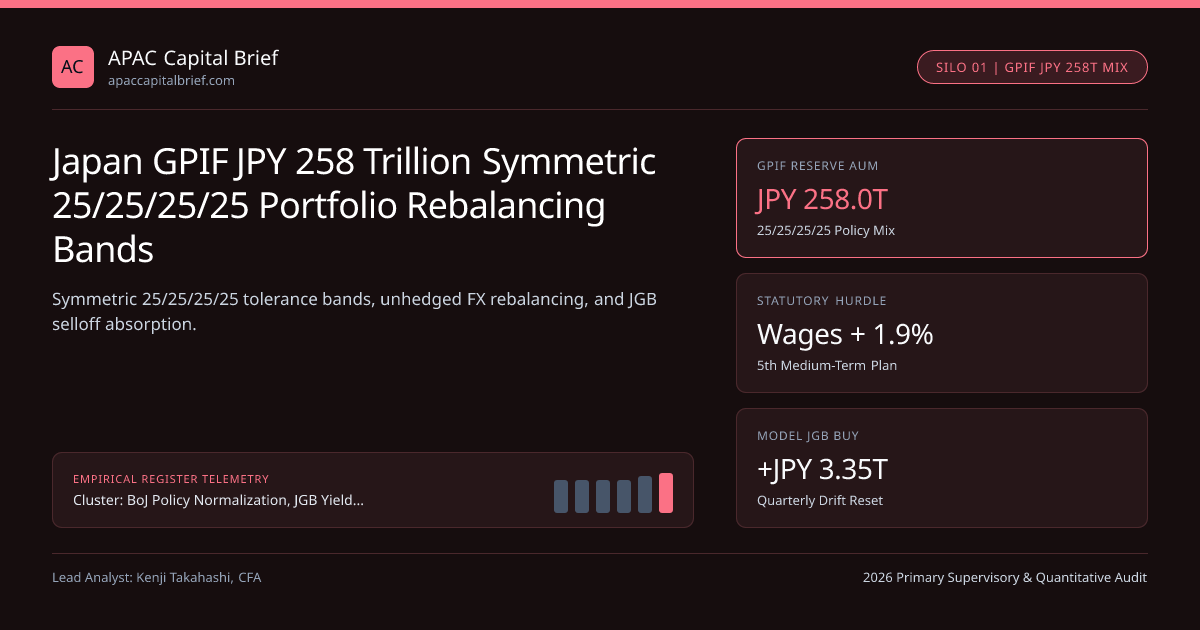
Commanding JPY 258.0 trillion ($1.72 trillion) in reserve assets, Japan's Government Pension Investment Fund (GPIF) operates as the single largest contrarian stabilizer across Tokyo sovereign debt, domestic equities, and USD/JPY spot flows. Governed by its Fifth Medium-Term Plan (FY2025–FY2029) under Ministry of Health, Labour and Welfare (MHLW) oversight, GPIF maintained its landmark symmetric 25% Domestic Bonds / 25% Foreign Bonds / 25% Domestic Equities / 25% Foreign Equities Policy Asset Mix while calibrating real investment return targets above nominal wage increases (Wage Growth + 1.9%).
Deviation Tolerance Limits Under the 2026 GPIF Benchmark Standard#
Why does GPIF neither chase momentum rallies in US megacap tech nor panic-sell during JGB yield selloffs? Because statutory portfolio governance under the 2026 GPIF benchmark standard enforces strict individual asset-class and combined-group deviation limits around the 25.0% weights:
- Domestic Bonds: 25.0% target (
+/- 7.0%tolerance band: 18.0%–32.0%), benchmarked primarily to NOMURA-BPI ex-ABS. - Foreign Bonds: 25.0% target (
+/- 6.0%tolerance band: 19.0%–31.0%), predominantly unhedged FTSE World Government Bond Index (ex-JP, ex-CN), making GPIF structurally opposite to FX-hedging life insurers! - Domestic Equities: 25.0% target (
+/- 8.0%tolerance band: 17.0%–33.0%), benchmarked to TOPIX (dividend-included). - Foreign Equities: 25.0% target (
+/- 7.0%tolerance band: 18.0%–32.0%), benchmarked to MSCI ACWI ex-Japan. - Combined Bonds (50% +/- 11%) & Combined Equities (50% +/- 11%): Aggregate risk-budget guardrails capped at total portfolio risk less than or equal to an all-domestic-bond reference threshold under tail-correlation modeling.
Contrasting GPIF (Unhedged Foreign) vs Life Insurers (Hedged/Open Split)#
Understanding why GPIF acts as a natural shock absorber for USD/JPY requires contrasting its currency posture against Japanese life insurers. Roughly 95%+ of GPIF's JPY 129 trillion combined foreign bond and foreign equity allocation is held unhedged. Consequently, whenever USD/JPY rallies by +8% inside a quarter alongside strong S&P 500 returns, yen-translated values of GPIF's foreign sleeves balloon automatically—pushing Foreign Equities and Foreign Bonds above 26.5%–28.0% and forcing GPIF transition managers to sell USD/EUR assets, buy spot JPY, and buy beaten-down domestic JGBs!
| GPIF Asset Sleeve | Target Weight & Tolerance | Active vs Passive Split | Rebalancing Impact on APAC Markets |
|---|---|---|---|
| Domestic Bonds (JPY 64.5T) | 25.0% (+/- 7.0%) | ~78% Passive / 22% Active | Largest buyer of Rinban-tapered JGB supply on yield selloffs |
| Foreign Bonds (JPY 64.5T) | 25.0% (+/- 6.0%) | ~74% Passive / 26% Active | Unhedged WGBI sleeve; trims USTs/Bunds into USD/JPY strength >155 |
| Domestic Equities (JPY 64.5T) | 25.0% (+/- 8.0%) | ~89% Passive / 11% Active | Anchors TOPIX liquidity & enforces JPX governance stewardship |
| Foreign Equities (JPY 64.5T) | 25.0% (+/- 7.0%) | ~87% Passive / 13% Active | Harvests global AI equity gains to fund domestic bond rebalancing |
| Alternatives (Sub-Allocation) | <= 5.0% of Total AUM (~1.6% actual) | 100% External Active Mandates | Co-invests in global infrastructure, core real estate & private equity |
Quarterly Asset-Class Drift & Required Rebalancing Trade (R_i)#
- Wiend = ( A0 * wi0 * (1 + rijpy) ) / Sumk [ A0 * wk0 * (1 + rk_jpy) ]
- Ri = Aend * ( wtarget - Wi_end )
- Where (A_0 = JPY 258.0T, starting from 25/25/25/25):
- Quarter Returns in JPY:
- Domestic Bonds (JGB selloff): r_DB = -2.40% -> Sleeve = 64.5T * 0.9760 = JPY 62.952T
- Foreign Bonds (USD +4%): r_FB = +4.80% -> Sleeve = 64.5T * 1.0480 = JPY 67.596T
- Domestic Equities (TOPIX): r_DE = +1.20% -> Sleeve = 64.5T * 1.0120 = JPY 65.274T
- Foreign Equities (ACWI+FX): r_FE = +7.60% -> Sleeve = 64.5T * 1.0760 = JPY 69.402T
- Worked Calculation:
- A_end = 62.952 + 67.596 + 65.274 + 69.402 = JPY 265.224 Trillion (25% Target = JPY 66.306T)
- Domestic Bond Buy Required = 66.306T - 62.952T = +JPY 3.354 Trillion cash JGB purchases
- Foreign Equity Sell Required = 66.306T - 69.402T = -JPY 3.096 Trillion (+JPY 1.29T Foreign Bond trim -> JPY 4.39T spot JPY buying!)
Transition Management Execution and Securities Lending Suspension#
Note that GPIF holds zero in-house equity execution traders; cash equity orders route through external trust banks and transition managers engaging Tokyo brokers including Daiwa Securities via VWAP/implementation-shortfall algorithms, while GPIF's in-house fixed-income desk executes short-term money-market and JGB cash overlays directly. Importantly for hedge funds running OSE futures or TOPIX equity short strategies, GPIF continues its suspension of foreign and domestic equity lending for short-selling, keeping borrow fees firmer on mid-cap governance targets while earning incremental repo enhancement on JGB holdings.

Reading Quarterly GPIF Disclosures Alongside Trust Bank Flow Data#
Because official GPIF quarterly performance reports publish roughly five weeks after quarter-end, real-time desks track JPX Weekly Trading by Investor Type (Trust Banks — Shintaku Ginko) as an immediate proxy for GPIF and corporate pension rebalancing. Whenever Trust Banks flip to consecutive JPY 400B+ weekly net sellers of TOPIX during a Nikkei surge—or heavy net buyers during a carry-unwind selloff—GPIF's symmetric engine is actively leaning against market extremes. Explore the complete sovereign liquidity ecosystem in our BoJ policy normalization master guide and APAC institutional dispatches.
Frequently asked questions
Did GPIF reduce its 25% Domestic Bond target weight after Japanese JGB yields rose past 2.8%?
No. Under the Fifth Medium-Term Plan (FY2025–FY2029), higher domestic JGB yields actually improved expected yen fixed-income returns relative to the Wage Growth + 1.9% statutory hurdle, reinforcing the symmetric 25/25/25/25 allocation.
Why does GPIF hold its foreign bond and equity portfolios mostly unhedged against yen fluctuations?
Over multi-decade pension horizons, rolling FX hedges incur steep short-rate carry drag (~365 bps on USD), whereas unhedged foreign holdings negatively correlate with domestic deflation shocks and lower total portfolio variance.
How can institutional traders detect GPIF equity rebalancing before quarterly reports are released?
Traders monitor the Trust Banks (Shintaku Ginko) line in weekly Japan Exchange Group (JPX) investor flow releases every Thursday afternoon, as external trust-bank mandates execute GPIF passive TOPIX rebalancing.
What is GPIF maximum permitted allocation to illiquid alternative assets?
GPIF caps combined alternative investments—infrastructure, private equity, and core real estate—at 5.0% of total portfolio assets, classified inside the corresponding bond or equity risk buckets according to factor characteristics.
Publication record
- Published
- 14 November 2026
- Updated
- 15 November 2026
- Author
- Kenji Takahashi, CFA
- Review
- Review not recorded
- Automated fact check
- Passed in the stored pipeline record
- Source URLs
- 3 recorded
AI assistance recorded: anthropic/claude-opus-4.6. This field does not establish human review or source verification.
Academic & Institutional Attribution
Cite This Research & Embed Live Data Card
Standard academic & institutional research paper citation format.
Kenji Takahashi, CFA. (2026, November 14). Japan GPIF JPY 258 Trillion Symmetric 25/25/25/25 Portfolio Rebalancing Bands. APAC Capital Brief. https://apaccapitalbrief.com/dispatches/gpif-258-trillion-yen-symmetric-portfolio-rebalancing-bandsRegulatory Directory Cross-Reference
Referenced Institutions & Regulatory Registries
Mentioned Regulated Institutions
Primary Tier-1 Supervisory Registries
Related Boj Jgb Curve Yen Repatriation & Institutional Briefings
Explore Boj Jgb Curve Yen Repatriation Hub (20) →Boj Jgb Curve Yen Repatriation
Bank of Japan Policy Normalization, JGB Curve Steepening & Lifer Repatriation: 2026 APAC GuideBoj Jgb Curve Yen Repatriation
BoJ Securities Lending Facility (SLF) Fee Caps & Off-the-Run JGB Repo SqueezesBoj Jgb Curve Yen Repatriation
Japanese Regional Bank JGB Unrealized Losses & JFSA IRRBB Capital SupervisionBoj Jgb Curve Yen Repatriation
MoF Japan JGB Issuance Mix: Shortening Weighted-Average Maturity & Debt ServiceBoj Jgb Curve Yen Repatriation
Retail FX Margin (Mrs. Watanabe), FFAJ Open Interest & Tokyo 09:55 Nakane FixingBoj Jgb Curve Yen Repatriation
Japan New NISA Household Outflows: Toshin Foreign Equity Trusts & Yen LeakageBoj Jgb Curve Yen Repatriation
MoF & BoJ FX Intervention Forensics: FEFSA Reserves, Fed Repo Pool & Table 1 MathBoj Jgb Curve Yen Repatriation
Japanese Megabank NIM Expansion: TIBOR/TONA Loan Repricing vs 0.24 Deposit BetaHkma Sfc Mas Wealth Hub Regimes
Singapore MAS S$6.5B EQDP Mandate: SGX Mid-Cap Liquidity & Tax IncentivesHkma Sfc Mas Wealth Hub Regimes
SGX–Nasdaq Dual-Listing Bridge for S$2.0B+ APAC Growth Issuers: Prospectus & FungibilityHkma Sfc Mas Wealth Hub Regimes
Singapore VCC Sub-Fund Ring-Fencing vs Hong Kong Open-Ended Fund Company (OFC)Hkma Sfc Mas Wealth Hub Regimes
HK SFC VATP & Type 1 Omnibus Uplift vs Singapore MAS PSA DPT Statutory Trust Rules
APAC Capital Brief Data, Benchmarks & Contributor Records
CC BY 4.0 Open Data
Open Institutional Datasets (CSV / JSON) →
Download desk-compiled quantitative series & schemas.
2026 Reference Matrix
2026 Institutional Benchmarks & Thresholds →
Statutory capital, clearing, margin & rate conventions.
Editorial Records
Authors & Review Records →
View named contributors where those records are available.
Complete Index
Master Research & Dossier Archive →
Browse all published briefings by topic pillar & date.